Our Location
Killa-Pardi, Dist. Valsad, 396125


A combined load bearing is a bearing that operates under two or more types of loads at the same time, most commonly radial load and axial load. In real-world machinery, bearings rarely experience only one type of force. Rotating shafts, gears, pumps, motors, conveyors, and automotive components often generate forces in different directions.
Understanding combined loading is important because selecting a bearing only on the basis of radial capacity or axial capacity can lead to overheating, excessive wear, vibration, premature failure, or reduced service life.
The basic principle is simple:
Combined Load = Radial Load + Axial Load acting simultaneously
For bearing calculations, these loads are generally converted into an equivalent bearing load, which can then be used to estimate bearing life and select an appropriate bearing.
A combined load occurs when a bearing is subjected to forces acting in different directions at the same time.
The two most common components are:
For example, consider a shaft supported by a bearing. A gear mounted on the shaft may produce a radial force while the gear’s helical angle simultaneously produces an axial force. The bearing must withstand both forces.
Therefore:
Combined Bearing Load = Radial Load + Axial Load

However, these loads cannot simply be added numerically because they act in different directions. Bearing manufacturers therefore use factors to calculate an equivalent dynamic bearing load.
This guide explains 9 proven methods and calculation approaches for evaluating combined bearing load and capacity.
The first step is to determine the total radial load (Fr) acting on the bearing. Radial load acts perpendicular to the shaft axis.
Common sources include:
If several radial forces act on the bearing, their resultant must be determined according to their directions.
For simple perpendicular forces:
Fr = √(F₁² + F₂²)
If two radial forces are:
F₁ = 1,500 N and F₂ = 1,000 N Then:
Fr = √(1,500² + 1,000²)
Fr ≈ 1,803 N
Therefore, the resultant radial load is approximately:
Fr = 1.80 kN
The next step is to determine the axial load (Fa). Axial load acts parallel to the shaft axis and is also called thrust load.
Typical sources include:
If multiple axial forces act in opposite directions, the net axial force can be calculated as:
Fa = |F₁ − F₂|
For forces acting in the same direction:
Fa = F₁ + F₂
Suppose a shaft experiences:
F₁ = 1,200 N
F₂ = 400 N
in opposite directions.
Then:
Fa = 1,200 − 400
Fa = 800 N
Therefore:
Fa = 0.8 kN
The relationship between radial load and axial load is important when determining whether a bearing is primarily radially loaded or heavily affected by axial loading.
The basic ratio is: Fa / Fr
Where:
If:
Fr = 2,000 N
Fa = 800 N
Then:
Fa / Fr = 800 / 2,000
Fa / Fr = 0.40
This ratio can help determine the appropriate bearing calculation method and whether the axial load is significant.
For actual bearing selection, the manufacturer’s catalogue should be consulted because the limiting values and factors depend on bearing design.
This is one of the most important methods for combined loading. When a bearing experiences both radial load and axial load, the equivalent dynamic bearing load is commonly calculated using:
P = XFr + YFa
Where:
The values of X and Y are not universal. They depend on the bearing type, internal geometry, contact angle, and manufacturer’s Bearing Load calculation method.
Assume:
Fr = 2,000 N
Fa = 800 N
For bearing loads illustration, assume:
X = 0.56
Y = 1.50
Then:
P = (0.56 × 2,000) + (1.50 × 800)
P = 1,120 + 1,200
P = 2,320 N
Therefore:
Equivalent Dynamic Load = 2.32 kN
The X and Y values in this example are illustrative only and must be replaced with the actual values specified for the selected bearing.
The basic dynamic load rating (C) is one of the most important bearing specifications. It represents the bearing’s capacity for calculating fatigue life under dynamic operating conditions. Once the equivalent load P is known, bearing life can be estimated.
Where:
Suppose:
C = 20 kN
P = 2.32 kN
Then:
L₁₀ = (20 / 2.32)³
L₁₀ ≈ 640 million revolutions
This demonstrates why reducing the equivalent bearing load can have a major effect on theoretical bearing life.
Dynamic loading is not the only consideration. A bearing may also experience heavy loads while stationary or rotating slowly.
The basic static load rating is represented by: C₀
The equivalent static load can be determined according to the bearing manufacturer’s method.
A basic static safety factor can then be expressed as: S₀ = C₀ / P₀
Where:
A higher static safety factor generally provides greater resistance to permanent deformation under heavy or shock loading. The required safety factor depends on the application and operating conditions.
A machine may experience loads much higher than its normal operating load.
Examples include:
For such applications, the design should not consider only the average load.
A practical approach is to identify:
The maximum expected load should be checked against the bearing’s static and dynamic capabilities.
For example, if the normal combined load is:
P = 3 kN
but a machine can experience a short-duration peak load of:
Pmax = 8 kN
the bearing must be checked for both operating life and static safety.
Bearing capacity is not determined by load alone.
Rotational speed, temperature, lubrication, alignment, and operating environment can significantly affect performance.
Important factors include:
Therefore, a bearing with an adequate load rating may still fail if the operating conditions exceed its permissible limits.
The final step is selecting a bearing that can safely handle the calculated combined load.
A simplified selection process is:

Consider a bearing subjected to:
Radial Load (Fr) = 3,000 N
Axial Load (Fa) = 1,000 N
Assume, for illustration:
X = 0.56
Y = 1.50
P = XFr + YFa
P = (0.56 × 3,000) + (1.50 × 1,000)
P = 1,680 + 1,500
P = 3,180 N
Therefore:
P = 3.18 kN
Suppose the bearing has:
C = 25 kN
For a ball bearing:
L₁₀ = (C/P)³
L₁₀ = (25/3.18)³
L₁₀ ≈ 486 million revolutions
This is a theoretical basic rating life and does not account for every real-world factor such as contamination, lubrication, misalignment, installation quality, or material effects.
Correct calculation provides several benefits:
| Calculation | Formula |
|---|---|
| Resultant radial load | Fr = √(F₁² + F₂²) |
| Net axial load | Fa = |F₁ − F₂| |
| Load ratio | Fa/Fr |
| Equivalent dynamic load | P = XFr + YFa |
| Ball-bearing life | L₁₀ = (C/P)³ |
| Roller-bearing life | L₁₀ = (C/P)^(10/3) |
| Static safety factor | S₀ = C₀/P₀ |
A practical selection process is:
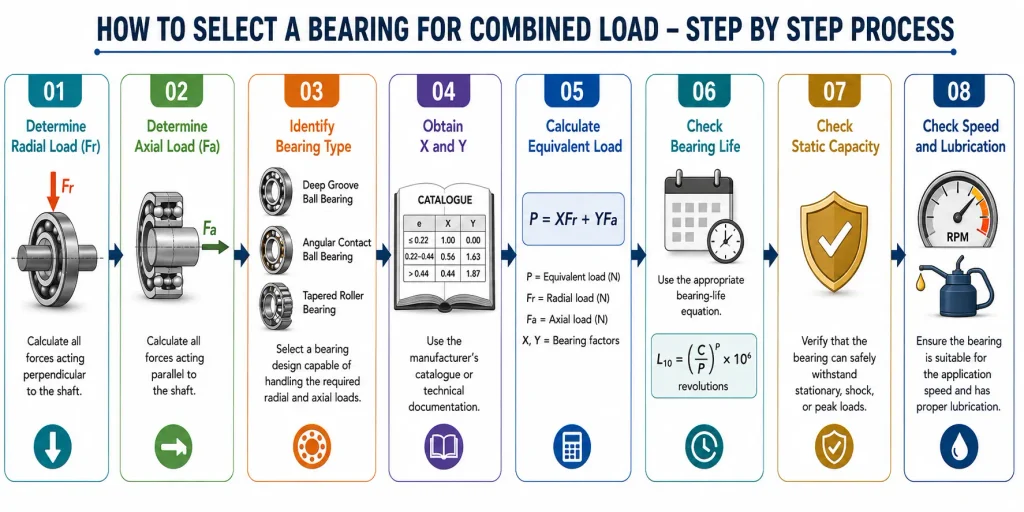
Confirm that the bearing is suitable for the required rotational speed, temperature, and lubrication method.
Different bearing designs have different capabilities.

Combined-load-capable bearings provide several important benefits:
Combined loading also creates additional design challenges.
Therefore, the bearing should not be selected solely by comparing its radial load rating with the radial force.
Combined load bearings are used extensively in industrial and mechanical systems.
Electric Motors :Motor bearings may experience radial forces from the rotor and axial forces from the machine arrangement.
Gearboxes :Gears can generate both radial and axial forces, especially helical gears.
Pumps :Pump bearings may experience radial loads from shaft rotation and axial thrust generated by the impeller.
Automotive Systems :Wheel hubs, transmissions, and differentials frequently require bearings capable of handling combined loading.
Machine Tools :Machine-tool spindles often require precise bearings capable of handling radial and axial forces at high speeds.
Calculating combined load bearing capacity is essential when a bearing simultaneously experiences radial and axial forces. The most important calculation is the equivalent dynamic bearing load:
P = XFr + YFa
The complete evaluation should also consider dynamic load rating, static load rating, bearing life, speed, lubrication, temperature, alignment, and shock loads.
For an actual engineering application, always use the specific calculation factors and bearing load ratings supplied by the bearing manufacturer.
Combined load occurs when a bearing experiences radial and axial forces simultaneously.
A commonly used equivalent dynamic load formula is:
P = XFr + YFa
where X and Y are bearing-specific factors.
Angular contact ball bearings and tapered roller bearings are commonly used for significant combined radial and axial loads. The correct choice depends on the magnitude and direction of the loads, speed, life requirement, and application.
Generally, no. Because the forces act in different directions, an equivalent bearing-load calculation should be performed using the appropriate manufacturer’s method.
It converts the combined effect of radial and axial forces into a load value that can be used for bearing-life calculations and bearing selection.
Higher combined loading increases the equivalent bearing load P, which generally reduces the calculated bearing fatigue life.
Dynamic capacity is primarily used for calculating bearing fatigue life during rotation, while static capacity is important for checking permanent deformation under stationary, slow-speed, or shock loading.
Accurate calculation helps prevent premature bearing failure, overheating, excessive wear, vibration, and unexpected machine downtime.
Select a bearing for combined loading by considering radial load (Fr), axial load (Fa), speed, bearing life, and operating conditions. Calculate the equivalent dynamic load using P = XFr + YFa, then choose a bearing with sufficient dynamic and static load capacity for the application.
Calculate the equivalent dynamic load first using P = XFr + YFa. Then estimate bearing life using:
Ball Bearing: L₁₀ = (C/P)³
Roller Bearing: L₁₀ = (C/P)^(10/3)
Where C is the dynamic load rating and P is the equivalent combined load.

Welcome! I am a dedicated entrepreneur running an industrial affiliate product website, helping businesses and professionals find the best tools, equipment, and resources for their needs. With a passion for industrial products and a keen eye for quality, I curate and recommend top-performing items that enhance efficiency and reliability.
Through my platform, I aim to simplify the buying process by providing valuable insights, expert reviews, and trusted affiliate links to high-quality industrial products. Whether you’re looking for the latest machinery, tools, or safety gear, I strive to connect you with the best solutions available.
Thank you for visiting, and I look forward to helping you make informed purchasing decisions!
