Our Location
Killa-Pardi, Dist. Valsad, 396125

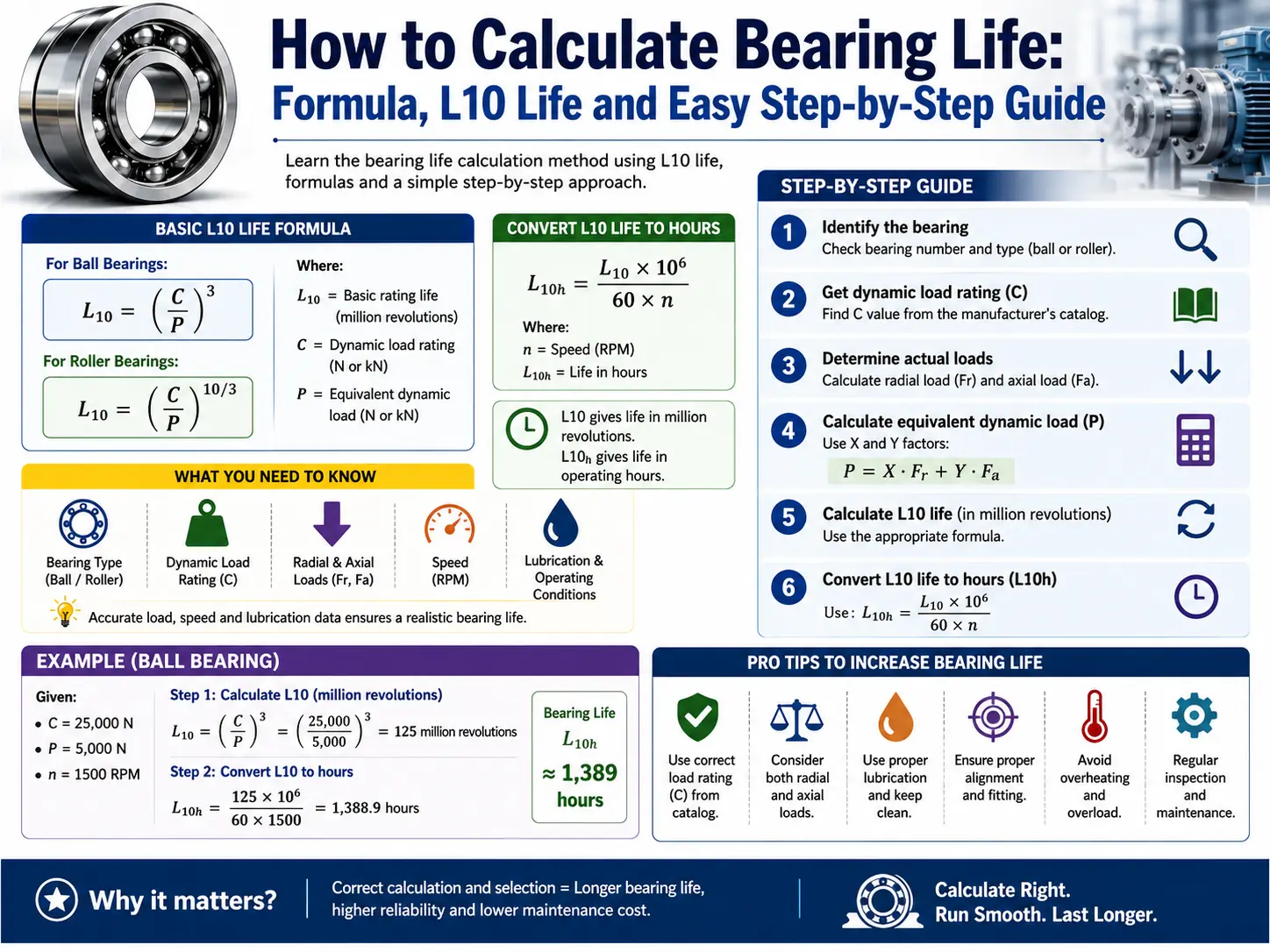
Knowing how to calculate bearing life is essential when selecting a bearing for motors, pumps, gearboxes, conveyors, fans, machine tools and other rotating equipment. A bearing may have the correct inner diameter and outer diameter, but that does not automatically mean it will provide the required service life.
Bearing life depends primarily on factors like dynamic load rating, actual operating load, rotational speed, lubrication, temperature, alignment, and contamination. The standard metric for measuring durability is L10 life, which defines the operating hours at which 90% of a given population of identical bearings will survive (and only 10% fail) under specified conditions. The term B10 life is often used interchangeably in industrial settings to denote the point where 10% of the bearings have failed, though manufacturer documentation should always be verified for specific definitions.
This guide explains the complete method to calculate bearing life, including the formula, five different bearing examples, bearing life in hours, load carrying capacity, ID and OD identification, clearance formula, C3 rating, service life, common problems and a simple calculation tool.
Bearing life is generally expressed as the number of revolutions a bearing can complete before the first signs of fatigue, such as rolling-element or raceway fatigue, occur under defined operating conditions.
Bearing life can be expressed in two common ways:
For practical machine design, bearing life in hours is often easier to understand.
For example, if a bearing has a calculated L10 life of 50 million revolutions and operates at 1,000 RPM, its life in hours can be calculated by converting those revolutions into hours.
L10 Life : L10 life is the basic rating life corresponding to 90% reliability.
The basic bearing life equation is:
Where:
The exponent is approximately:
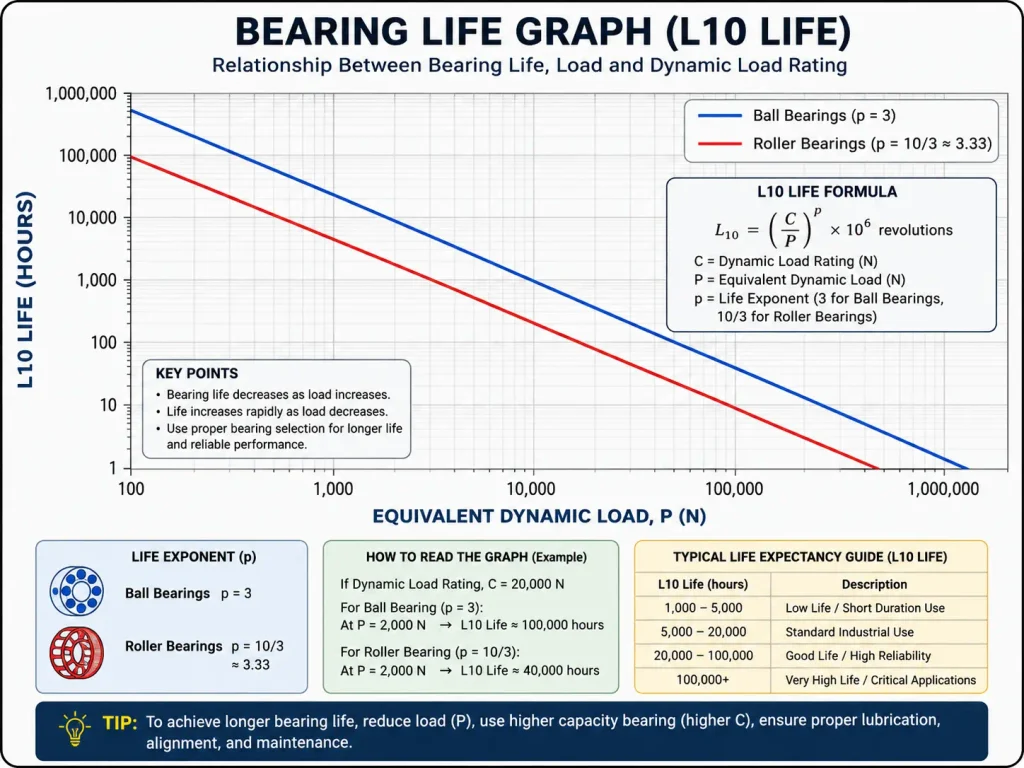
The bearing life formula is one of the most important calculations used in bearing selection.
(1) For a deep-groove ball bearing or other applicable ball bearing: L10 = (C/P)³
Example:
Suppose:
Then:
L10 = (15,000 / 5,000)³
L10 = 3³
L10 = 27 million revolutions
Therefore, the basic rating life is 27 million revolutions.
(2) Roller Bearing Formula : L10 = (C/P)^(10/3)
The higher exponent means that increasing the dynamic load rating relative to the applied load can produce a substantial increase in calculated rating life.
Important: Always use the exact bearing manufacturer‘s load ratings and life method for the selected bearing. The examples below are educational calculations.
Engineers often need bearing life in hours rather than revolutions.
The conversion formula is:
L10h = (L10 × 10⁶) / (60 × n)
Where:
Example :
If:
Then:
L10h = (40 × 10⁶) / (60 × 1,500)
L10h = 444.44 hours
So the calculated bearing life is approximately 444 hours.
Calculating bearing life is easier when you follow a fixed sequence. The key point is that bearing ID and OD are used to select the correct bearing, while the basic L10 life calculation mainly uses the dynamic load rating (C), equivalent dynamic load (P), and speed (RPM).
First identify the bearing type and bearing number.
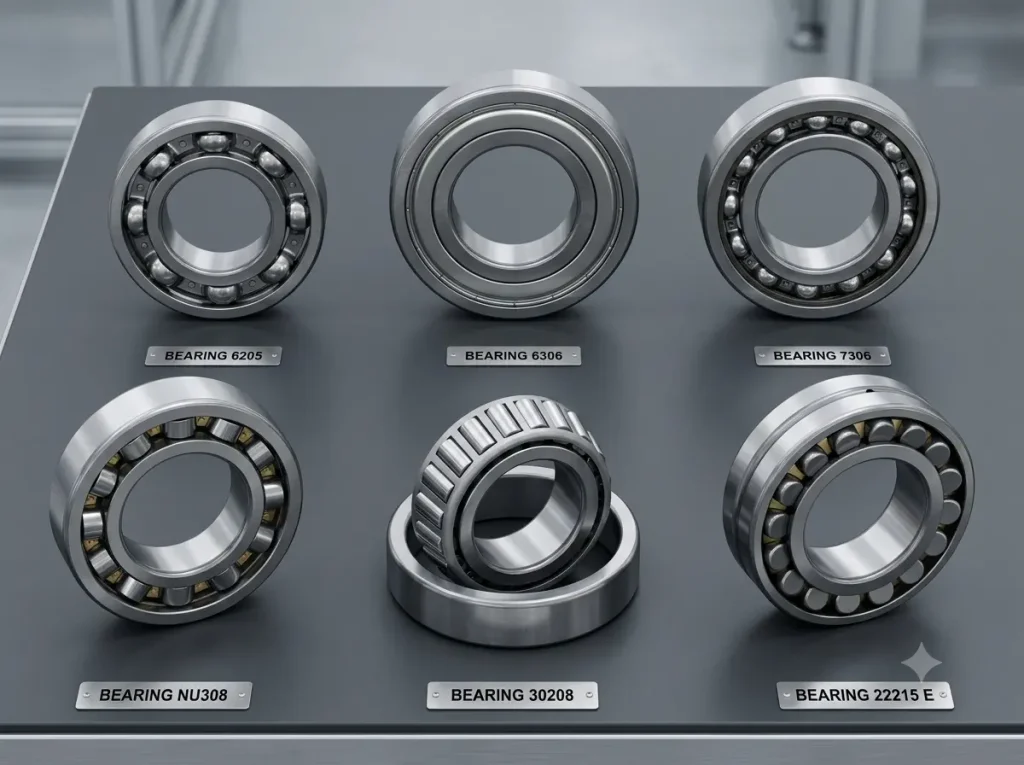
The bearing number helps identify the bearing series, bore size and construction, but the complete manufacturer catalogue should be used for exact dimensions and ratings.
The ID is the diameter of the hole through the bearing.
The OD is the outside diameter of the bearing.
The width is normally represented by B for many radial bearings.
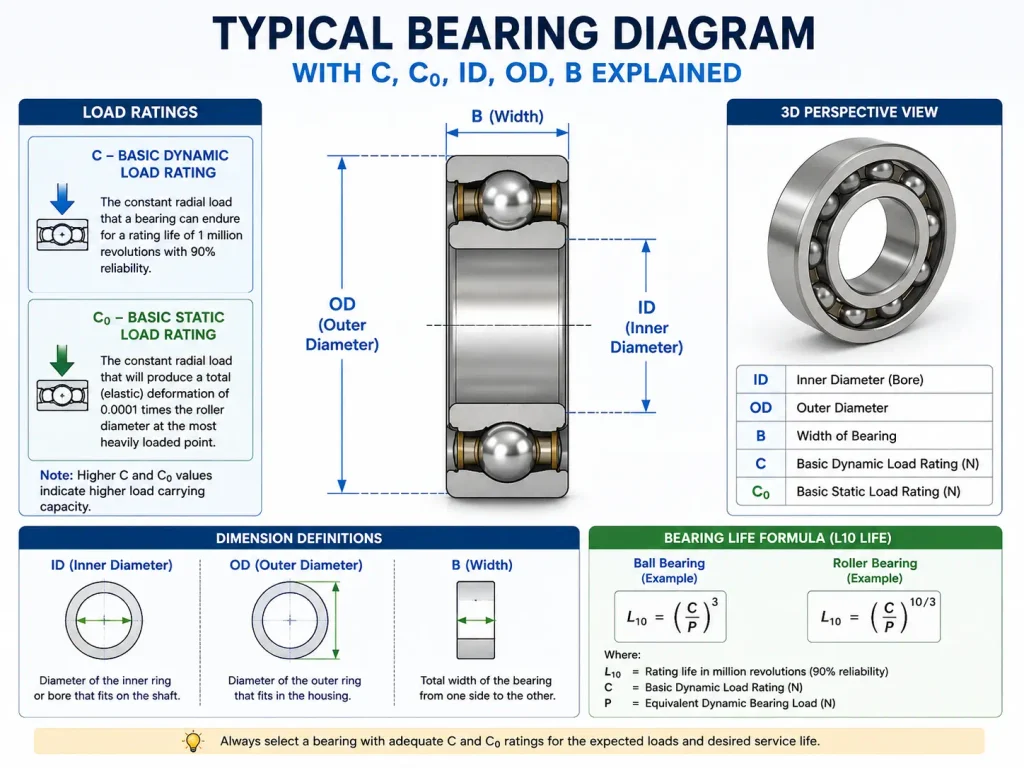
For many metric deep-groove ball bearings, bore codes follow a standard system. For example, a 6205 commonly has a 25 mm bore. However, do not assume ID and OD from the bearing number alone for every bearing type. Always confirm dimensions from the manufacturer’s catalogue or technical drawing.
Example:
For a typical 6205 bearing:
These dimensions confirm whether the bearing physically fits the shaft and housing.
| Bearing | Typical ID | Typical OD | Width |
|---|---|---|---|
| 6205 | 25 mm | 52 mm | 15 mm |
| 6306 | 30 mm | 72 mm | 19 mm |
| 6208 | 40 mm | 80 mm | 18 mm |
| 6310 | 50 mm | 110 mm | 27 mm |
| 22215 E | 75 mm | 130 mm | 31 mm |
Dimensions can vary by bearing design or manufacturer, so catalogue verification is recommended.
The basic dynamic load rating C is normally provided in the manufacturer’s bearing catalogue.
It represents the bearing’s standardized load-rating capability for life calculations.
Do not confuse:
A higher C generally provides greater calculated rating life when all other factors remain constant.
The actual bearing may experience radial load, axial load or a combination. For a purely radial load, the calculation may be relatively simple. For combined loading, the equivalent dynamic load may be represented by:
P = XFr + YFa
Where:
Example:
Suppose the radial load is:
Fr = 4,000 N
For this simplified example:
P = 4,000 N
The correct X and Y values depend on the bearing type, internal design, contact angle and operating conditions. They must be obtained from the appropriate manufacturer’s catalogue.
After finding C and P, use the appropriate formula.
L10 = (C/P)³
Example:
Suppose the radial load is:
Fr = 4,000 N
For this simplified example:
P = 4,000 N
L10 = (C/P)10/3
The result is in million revolutions.
Use:
L10h = (L10 × 10⁶)/(60n)
where:
This gives the calculated rating life in operating hours.
Example :
Assume:
Then:
L10h = (42.875 × 10⁶) / (60 × 1,500)
L10h ≈ 476.4 hours
Therefore:
Bearing L10 life ≈ 476 hours
Now compare the calculated L10 life with the machine’s required service life.
Example :
Suppose the machine requires:
Required service life = 400 hours
Calculated:
L10 life = 476 hours
Since:
476 > 400
the calculated L10 rating life exceeds the basic required life in this simplified example.
However, actual bearing service life can still be affected by lubrication, contamination, temperature, misalignment, installation, clearance and other operating conditions.
After the basic life calculation, check whether the bearing’s internal clearance is suitable for the application.
C3 means the bearing has greater-than-normal radial internal clearance. C3 is not a higher dynamic load rating.
For example, a bearing may be available in:
The appropriate clearance depends on factors such as shaft and housing fits, operating temperature and thermal expansion.
Suppose you need to calculate the basic rating life of a 6205 ball bearing.
Given:
Formula: L10 = (C/P)³
Calculation:
L10 = (14,000/4,000)³
L10 = 42.875 million revolutions
Convert to hours:
L10h = (42.875 × 10⁶)/(60 × 1,500)
L10h ≈ 476 hours
Final Answer:
Basic L10 life = 42.88 million revolutions
Bearing life ≈ 476 hours at 1,500 RPM
| Calculation | Formula |
|---|---|
| Ball bearing L10 | L10 = (C/P)³ |
| Roller bearing L10 | L10 = (C/P)^(10/3) |
| Bearing life in hours | L10h = (L10 × 10⁶)/(60 × RPM) |
| Simple radial load | P ≈ Fr |
| Combined load | P = XFr + YFa |
1. Identify bearing → 2. Check ID/OD → 3. Find C → 4. Calculate P → 5. Calculate L10 → 6. Convert to hours → 7. Compare with required service life → 8. Check clearance and operating conditions.
Important: For real engineering selection, use the exact C rating, C₀ rating, equivalent-load factors, clearance, speed limits and life method specified by the bearing manufacturer.
The following examples use representative values for demonstrating the calculation method. They are not substitutes for the manufacturer’s catalogue ratings.
Assume:
Step 1: Apply the formula
L10 = (C/P)³
L10 = (14,000/4,000)³
L10 = (3.5)³
L10 = 42.875 million revolutions
Calculate bearing life in hours :
L10h = (42.875 × 10⁶)/(60 × 1,500)
L10h = 476.39 hours
Result :
L10 = 42.875 million revolutions
Bearing life ≈ 476 hours
Assume:
For this educational example, use the ball-bearing exponent of 3.
Calculation :
L10 = (19,500/5,000)³
L10 = (3.9)³
L10 = 59.319 million revolutions
Now convert to hours:
L10h = (59.319 × 10⁶)/(60 × 2,000)
L10h = 494.33 hours
Result :
L10 = 59.319 million revolutions
Bearing life ≈ 494 hours
For an actual angular-contact bearing calculation, axial load and the manufacturer’s equivalent-load method must also be considered when applicable.
Assume:
Use: L10 = (C/P)^(10/3)
Calculation :
L10 = (36,000/9,000)^(10/3)
L10 = 4^(10/3)
L10 ≈ 101.59 million revolutions
Now:
L10h = (101.59 × 10⁶)/(60 × 1,200)
L10h ≈ 1,411 hours
Result :
L10 ≈ 101.59 million revolutions
Bearing life ≈ 1,411 hours
Assume:
For the simplified educational calculation:
L10 = (33,000/8,000)^(10/3)
L10 ≈ 112.57 million revolutions
Convert to hours:
L10h = (112.57 × 10⁶)/(60 × 1,000)
L10h ≈ 1,876 hours
Result :
L10 ≈ 112.57 million revolutions
Bearing life ≈ 1,876 hours
For an actual tapered roller bearing application, use the manufacturer’s complete equivalent-load and rating-life procedure, particularly when radial and axial loads are both present.
Assume:
Use the roller bearing equation:
L10 = (62,000/15,000)^(10/3)
L10 ≈ 113.33 million revolutions
Convert to hours:
L10h = (113.33 × 10⁶)/(60 × 900)
L10h ≈ 2,099 hours
Result :
L10 ≈ 113.33 million revolutions
Bearing life ≈ 2,099 hours
| Example | Bearing | Type | C (N) | P (N) | RPM | L10 (million rev.) | Life (hours) |
| 1 | 6205 | Ball | 14,000 | 4,000 | 1,500 | 42.88 | 476 |
| 2 | 7306 | Ball | 19,500 | 5,000 | 2,000 | 59.32 | 494 |
| 3 | NU308 | Roller | 36,000 | 9,000 | 1,200 | 101.59 | 1,411 |
| 4 | 30208 | Roller | 33,000 | 8,000 | 1,000 | 112.57 | 1,876 |
| 5 | 22215 E | Roller | 62,000 | 15,000 | 900 | 113.33 | 2,099 |
These figures demonstrate an important point: bearing life is highly sensitive to the ratio between C and P.
Bearing selection should never be based only on bore size.
Two bearings may have the same ID but significantly different load carrying capacity.
For example, a larger bearing series may provide a higher dynamic load rating C, which can significantly improve calculated L10 life under the same applied load.
The basic relationship is:
Higher C / Lower P = Longer calculated rating life
Conversely:
Lower C / Higher P = Shorter calculated rating life
However, load capacity is not the only consideration. Speed, lubrication, temperature, contamination, alignment, clearance and installation also affect actual service performance.
Bearing clearance is the amount of internal movement available between the bearing’s rolling elements and raceways when the bearing is not mounted.
A simplified representation of radial internal clearance is:
Cr = Cmax − Cmin
Where:
The actual manufacturer’s clearance specification should be used because the measurement procedure and tolerance depend on bearing design and standard.
Incorrect clearance can cause:
C3 refers to a bearing with radial internal clearance greater than normal.
A simplified clearance sequence is:
C2 < Normal < C3 < C4 < C5
C3 does not mean that the bearing has a higher load rating.
It means the bearing has greater internal clearance than the normal-clearance version.
C3 clearance may be selected for applications where operating temperature, interference fits or other conditions reduce the operating clearance.
Examples can include certain:
But C3 should not be selected simply because it sounds “stronger.” The correct clearance depends on the application.
A bearing with inappropriate clearance can experience increased stress, heat and vibration.
If the internal clearance becomes too small during operation, rolling elements may experience excessive preload or reduced running clearance.
If clearance is excessive, load distribution may become less favorable and vibration can increase.
Therefore:
Correct clearance → Better operating conditions → Better reliability
C3 is an internal-clearance specification, not a direct measure of bearing life.
It is important to understand that calculated L10 life is not necessarily the same as actual service life.
A bearing can fail before the calculated rating life because of:
Conversely, a bearing may operate much longer than the basic L10 calculation if operating conditions are favorable.
Therefore, L10 is a rating-life calculation, not a guaranteed failure date.
You can create a basic bearing life calculator using the following inputs:
Inputs:
For a ball bearing:
L10 = (C/P)³
For a roller bearing:
L10 = (C/P)^(10/3)
Then:
Life in hours = L10 × 1,000,000 / (60 × RPM)
| PROBLEM | POSSIBLE CAUSE | SOLUTIONS |
| Bearing Fails Earlier Than Calculated | The calculated L10 life assumed a clean and correctly lubricated bearing, but the actual application may have contamination, excessive load or incorrect installation. | Check: Actual radial load Axial load Lubrication Contamination Alignment Shaft and housing fits Operating temperature Then recalculate the bearing life using realistic operating conditions. |
| Excessive Bearing Temperature | Too much grease Incorrect lubricant Excessive preload Incorrect clearance Excessive speed | Check the manufacturer’s recommended lubrication quantity, operating speed and clearance specification. |
| Bearing Has High Noise and Vibration | Noise can result from: Contamination Raceway damage Incorrect installation Misalignment Excessive clearance Lubrication problems | Inspect the bearing, shaft, housing and lubricant. Verify that the selected clearance is appropriate. |
| Calculated Life Is Too Low | The applied load P may be too high compared with the bearing’s dynamic load rating C. | Consider a bearing with: Higher dynamic load rating Appropriate bearing geometry Suitable speed capability Correct internal clearance Reducing unnecessary load can also improve calculated life. |
| Wrong C3 Bearing Selected | C3 was selected only because it is commonly used in motors or because the user assumed C3 means higher strength. | Select clearance based on: Shaft fit Housing fit Operating temperature Thermal expansion Bearing arrangement Manufacturer recommendations Remember that C3 means greater-than-normal internal clearance, not greater load capacity. |
The basic L10 calculation is useful, but real bearing service life depends on many factors.
| 1. Load | Higher operating load generally reduces calculated fatigue life. |
| 2. Speed | Higher RPM increases the number of revolutions accumulated per hour and can also increase temperature and lubrication demands. |
| 3. Lubrication | Correct grease or oil is essential for separating rolling surfaces and controlling friction and heat. |
| 4. Contamination | Dust, water and abrasive particles can significantly reduce bearing service life. |
| 5. Alignment | Misalignment can create additional stresses and uneven load distribution. |
| 6. Temperature | Excessive temperature can degrade lubricant and affect bearing material and clearance. |
| 7. Installation | Incorrect mounting force, shaft damage, improper fits or contamination during installation can cause early failure. |
| 8. Clearance | Correct internal clearance is important for maintaining suitable operating conditions. |
Before calculating bearing life, collect:
Then follow this method:
Bearing → Dimensions → Load → C rating → Equivalent load P → L10 → Hours → Service-life check
When engineers calculate bearing service life, they usually use L10 life rather than an “average life” value because L10 provides a standardized and conservative basis for comparing bearings under a defined load and operating condition.
The important point is that rolling bearings do not all fail at exactly the same number of revolutions. Even bearings made to the same specification and operated under apparently identical conditions can have different fatigue lives because of variations in material, manufacturing, lubrication, surface condition, contamination and operating environment.
Therefore, simply saying that a bearing has an “average life” can be misleading.
L10 life is the basic rating life at which 10% of an identical group of bearings are statistically expected to have reached fatigue failure, while approximately 90% are expected to survive.
For a ball bearing:
L10 = (C/P)³ million revolutions
For a roller bearing:
L10 = (C/P)^(10/3) million revolutions
Where:
L10 is therefore not a guaranteed failure point. It is a statistical rating used for bearing selection and comparison.
The terms L10, L50 and L90 describe different statistical reliability levels.
| Life Value | Approximate Survival | Approximate Failure | Meaning |
|---|---|---|---|
| L10 | 90% | 10% | Standard basic rating life |
| L50 | 50% | 50% | Median life |
| L90 | 10% | 90% | Very high failure probability by this point |
The terminology is easiest to understand by thinking about a group of 100 identical bearings.
At L10 life:
This is why L10 is the standard rating-life reference used in bearing calculations.
At L50 life:
L50 is therefore the median life, not necessarily the arithmetic average life.
At L90 life:
Therefore, L90 should not be interpreted as “90% reliability.” In this notation, the subscript refers to the percentage of the population expected to fail.
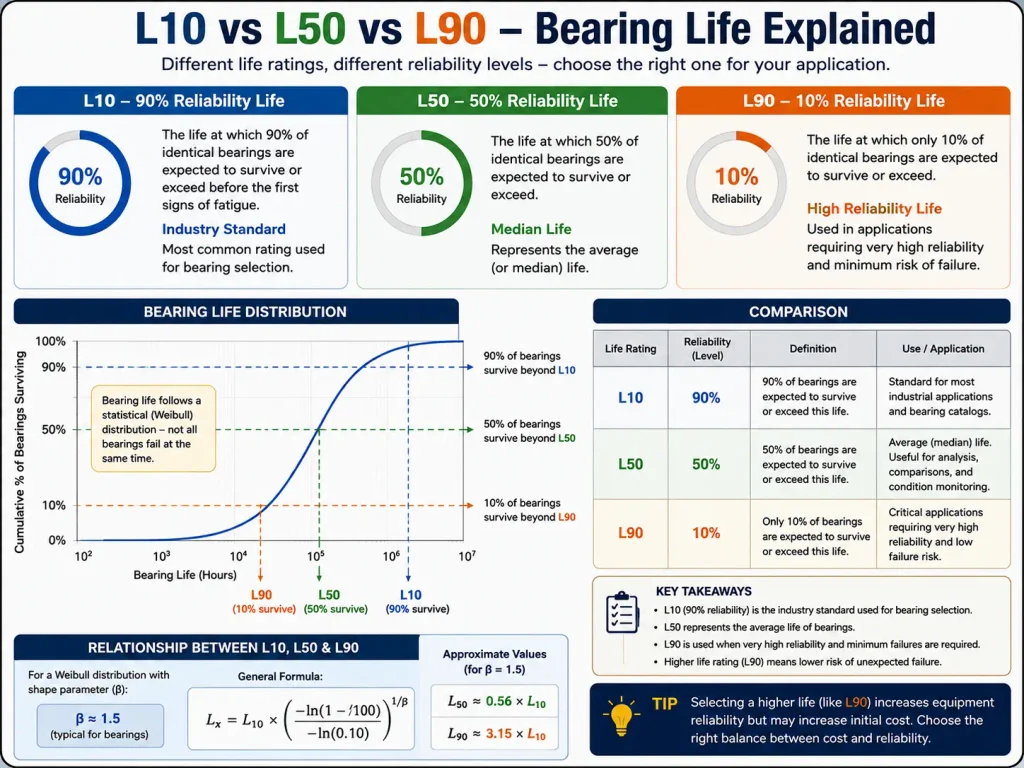
An average can hide the spread of actual bearing failures.
Imagine 10 bearings operating under the same nominal conditions:
If an engineer only uses the average, the value may not adequately represent the risk of an early failure.
L10 provides a more useful engineering reference because it establishes a recognized 90% survival basis.
This is particularly important in machinery where unexpected bearing failure can cause:
For this reason, engineers generally begin bearing selection with the standardized L10 rating-life calculation and then consider application-specific reliability requirements.
Suppose a bearing population has a calculated statistical life distribution in which the approximate life points are:
These numbers would mean:
At 10 million revolutions: approximately 90% of the bearings are expected to survive.
At 50 million revolutions: approximately 50% are expected to survive.
At 200 million revolutions: approximately 10% are expected to survive.
This demonstrates why the three values represent very different reliability levels.
Important: The numerical relationship between L10, L50 and L90 is not universal. It depends on the statistical life distribution and assumptions used. Do not convert L10 to L50 or L90 using an arbitrary multiplier unless the applicable reliability model or bearing manufacturer’s data supports it.
L10 bearing life is normally the appropriate starting point when:
For example, suppose a machine requires a bearing to operate for 20,000 hours.
The engineer can calculate the required L10 life:
Required L10 = (20,000 × 60 × n) / 10⁶
If the shaft operates at 1,000 RPM:
Required L10 = (20,000 × 60 × 1,000) / 10⁶
Required L10 = 1,200 million revolutions
The engineer can then compare this requirement with the calculated L10 rating life of candidate bearings.
Although L10 is extremely useful, it should not be the only consideration for every application.
For critical equipment, engineers may need a higher reliability target and additional life calculations.
Examples include:
In such cases, the engineer may use a manufacturer’s modified rating-life calculation, reliability adjustment factors, application-specific life models or other reliability methods.
The calculation may account for factors such as:
The terms L10 and B10 are closely related in many engineering contexts because both can describe the point at which approximately 10% of a population has failed, corresponding to approximately 90% survival.
However, terminology can vary between industries, standards and manufacturers.
For rolling-bearing rating calculations, L10 is the conventional term used for basic rating life in million revolutions.
When a manufacturer specifies B10 life, always check its exact definition and test method before treating it as directly interchangeable with an L10 rating.
The main reason engineers use L10 instead of “average life” is simple:
L10 provides a standardized statistical reference for bearing selection, while an average-life number alone does not adequately describe the spread of possible bearing failures.
A good bearing-life analysis should therefore follow this sequence:
Bearing selection → C rating → Equivalent load P → L10 calculation → Bearing life in hours → Reliability/application check
L10 is an excellent starting point, but actual service life can be affected by lubrication, contamination, mounting, alignment, temperature, clearance, vibration and other operating conditions.
Learning how to calculate bearing life is essential for proper bearing selection. The basic process involves identifying the bearing, checking C (dynamic load rating) and calculating the equivalent dynamic load P.
Bearing life is also affected by load, lubrication, speed, temperature, contamination, alignment and clearance. Remember, C3 means greater-than-normal internal clearance, not higher load capacity.
Always use the latest manufacturer catalogue data for accurate bearing selection.
Bearing life is commonly calculated using the L10 bearing life formula:
L10 = (C/P)³ for ball bearings, where C is dynamic load rating and P is equivalent dynamic load.
L10 life is the number of revolutions that 90% of a group of identical bearings are expected to reach or exceed before fatigue failure.
Yes, but ID and OD are not directly used in the L10 formula. Bearing dimensions help identify the bearing and its load-rating data, especially the dynamic load rating C.
First calculate L10 in million revolutions, then convert it into hours using:
L10h = (L10 × 10⁶) / (60 × RPM).
Bearing life decreases significantly as load increases. For ball bearings, life varies approximately with the inverse cube of the load.
Yes, you can calculate L10 life in million revolutions without RPM. However, RPM is required to convert that life into operating hours.
When both radial and axial loads act on a bearing, calculate the equivalent dynamic bearing load P using the manufacturer’s X and Y factors, then use P in the bearing-life equation.
Differences can occur because manufacturers may consider factors such as load distribution, lubrication, contamination, operating temperature, speed, alignment, and bearing-specific life adjustment factors.
Proper lubrication, correct load selection, good alignment, contamination control, correct installation, and avoiding excessive loads and temperatures can help extend bearing life.
No. Bearing ID and OD alone are not enough. You need the bearing’s dynamic load rating C and the actual operating load P for the basic L10 calculation.

Welcome! I am a dedicated entrepreneur running an industrial affiliate product website, helping businesses and professionals find the best tools, equipment, and resources for their needs. With a passion for industrial products and a keen eye for quality, I curate and recommend top-performing items that enhance efficiency and reliability.
Through my platform, I aim to simplify the buying process by providing valuable insights, expert reviews, and trusted affiliate links to high-quality industrial products. Whether you’re looking for the latest machinery, tools, or safety gear, I strive to connect you with the best solutions available.
Thank you for visiting, and I look forward to helping you make informed purchasing decisions!
