Our Location
Killa-Pardi, Dist. Valsad, 396125


Selecting the correct lubricant for a bearing is one of the most important decisions in machine maintenance. A suitable lubricant can reduce friction, control operating temperature, minimize wear, protect against corrosion and contamination, and help a bearing achieve its expected service life.
However, choosing a lubricant is not as simple as buying a general-purpose grease. The correct selection depends on several operating factors, including bearing type, load, rotational speed, operating temperature, environment, shaft orientation, vibration, contamination, and maintenance requirements. SKF specifically recommends considering these factors when selecting bearing grease.
The two major lubrication choices are grease and oil. Grease is widely used because it remains where it is applied and generally requires simpler equipment. NSK reports that grease is used in approximately 80% of rolling bearings. Oil can be preferable for certain high-speed applications, particularly where continuous circulation and heat removal are required.
This guide explains how to select lubricant for bearings, including grade-wise grease selection, grease-versus-oil comparison, application examples, maintenance practices, common mistakes, and frequently asked questions.
A bearing operates under repeated rolling contact. Without adequate lubrication, the contacting surfaces can experience increased friction and wear.
The right lubricant helps create a protective film between surfaces.
Incorrect lubricant selection can have the opposite effect. A lubricant that is too thick can create excessive resistance, while one that is too thin may not provide sufficient film strength under the operating conditions.
Therefore, lubricant selection should always begin with the bearing and machine manufacturer’s recommendations.
A simple selection process is:
Bearing Type → Load → Speed → Temperature → Environment → Grease or Oil → Grade/Viscosity → Quantity → Relubrication Interval
Let’s examine each factor.
First determine what type of bearing you are lubricating.
Common types include:
Different bearing designs have different contact conditions and lubrication requirements.
For example, a high-speed angular-contact bearing may require a lubricant with very different characteristics from a heavily loaded, slow-speed spherical roller bearing.
Always check the bearing designation and manufacturer’s technical documentation before choosing a lubricant.
Load is another major consideration.
Bearings may experience:
Heavier loads generally require a lubricant capable of maintaining an appropriate protective film under the operating conditions.
Base-oil viscosity is particularly important here. Remember that grease consistency and base-oil viscosity are different properties. NLGI explains that grease consistency is mainly determined by thickener type and concentration, while base-fluid viscosity is a separate characteristic.
Higher load → carefully evaluate base-oil viscosity and load-carrying capability.
Do not simply choose a higher NLGI number because the machine has a heavy load.
Speed has a major influence on lubricant selection.
High-speed bearings can generate significant heat. Excessively viscous grease or too much lubricant can increase churning and friction.
| Operating Condition | Possible Lubrication Choice |
|---|---|
| Low speed | Grease or oil |
| Moderate speed | Usually grease is practical |
| High speed | Specialized grease or oil |
| Very high speed | Often oil or specially formulated grease |
For high-speed applications, consult the bearing manufacturer’s speed and lubrication recommendations rather than relying on a generic grease chart.
Temperature affects both the bearing and lubricant.
Before selecting a lubricant, determine:
A grease designed for moderate temperatures may not be appropriate for a continuously hot bearing.
High temperatures can accelerate oxidation and lubricant degradation.
Low temperatures can increase lubricant resistance and make grease difficult to move.
Select a lubricant whose operating-temperature capability comfortably covers the actual application range.
Do not use the grease’s dropping point alone as the operating-temperature rating.
Environmental conditions can dramatically influence lubricant selection.
Consider whether the bearing is exposed to:
For wet environments, water-resistant grease may be important.
For dusty environments, contamination control and proper sealing become critical.
For chemical environments, the lubricant must be compatible with the chemicals and seals.
After evaluating the operating conditions, decide whether grease or oil is more appropriate.
Grease is often preferred when:
NSK highlights grease’s ease of use, simpler sealing arrangements and reduced leakage/scatter compared with oil.
Oil may be preferred when:
Oil can circulate through a system and carry heat away from the bearing.
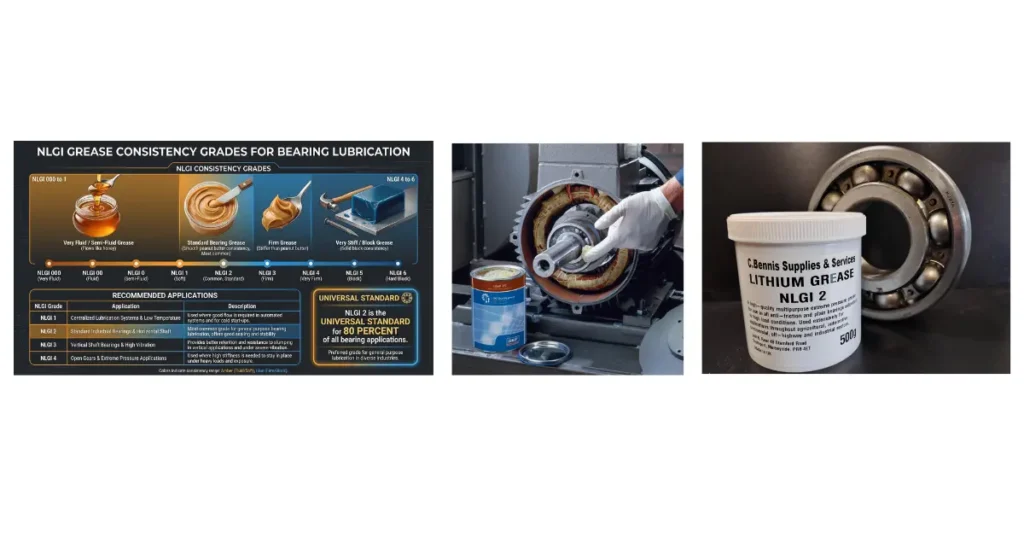
The NLGI grade describes grease consistency, or how soft/hard the grease is.
NLGI grades range from very soft 000 through very hard 6. The NLGI classification is based on worked penetration at 25°C.
| NLGI Grade | Consistency | General Application Consideration |
|---|---|---|
| 000 | Extremely soft/fluid | Centralized systems, some gear applications |
| 00 | Very soft | Semi-fluid lubrication systems |
| 0 | Soft | Low-temperature/centralized applications |
| 1 | Soft | Pumpability and lower-temperature applications |
| 2 | Medium | Common general-purpose bearing grease |
| 3 | Firm | Certain bearing and higher-temperature applications |
| 4 | Very firm | Specialized applications |
| 5 | Very hard | Specialized applications |
| 6 | Extremely hard | Highly specialized uses |
NLGI 2 does not mean “best grease.”
It only describes consistency.
NLGI itself explains that grease consistency and base-fluid viscosity are independent properties.
These are relatively soft or semi-fluid grades.
They may be appropriate where excellent flow or pumpability is required.
They are not automatically suitable for ordinary bearings simply because they flow easily.
NLGI 1 is softer than NLGI 2.
It can be useful when:
However, application-specific requirements remain more important than the grade number alone.
NLGI 2 is one of the most widely encountered grades for general-purpose bearing lubrication.
SKF states that a mineral-oil/lithium-thickener grease with NLGI 2 consistency is sufficient for most applications, while also emphasizing that application, bearing type, load, temperature, speed, vibration and contamination must be considered.
Typical applications can include:
But a suitable NLGI 2 grease still needs the correct base-oil viscosity, thickener, additives and temperature capability.
NLGI 3 is firmer than NLGI 2.
Higher grades such as 4, 5 and 6 are increasingly firm and are used for specialized applications.
They should not automatically be selected for bearings simply because they are “thicker.”
A grease that is too stiff can have poor distribution and may increase resistance, depending on the application.
Many people select grease only by NLGI grade.
That is a mistake.
A grease is primarily composed of lubricating fluid, thickener and additives. NLGI consistency describes the grease’s consistency, but the base-oil viscosity determines an important part of the lubricant film behavior.
For bearing selection, consider:
Higher speed → often requires lower-viscosity lubricant characteristics.
Higher load → may require higher-viscosity lubricant characteristics.
But actual selection should be made using the bearing manufacturer’s data.
Bearing grease can use different thickener systems.
Common examples include:
The thickener affects properties such as:
Two greases with the same NLGI grade can behave very differently because their thickener and base-oil systems differ.
Grease may contain additives designed to provide additional performance.
Examples include additives for:
The correct additive package depends on the application.
Do not assume that a grease containing more additives is automatically better.
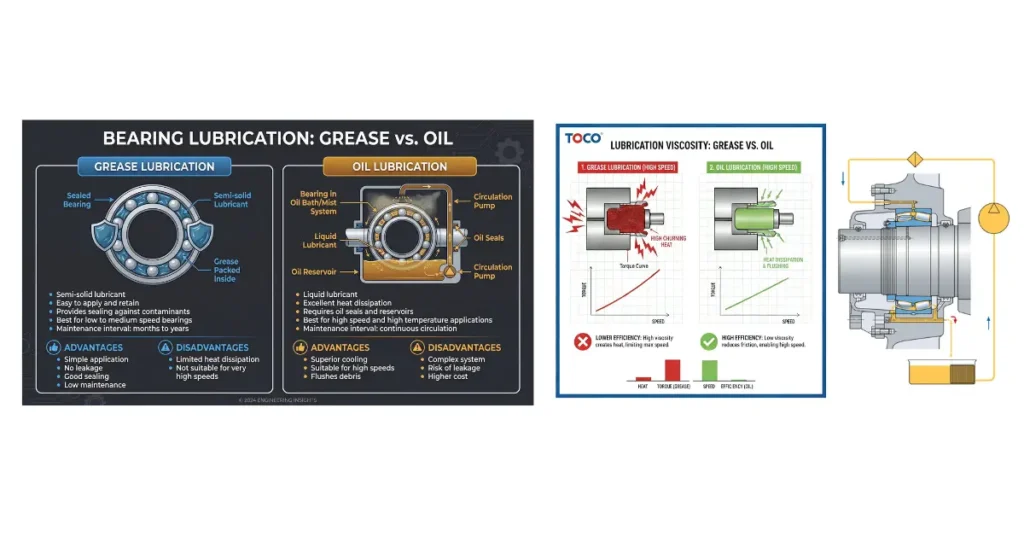
| Factor | Grease | Oil |
|---|---|---|
| Physical form | Semi-solid | Liquid |
| Retention | Very good | Requires containment |
| Application | Usually simple | Often more complex |
| High-speed performance | Application dependent | Often advantageous |
| Heat removal | Limited | Excellent with circulation |
| Leakage | Generally lower | Higher potential |
| Filtration | Difficult | Easy |
| Lubricant monitoring | More difficult | Easier |
| Maintenance | Generally simpler | Can require equipment |
| Typical use | Motors, pumps, fans | High-speed/high-temperature systems |
NSK notes that grease generally avoids the need for complex pumps and coolers, while oil lubrication can be advantageous where cooling is needed.
Electric motors commonly use grease-lubricated bearings.
When selecting grease, check:
Polyurea and lithium-complex greases are examples of grease families used in different motor applications, but the specific motor manufacturer’s specification should take priority.
For pumps, consider:
Water-resistant grease may be important for applications where water contamination is possible.
Conveyor bearings often operate at moderate speeds but can experience:
A suitable grease should therefore provide appropriate contamination resistance, temperature performance and relubrication characteristics.
High-speed applications require extra attention.
Consider:
Oil may be preferable when continuous heat removal is required.
Do not simply use a “high-temperature grease” and assume it is automatically suitable for high speed.
Correct quantity is just as important as correct lubricant selection.
Too little lubricant can cause:
Friction → Heat → Wear → Bearing damage
Too much grease can cause:
Churning → Heat → Energy loss → Possible premature failure
The correct quantity should be based on the bearing and equipment manufacturer’s instructions.
Compatibility is a major issue when changing grease.
NLGI advises that it is best practice not to mix different greases when the compatibility is unknown. It recommends appropriate displacement/purging procedures when changing products and monitoring the bearing for signs of incompatibility.
Possible warning signs include:
Always document the lubricant currently being used.
| Application | Common Starting Point | Important Checks |
|---|---|---|
| Electric motor | Bearing grease | Speed, temperature, compatibility |
| Pump | Grease or oil | Water, load, speed |
| Conveyor | Grease | Dust, water, load |
| Industrial fan | Grease | Speed, temperature |
| High-speed spindle | Oil/specialized grease | Speed, cooling |
| Heavy-load bearing | Specialized grease/oil | Load, viscosity, EP requirements |
| Wet environment | Water-resistant grease/oil | Corrosion and water resistance |
| High-temperature machinery | High-temperature grease/oil | Actual operating temperature |
This table is a selection starting point, not a substitute for the bearing manufacturer’s specification.
If you need a quick method for selecting a lubricant, follow these five steps:
For reliable bearing operation:
A documented lubrication program can help prevent avoidable bearing failures.
Selecting the correct lubricant for bearings requires more than choosing a popular grease or an NLGI number. The correct decision should consider bearing type, load, speed, operating temperature, environment, shaft orientation, vibration, contamination and maintenance requirements.
For many general-purpose applications, NLGI 2 grease is a common starting point, and SKF notes that a mineral-oil/lithium-thickener NLGI 2 grease is sufficient for many applications. However, this should not be interpreted as a universal recommendation.
NLGI grade describes grease consistency—not overall lubricant quality. Base-oil viscosity, thickener type, additives, temperature capability and compatibility are equally important.
Grease is often preferred because it is easy to apply, stays in place and generally requires simpler equipment. Oil can be advantageous for high-speed applications or systems where continuous cooling and circulation are important.
The simplest rule is:
Choose the right lubricant for the right bearing, under the right operating conditions, in the right quantity.
Correct lubricant selection can reduce friction, control temperature, minimize wear, improve reliability and help extend bearing life.
There is no universal best lubricant. The correct choice depends on bearing type, speed, load, temperature, environment and manufacturer specifications.
Grease is generally easier to retain and maintain, while oil can offer better cooling and may be advantageous at high speeds. The application determines the better option.
No. A higher NLGI number means a firmer grease consistency. It does not mean higher overall quality or better bearing performance.
There is no single factor. Speed, load, temperature, bearing type, environment, lubricant properties and manufacturer specifications should all be evaluated.
NLGI 1 is softer and generally more easily pumped, while NLGI 2 is firmer and commonly used for general-purpose applications. NLGI grade describes consistency, not complete lubricant performance.
No. Specialized bearings and demanding applications may require specific grease formulations.

Welcome! I am a dedicated entrepreneur running an industrial affiliate product website, helping businesses and professionals find the best tools, equipment, and resources for their needs. With a passion for industrial products and a keen eye for quality, I curate and recommend top-performing items that enhance efficiency and reliability.
Through my platform, I aim to simplify the buying process by providing valuable insights, expert reviews, and trusted affiliate links to high-quality industrial products. Whether you’re looking for the latest machinery, tools, or safety gear, I strive to connect you with the best solutions available.
Thank you for visiting, and I look forward to helping you make informed purchasing decisions!
