Our Location
Killa-Pardi, Dist. Valsad, 396125

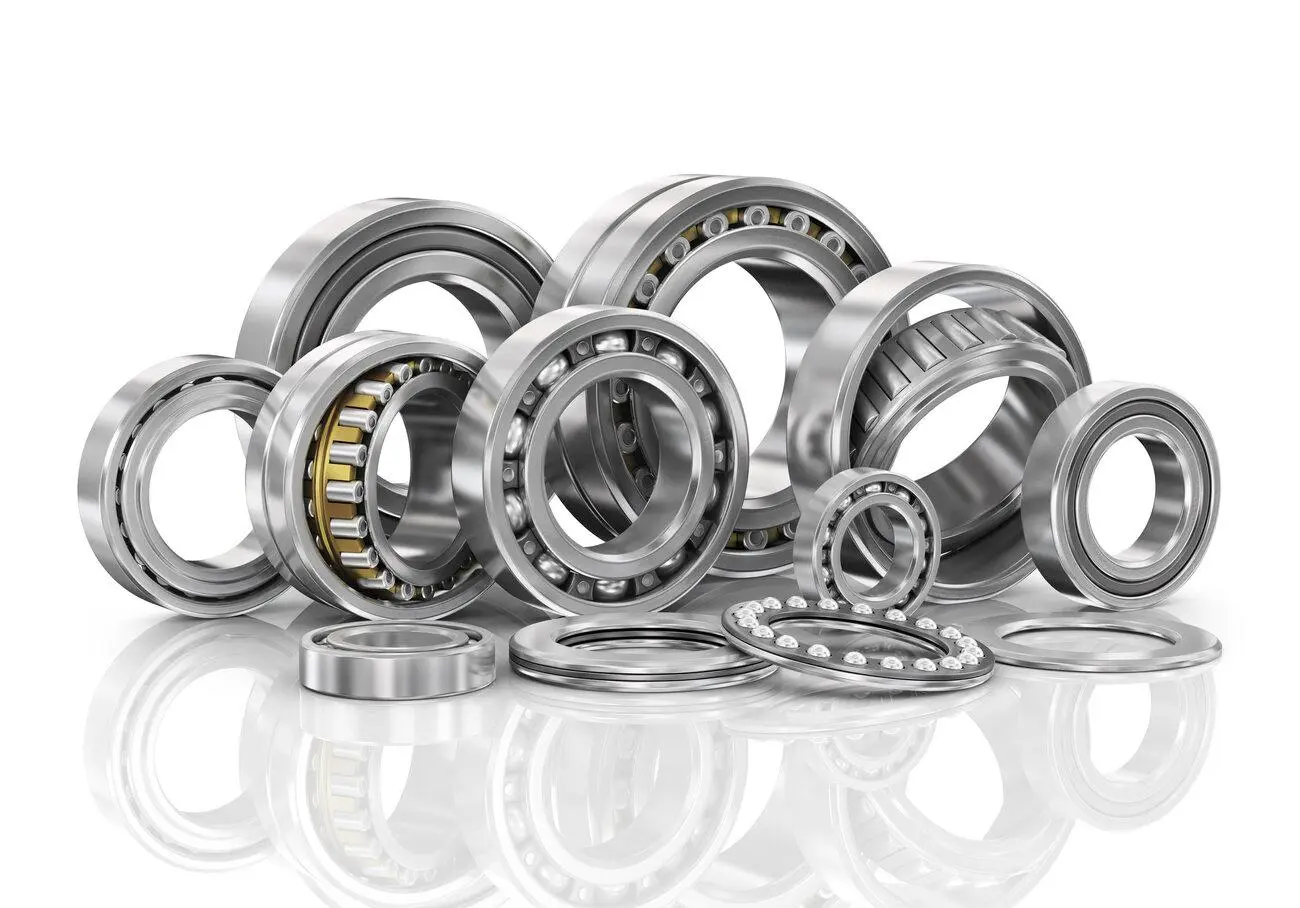
Bearings are among the most important mechanical components used in modern machines and industrial equipment. Although they are often small compared with the machines in which they operate, bearings perform critical core functions that directly affect friction, load capacity, speed, efficiency, reliability, and service life.
From electric motors and pumps to automobiles, conveyors, gearboxes, agricultural machinery, machine tools, and industrial production systems, bearings allow rotating or moving components to operate smoothly. Without suitable bearings, excessive friction and wear would quickly damage shafts and other machine components.
The core functions of bearings go far beyond simply allowing rotation. A properly selected bearing supports radial and axial loads, maintains shaft alignment, reduces friction, controls movement, handles operating speeds, and helps protect critical machine components.
This article explains the major functions of bearings, how they work, their importance in industrial applications, different types of bearings, and the factors that determine bearing performance.
A bearing is a mechanical component designed to support and guide moving or rotating parts while minimizing friction between surfaces.
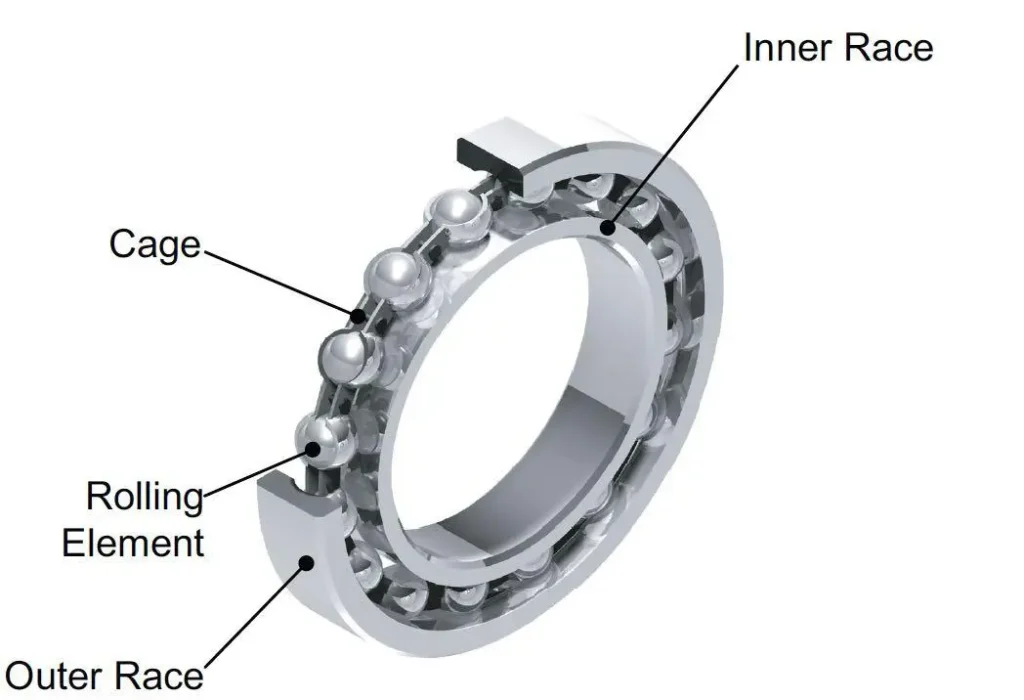
In a typical rolling-element bearing, the main components include:
The rolling elements may be balls, cylindrical rollers, tapered rollers, spherical rollers, or needles.
Instead of allowing two surfaces to slide directly against each other, rolling bearings use rolling elements between the surfaces. Rolling contact generally produces considerably less friction than direct sliding contact.
Bearings are therefore essential wherever controlled movement is required.
One of the primary functions of a bearing is to reduce friction between moving components.
When a shaft rotates directly inside a stationary housing, the contacting surfaces create sliding friction. This friction produces heat, consumes energy, and causes wear.
Bearings introduce rolling elements or specially designed sliding surfaces between components. In rolling bearings, balls or rollers move between the inner and outer rings.
For example, a ball bearing changes much of the sliding interaction into rolling contact.
Lower friction can provide:
This makes friction reduction particularly important in electric motors, pumps, fans, compressors, gearboxes, and high-speed machinery.
Another important bearing function is to support radial loads.
A radial load acts perpendicular to the shaft axis. For example, the weight of a rotating shaft, pulley, gear, or flywheel can create a radial load.
Many common bearings are designed primarily to handle these loads.
Radial loads are common in:
Deep-groove ball bearings are widely used because they can handle radial loads while also accommodating certain levels of axial loading.
Cylindrical roller bearings can provide high radial load capacity and are often selected for demanding industrial applications.
Bearings can also support axial loads, sometimes called thrust loads.
An axial load acts parallel to the shaft axis.
For example, in a screw mechanism or certain gearbox arrangements, forces may push a shaft in the axial direction. A bearing designed to handle this force prevents unwanted shaft movement.
Thrust bearings are commonly found in:
Different bearing designs have different axial-load capabilities. Ball thrust bearings are suitable for certain moderate-load applications, while tapered roller and spherical roller bearings can handle substantial combined loads when properly configured.
Bearings help shafts and other rotating components move smoothly and consistently.
Without proper bearings, rotating components may experience:
The bearing provides a controlled interface between the rotating shaft and stationary housing.
This smooth movement is especially important for precision machinery where even small amounts of vibration or runout can affect the quality of the finished product.
Bearings help keep a rotating shaft in its intended position relative to the machine housing.
Maintaining proper alignment is essential because excessive shaft movement can cause:
Some bearing types are specifically designed to accommodate shaft misalignment.
Spherical roller bearings are particularly useful where shaft deflection or housing misalignment may occur.
They are commonly used in:
Many machines do not generate only radial or only axial loads. Instead, bearings frequently experience combined radial and axial forces.
For example, gears can generate both radial and axial forces depending on their design and operating conditions.
Certain bearings are designed specifically for combined loads.
Selecting the correct bearing for combined loading is critical because an unsuitable bearing can experience excessive stress and premature fatigue.
A bearing can help control the position of a shaft in relation to the machine structure.
Depending on the arrangement, bearing can control:
In many machines, one bearing is configured as a locating bearing, while another may allow controlled axial movement to accommodate thermal expansion.
This arrangement prevents excessive internal stresses when the shaft or housing expands because of temperature changes.
Direct contact between moving metal surfaces can cause significant wear.
Bearing reduce this problem by providing controlled contact between the rolling elements and raceways or between specially engineered sliding surfaces.
Proper lubrication further reduces surface damage.
Bearing wear can result from:
Proper bearing selection and maintenance can therefore significantly extend the service life of machinery.
Reduced friction means less energy is required to rotate a shaft.
This is particularly important in equipment that operates continuously.
Examples include:
Even relatively small improvements in mechanical efficiency can produce meaningful energy savings when equipment operates for thousands of hours each year.
Bearing manufacturers therefore focus heavily on improving internal geometry, materials, lubrication, seals, and manufacturing precision.
Many machines require components to rotate at high speeds.
Bearing help provide stable rotation while controlling friction and heat generation.
High-speed applications can include:
However, bearing speed capability depends on several factors, including:
A bearing should never be selected based on speed alone.
A correctly selected and properly installed bearing can contribute to smooth, low-vibration operation.
Poor bearing conditions can produce:
Bearing noise and vibration may indicate problems such as contamination, inadequate lubrication, raceway damage, misalignment, or fatigue.
In precision applications, low vibration is particularly important.
Bearing help isolate shafts from direct contact with stationary components.
This protects expensive components from excessive friction and wear.
A damaged shaft can be expensive to repair because it may require:
A correctly selected bearing helps protect the entire mechanical system.
Different bearings designs are optimized for different operating conditions.
Ball bearing use spherical rolling elements.
They are widely used for:
They generally provide low friction and good speed capability.
These bearing use cylindrical rollers and can support high radial loads.
Typical applications include:
Tapered roller bearing can handle substantial radial and axial loads.
They are commonly used in:
Needle bearing use long, thin rollers.
Their major advantage is their high load capacity relative to their cross-sectional size.
They are useful where installation space is limited.
These bearings are designed for heavy loads and can accommodate certain levels of misalignment.
They are frequently used in:
Thrust bearings are designed primarily for axial loads.
They are useful in applications where forces act parallel to the shaft.
Lubrication is an essential part of bearing operation.
A suitable lubricant forms a protective film that helps reduce direct surface contact between moving components.
Lubricants may include:
Proper lubrication helps control:
However, more lubricant is not always better. Excessive grease can increase churning and heat, particularly at high speeds.
The correct lubrication method and quantity should therefore follow the bearing and equipment manufacturer’s specifications.
The performance and service life of a bearing depend on several factors.
Excessive radial or axial loads can shorten bearing life.
High rotational speeds increase friction and heat if the bearing is not designed for the application.
Incorrect lubricant selection or inadequate lubrication can cause rapid damage.
Dust, dirt, water, and other contaminants can damage bearing surfaces.
Misalignment can create uneven loading.
Incorrect mounting techniques can damage raceways or rolling elements.
Excessive operating temperature can degrade lubricant and affect bearing materials.
Regular inspection and lubrication can help identify problems before they become major failures.
Choosing the correct bearing requires consideration of the complete operating environment.
Important selection criteria include:
The cheapest bearing is not necessarily the most economical choice.
A bearing with better suitability and longer service life can reduce downtime, maintenance costs, and replacement frequency.
Understanding bearing failure is important for maintaining machinery and reduce bearing life.
Common causes include:
Insufficient or incorrect lubrication can increase friction and temperature.
Dirt, dust, water, and chemicals can damage rolling surfaces.
Loads beyond the bearing’s rated capacity can cause premature fatigue.
Improper alignment can create uneven load distribution.
Incorrect mounting force or tools can damage the bearing.
Moisture and aggressive environments can cause corrosion.
Operating above recommended speed limits can generate excessive heat and vibration.
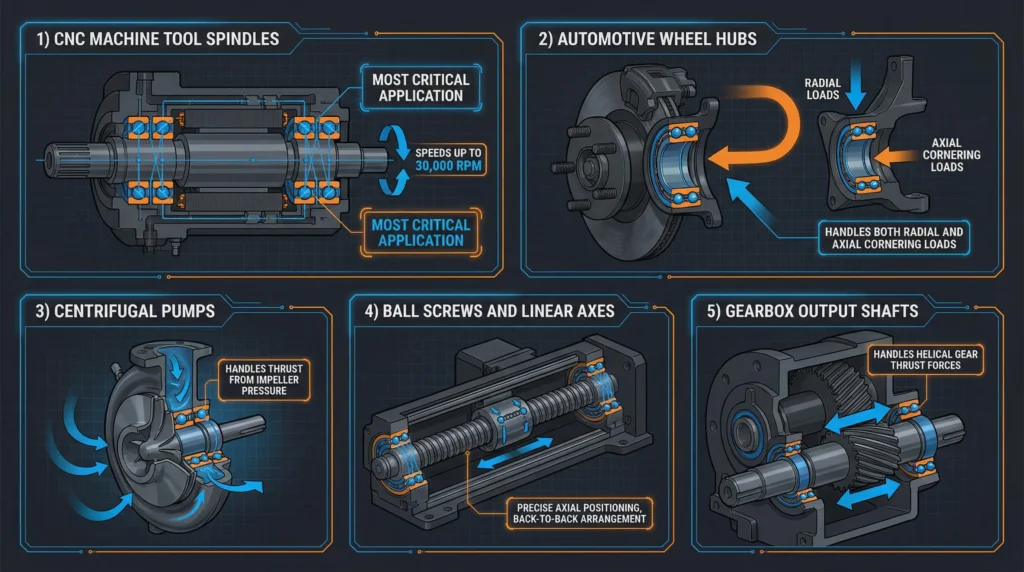
Bearings are used across virtually every major mechanical industry.
Precision bearings are used in various aircraft and aerospace systems where reliability, weight, speed, and temperature performance are critical.
Modern machines are expected to operate faster, longer, and more efficiently than ever before.
Bearings contribute to these goals by providing a controlled mechanical interface between moving components.
Their importance can be summarized through five major benefits:
Lower friction → Lower energy loss → Less heat → Less wear → Longer machine life
This relationship demonstrates why bearing quality and correct selection are essential for industrial productivity.
These are fundamental components of modern mechanical systems. Their core functions include reducing friction, supporting radial and axial loads, maintaining shaft alignment, controlling movement, reducing wear, improving energy efficiency, and enabling smooth and reliable rotation.
Different designs are optimized for different applications. Ball bearings are widely used for general-purpose and high-speed applications, cylindrical roller provide strong radial-load capability, tapered roller bearings handle combined loads, needle bearings offer high load capacity in compact spaces, and spherical roller bearings can accommodate heavy loads and certain misalignment conditions.
However, its performance depends on more than bearing type alone. Proper lubrication, installation, alignment, load management, contamination control, and maintenance are equally important.
Ultimately, selecting the right bearing for the right application can improve machine efficiency, reduce downtime, extend component life, and lower maintenance costs. For industrial equipment, bearings may be small components—but their contribution to overall machine performance is enormous.
The main function of a bearing is to support and guide moving components while reducing friction between them.
The two major loads are radial loads, which act perpendicular to the shaft, and axial or thrust loads, which act parallel to the shaft.
Rolling-element bearings use balls or rollers between surfaces, converting much of the sliding contact into rolling contact and thereby reducing friction.
Bearings support the motor shaft, allow smooth rotation, reduce friction, control shaft position, and help the motor operate efficiently.
Cylindrical roller bearings and spherical roller bearings are commonly selected for high radial-load applications, depending on the specific operating conditions.
Several bearing types can handle combined loads, including tapered roller bearings, angular contact ball bearings, and certain deep-groove and spherical roller bearings.
Lubrication reduces friction and wear, helps control operating temperature, and protects bearing surfaces from damage and corrosion.
Common causes include inadequate lubrication, contamination, overloading, misalignment, improper installation, corrosion, excessive speed, and normal fatigue.
Bearing life can be improved through correct selection, proper lubrication, accurate installation, alignment, contamination protection, suitable loading, and regular maintenance.
Correct bearing selection helps ensure reliable operation, lower friction, longer service life, reduced maintenance, and fewer unexpected machine failures.

Welcome! I am a dedicated entrepreneur running an industrial affiliate product website, helping businesses and professionals find the best tools, equipment, and resources for their needs. With a passion for industrial products and a keen eye for quality, I curate and recommend top-performing items that enhance efficiency and reliability.
Through my platform, I aim to simplify the buying process by providing valuable insights, expert reviews, and trusted affiliate links to high-quality industrial products. Whether you’re looking for the latest machinery, tools, or safety gear, I strive to connect you with the best solutions available.
Thank you for visiting, and I look forward to helping you make informed purchasing decisions!
