Our Location
Killa-Pardi, Dist. Valsad, 396125

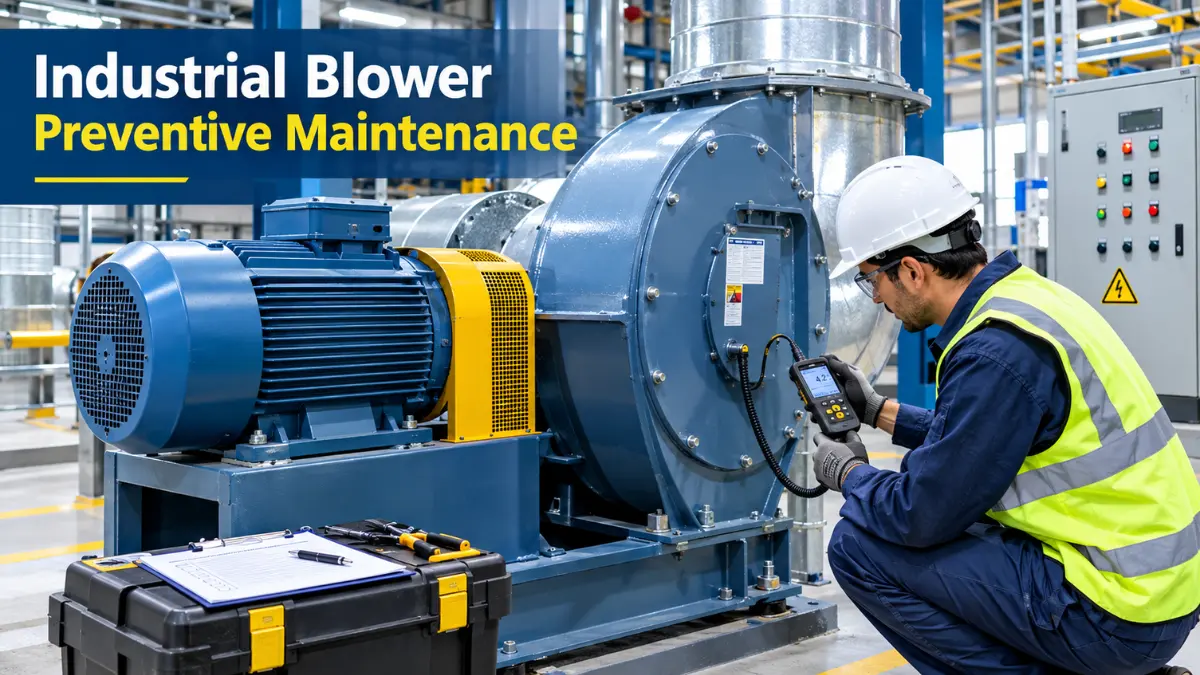
Industrial blowers are important components in manufacturing plants, HVAC systems, dust collection systems, pneumatic conveying, furnace combustion, wastewater treatment, and many other industrial applications. They move air or gas through a system at the required airflow and pressure. However, continuous operation, dust accumulation, bearing wear, incorrect lubrication, belt misalignment, and electrical problems can reduce blower performance. If these problems are not identified early, they may cause unexpected shutdowns, higher electricity costs, and expensive repairs. Industrial blower preventive maintenance is a planned process of inspecting, cleaning, lubricating, testing, and servicing blower equipment before a major failure occurs.
A proper maintenance checklist helps technicians identify warning signs early, improve equipment reliability, and reduce unplanned downtime. It also helps maintenance teams record inspection results and plan repairs more effectively.
This guide explains 15 essential industrial blower maintenance checks, daily and monthly inspection schedules, bearing lubrication, vibration monitoring, temperature checks, filter inspection, and common maintenance mistakes.
Industrial blower preventive maintenance is a scheduled maintenance program designed to keep blower equipment operating safely and efficiently. It includes regular inspection, cleaning, lubrication, adjustment, performance monitoring, and replacement of worn components.
The main objective is to identify developing problems before they cause equipment failure.
For example, a centrifugal blower may develop excessive vibration because of dust buildup on the impeller. If a technician identifies the problem during a routine inspection, the impeller can be cleaned and checked before the vibration damages bearings or other components.
Similarly, a blower operating with a blocked inlet filter may consume more power or deliver less airflow, depending on the system and operating conditions.
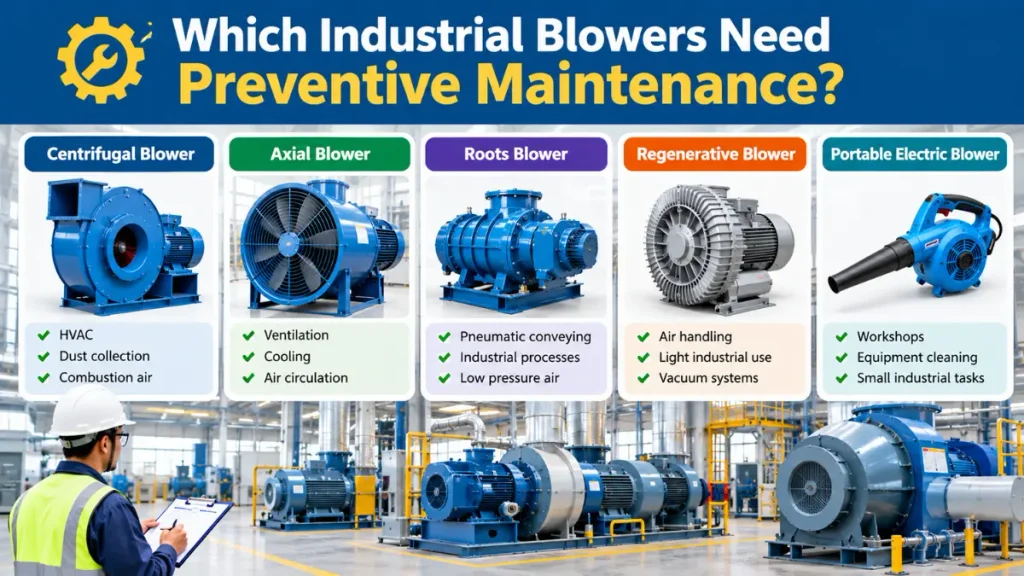
Preventive maintenance applies to several blower types, including:
| Blower Type | Typical Applications | Important Maintenance Checks |
|---|---|---|
| Centrifugal blower | HVAC, dust collection, combustion air | Impeller, bearings, vibration, inlet and outlet |
| Axial blower | Ventilation and cooling | Fan blades, guards, motor, airflow |
| Roots blower | Pneumatic conveying and industrial processes | Timing gears, bearings, lubrication and clearances |
| Regenerative blower | Air handling and light industrial processes | Filters, cooling, inlet restrictions and noise |
| Portable electric blower | Workshops and equipment cleaning | Motor, switch, air passages and power cable |
Maintenance requirements differ by design, operating speed, temperature, dust level, duty cycle, and manufacturer instructions.
Important: Always follow the manufacturer’s operation and maintenance manual. The checklist in this article is a general guide, not a replacement for equipment-specific procedures.
Daily inspection helps operators identify visible problems and changes in normal operating conditions. These checks are especially useful for blowers running continuously in factories. Not every blower requires the same daily inspection tasks. Establish the routine according to the equipment manual, operating conditions, and site maintenance policy.
Listen for unusual sounds during normal operation, from a safe position. Common warning signs include:
Different noises can indicate different problems. For example, scraping may indicate contact between rotating and stationary components, while rattling may be associated with loose hardware.
Do not assume every unusual noise is a bearing problem. Check the source systematically. If a new severe noise develops, stop the equipment when it is safe to do so and follow the site’s shutdown and inspection procedure.
Some vibration is normal, but a significant change from the blower’s established baseline requires investigation. Excessive vibration can result from:
Record vibration measurements at consistent locations and under comparable operating conditions. Use the manufacturer’s vibration limits or applicable engineering standards to evaluate the results. A handheld vibration meter can help technicians identify changes before visible damage occurs.
Inspect the motor, bearing housings, and other designated temperature-monitoring points. Possible causes of excessive temperature include:
Compare readings with the manufacturer’s limits and previous measurements. Do not touch rotating equipment or hot surfaces to estimate temperature. Use an appropriate non-contact thermometer or installed sensor. If temperature rises rapidly or exceeds the permitted limit, follow the equipment shutdown procedure and investigate the cause.
Monitor airflow, static pressure, or differential pressure where instruments are installed.
A reduction in airflow may result from a clogged filter, blocked duct, closed damper, leaking connection, damaged impeller, or an operating condition outside the design range. A pressure change can also result from changes in the connected process. Therefore, compare readings with the normal operating baseline rather than diagnosing the blower using one measurement alone.
Record the following data where available:
For a reliable comparison, use the same measurement method and note any changes in the system.
Inspect the bearing housings, lubricant reservoirs, seals, and nearby surfaces for visible leakage. Leakage may indicate damaged seals, loose fittings, overfilling, or incorrect lubricant application.
Excess lubricant can also contribute to overheating in some bearing arrangements. More grease does not automatically mean better lubrication. Clean the area according to site procedures and investigate repeated leakage. Never ignore a leak simply because the blower is still running.
Daily monitoring is useful for identifying immediate changes, but some problems require more detailed inspection. Weekly and monthly checks can help identify developing mechanical, electrical, and airflow problems.
The actual frequency depends on manufacturer recommendations, operating hours, process conditions, and equipment criticality.
Weekly Maintenance Checks
Air filters and inlet screens help prevent dust and debris from entering the blower or downstream equipment. A dirty filter may restrict airflow and increase system resistance. Depending on the system design, this can reduce delivered airflow or change the operating point.
Inspect for:
Where differential-pressure instruments are available, compare readings with the filter manufacturer’s recommended limits. Clean or replace filters according to the manufacturer’s instructions. Do not use compressed air on filter media unless the manufacturer specifically permits it.
Belt-driven blowers require regular inspection of the belt drive. Look for:
Incorrect tension can reduce power transmission and accelerate belt or bearing wear. Excessive tension can increase radial loads on shafts and bearings. Use the manufacturer’s belt-tension and alignment procedure. Never inspect or adjust a belt while the drive is running. If the blower uses direct drive, this particular belt inspection does not apply.
Loose mounting bolts, damaged base plates, and weakened supports can contribute to vibration and misalignment. Inspect accessible mounting points, structural supports, and approved foundation connections.
Look for:
Tighten fasteners only to the specified torque and procedure. Do not tighten components around operating rotating machinery.
Motors and blower assemblies may depend on unobstructed cooling airflow. Dust buildup around motor cooling fins, ventilation openings, or designated cooling passages can reduce heat dissipation.
Inspect and clean accessible areas according to the equipment manual. Before cleaning, isolate the equipment and prevent unexpected startup. Avoid directing cleaning debris into bearings, electrical enclosures, or other sensitive components.
Monthly Maintenance Checks
Electrical inspection should be carried out by qualified personnel using approved procedures. Important checks may include:
Unexpectedly high motor current may indicate excessive load, mechanical friction, voltage problems, incorrect operating conditions, or a motor fault. Low current is not automatically evidence of good efficiency. It may also indicate reduced load or insufficient airflow.
Do not open energized electrical enclosures or perform electrical testing without the required qualifications and safety controls.
The impeller transfers energy to the moving air or gas. Deposits, erosion, corrosion, or mechanical damage can affect performance. Inspect the impeller at the manufacturer’s recommended interval or when vibration, noise, airflow, or pressure readings indicate a potential problem.
Look for:
Any cleaning or internal inspection must follow the equipment isolation procedure. Never reach into an operating blower. The impeller can continue rotating after power is removed, so verify that all motion has stopped before accessing the equipment.
Monthly maintenance should include a review of operating data and previous inspection records. Compare current readings with historical measurements to identify trends. Useful parameters include:
| Parameter | What to Monitor | Potential Warning Sign |
|---|---|---|
| Vibration | Overall level and frequency patterns | Increasing vibration |
| Temperature | Motor and bearing temperatures | Rising trend or limit exceeded |
| Motor current | Current under comparable load | Unexpected increase or imbalance |
| Airflow | Delivered air volume | Reduced output |
| Pressure | Static or differential pressure | Unexpected change |
| Lubricant condition | Level, contamination and leakage | Deterioration or loss |
| Maintenance history | Faults, repairs and repeat problems | Recurring failures |
A single reading may not explain the cause of a problem. Trends provide more useful evidence when operating conditions are recorded consistently.
Bearings support rotating shafts and help maintain correct alignment. Bearing problems can cause vibration, heat generation, noise, and eventually equipment failure. Correct lubrication is essential, but the required lubricant and service interval depend on bearing design, speed, load, temperature, and manufacturer instructions.
Common Signs of Bearing Problems:
These symptoms can have multiple causes. Confirm the diagnosis before replacing components.
Determine whether the blower uses grease-lubricated bearings, oil-lubricated bearings, sealed bearings, or another arrangement. Different bearing designs have different lubrication requirements. Do not add grease to a sealed bearing unless the manufacturer provides a specific service procedure.
Check the maintenance manual for the specified lubricant type and grade. Important factors may include:
Mixing incompatible greases or oils can damage lubrication performance. Confirm compatibility before changing lubricant brands or formulations.
Lubrication frequency should not be based on guesswork. Some bearings require periodic relubrication, while others are sealed for life or use circulating oil systems. The correct interval may depend on operating hours, temperature, contamination, speed, and bearing size.
Follow the manufacturer’s schedule and adjust only through an approved engineering process.
Applying excessive grease can increase friction and temperature in some bearing arrangements. Use the specified quantity and lubrication method. If automatic lubrication is installed, check its settings and condition according to the manufacturer’s instructions.
Record lubrication dates, lubricant type, quantity, and any unusual observations.
Track vibration and temperature trends. A new increase after lubrication may indicate an incorrect quantity, contamination, an existing bearing defect, or another mechanical issue. Do not assume that adding more lubricant will solve every bearing problem.
Practical recommendation: Maintain a bearing lubrication log for critical industrial blowers. Consistent records help maintenance teams identify recurring problems and evaluate whether the current lubrication schedule is appropriate.
Vibration, noise, and temperature monitoring are useful methods for detecting changes in blower condition. They should be used together with visual inspection, operating data, and the manufacturer’s acceptance limits.
Use an appropriate vibration meter or analyzer at established measurement points. For meaningful comparisons:
For advanced diagnostics, vibration frequency analysis may help identify imbalance, misalignment, bearing defects, looseness, or resonance. However, vibration interpretation requires appropriate training and equipment knowledge.
A change in noise can be an early warning sign.
For example, a new scraping sound may suggest contact between rotating and stationary components. A rattling sound may indicate looseness, while some bearing defects can produce a rough or repetitive sound.
Noise alone cannot confirm a specific fault. If abnormal noise appears together with increased vibration or temperature, prioritize a systematic inspection.
Measure temperature at designated points, such as motor housings and bearing housings. Record the ambient temperature and operating conditions where useful. Compare readings against the manufacturer’s limits rather than using a universal temperature threshold.
Infrared thermometers can help identify surface-temperature changes, but readings may be affected by surface emissivity, distance, and measurement technique.
Consider a blower with the following observations:
| Parameter | Previous Reading | Current Reading |
|---|---|---|
| Bearing temperature | 58°C | 72°C |
| Vibration | 2.0 mm/s RMS | 4.5 mm/s RMS |
| Airflow | 5,000 CFM | 4,700 CFM |
These are illustrative figures, not universal failure limits.
The temperature and vibration have increased, while airflow has decreased. The maintenance team should investigate possible bearing, impeller, drive, filter, or system problems instead of assuming that one component is responsible.
The appropriate response depends on equipment limits, operating conditions, and the severity of the change.
Air filters, impellers, and belt drives are important components in many industrial blower systems. Their maintenance needs differ according to blower design.
A blocked filter increases resistance to airflow. The effect on delivered airflow, pressure, and power depends on the blower type and the complete system.
For example, in a system with a restrictive inlet filter, increasing filter differential pressure may indicate that cleaning or replacement is needed.
Use filter differential pressure and the manufacturer’s replacement criteria rather than relying only on visual appearance. A filter can look relatively clean while still having significant pressure drop, depending on the filter media and type of contamination.
The impeller must remain clean, mechanically sound, and correctly secured. Dust accumulation can create uneven mass distribution, leading to imbalance. Erosion and corrosion can weaken blades and alter the impeller’s aerodynamic performance.
During an inspection, check for:
Do not modify, drill, weld, or balance an impeller without an approved engineering procedure. Improper repairs can create serious rotating-equipment hazards.
Belt-driven blowers need correct belt tension and pulley alignment. A loose belt may slip and reduce power transmission. An excessively tight belt may increase bearing loads. Misalignment can contribute to belt wear and vibration.
Use the manufacturer’s recommended measurement method and alignment tolerances. Replace belts according to the prescribed procedure. If multiple belts operate as a matched set, follow the manufacturer’s replacement requirements.
Direct-drive blowers do not use a belt and pulley arrangement between the motor and blower. For these units, focus on shaft coupling where applicable, mounting condition, alignment, bearings, impeller condition, motor performance, and cooling.
Do not apply belt-drive maintenance procedures to equipment that does not use belts.
A maintenance schedule helps operators and technicians understand which inspections are required and when. The following table provides a general starting point. The final schedule must be adjusted to the manufacturer’s recommendations, operating hours, process environment, and equipment criticality.
| Frequency | Maintenance Task | Responsible Person |
|---|---|---|
| Daily or each operating shift | Check abnormal noise, vibration indications, temperature alarms and visible leakage | Trained operator |
| Daily or each operating shift | Record airflow, pressure or motor readings where required | Operator or technician |
| Weekly | Inspect accessible inlet filters and screens | Maintenance technician |
| Weekly | Inspect belts, guards, supports and visible fasteners | Maintenance technician |
| Weekly | Check cooling passages and visible dust accumulation | Maintenance technician |
| Monthly | Review vibration, temperature and current trends | Maintenance technician |
| Monthly | Inspect electrical condition using approved procedures | Qualified electrical personnel |
| Monthly | Review filter differential pressure and operating performance | Maintenance team |
| At manufacturer-defined intervals | Lubricate bearings where applicable | Trained maintenance personnel |
| At manufacturer-defined intervals | Inspect impeller, shaft, coupling and internal clearances | Qualified maintenance personnel |
| During planned shutdowns | Complete detailed mechanical inspection and approved repairs | Qualified maintenance team |
| Annually, or as specified | Review the maintenance program, history and equipment condition | Maintenance engineer |
Important: Weekly, monthly, and annual intervals above are suggested planning categories, not mandatory intervals for every blower. High-speed, high-temperature, dusty, or critical-duty equipment may need more frequent inspection.
Record each inspection in a maintenance log or computerized maintenance management system (CMMS).
Include:
This information helps the maintenance team identify repeated failures, plan spare parts, and evaluate equipment reliability over time.
Preventive maintenance is effective only when inspections are performed correctly and findings are acted upon.
A gradual vibration increase can indicate a developing mechanical problem.
Better practice: Establish baseline readings, track trends, and investigate significant changes.
An unsuitable lubricant can reduce bearing protection and contribute to overheating or premature wear.
Better practice: Follow the specified lubricant grade and verify compatibility before changing products.
Excess grease can cause heating and other lubrication problems in some bearing arrangements.
Better practice: Use the manufacturer’s specified quantity and interval.
A restricted filter can increase system resistance and reduce delivered airflow.
Better practice: Monitor filter condition and differential pressure where available.
Rotating belts and pulleys create serious entanglement hazards.
Better practice: Stop and isolate the equipment, prevent unexpected startup, and verify zero motion before inspection.
A rising temperature may indicate lubrication problems, mechanical friction, electrical issues, or cooling restrictions.
Better practice: Compare measurements with established baselines and equipment limits.
A replacement bearing may fail again if misalignment, contamination, incorrect lubrication, or excessive loading remains unresolved.
Better practice: Investigate the failure mechanism before returning the equipment to service.
Not all blowers operate under the same conditions.
Better practice: Develop the schedule using the manufacturer’s manual, duty cycle, operating environment, and equipment history.
A blower can continue running while its performance deteriorates.
Better practice: Record airflow, pressure, current, temperature, and vibration where appropriate.
Unexpected startup or stored energy can cause serious injuries.
Better practice: Follow the site’s lockout/tagout (LOTO) procedure, isolate electrical and other energy sources, wait for rotating parts to stop, and verify a safe condition before work begins.
Preventive and reactive maintenance are different approaches to equipment care.
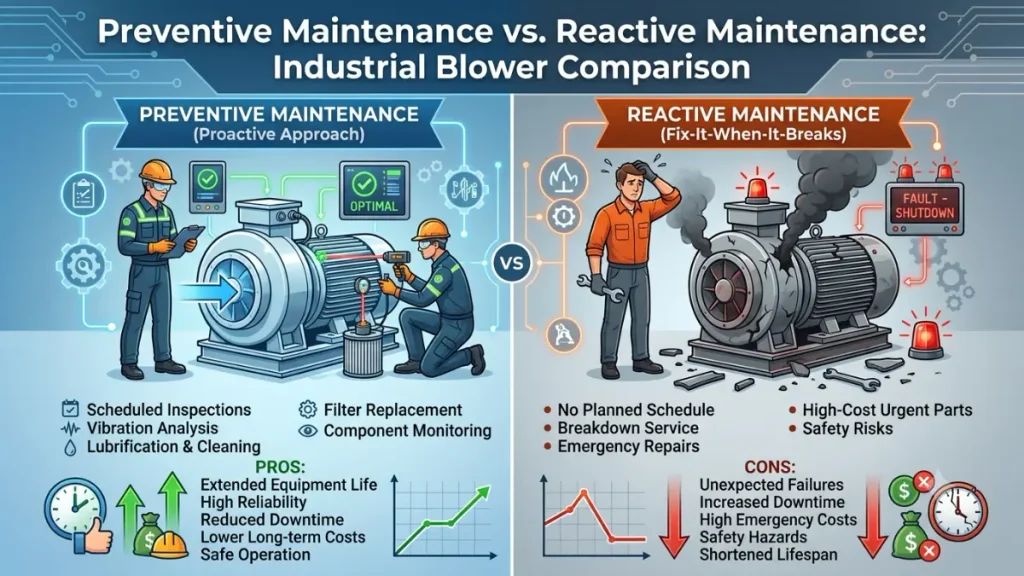
Preventive maintenance involves planned inspections and servicing intended to reduce the likelihood of failure. Reactive maintenance involves responding after a fault or breakdown has occurred.
| Comparison | Preventive Maintenance | Reactive Maintenance |
|---|---|---|
| Timing | Planned before failure | After a fault occurs |
| Inspection | Scheduled and documented | Often triggered by a problem |
| Downtime planning | Can be arranged around production | May be unexpected |
| Repair planning | Parts and labor can be prepared | Parts may be urgently required |
| Equipment monitoring | Uses regular checks and trends | Often relies on failure symptoms |
| Cost management | Supports planned maintenance budgets | Can involve emergency repair costs |
| Best application | Critical or frequently used equipment | Some low-criticality, nonessential equipment |
Condition-based maintenance uses equipment-condition data to determine when inspection or intervention is required. For example, a maintenance team may use increasing vibration or bearing temperature to trigger an inspection.
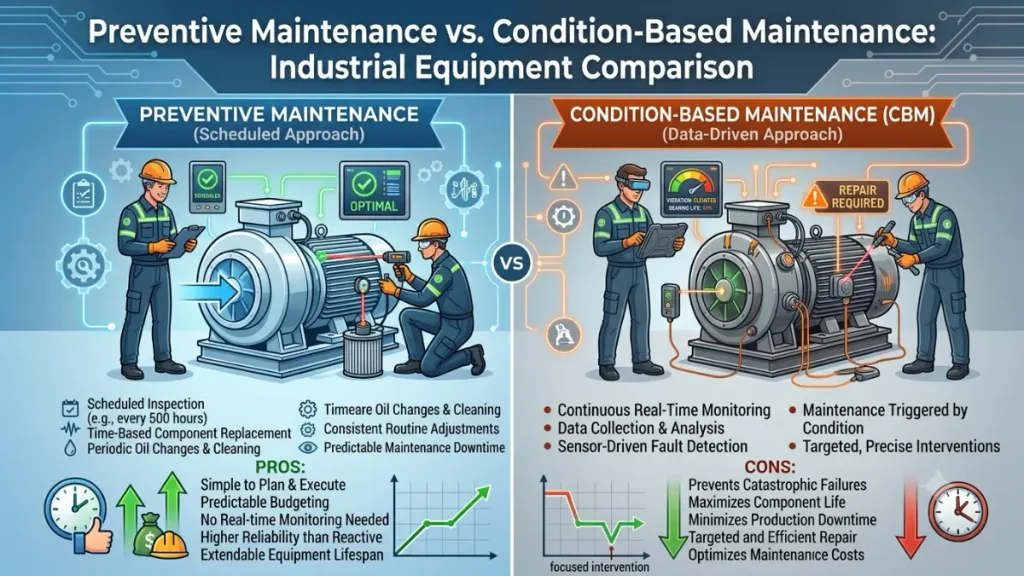
Preventive maintenance uses scheduled intervals, while condition-based maintenance responds to measured equipment condition. Both approaches can complement each other.
For critical industrial blowers, a combination of scheduled inspection and condition monitoring may provide a more useful maintenance strategy than relying only on fixed intervals.
Factories can improve blower reliability by following these practices:
The goal is not to eliminate every maintenance expense. It is to manage equipment risk and avoid preventable failures.
Industrial blower preventive maintenance is an important part of reliable factory operation. Regular inspection of vibration, noise, temperature, airflow, filters, impellers, belts, bearings, and electrical performance can help maintenance teams identify problems early.
The most effective approach combines a clear checklist, equipment-specific maintenance intervals, accurate inspection records, trained personnel, and proper safety procedures. For best results, use the manufacturer’s manual as the primary reference and adapt the checklist to your blower type, duty cycle, and operating environment.
Key takeaway: Inspect regularly, record changes, investigate abnormal conditions, and correct the underlying cause rather than waiting for a major breakdown.
Industrial blower preventive maintenance is a planned process of inspecting, cleaning, lubricating, and servicing blower equipment to identify developing problems and reduce unexpected failures.
The service interval depends on the blower design, operating hours, environment, and manufacturer’s instructions. Operators may perform basic checks each shift, while detailed inspections follow the equipment-specific maintenance schedule.
A checklist may include noise, vibration, temperature, airflow, pressure, lubrication, filters, belts, impeller condition, mounting hardware, electrical checks, and maintenance records.
Possible causes include impeller imbalance, shaft misalignment, loose mounting hardware, bearing damage, deposits, and structural resonance. Proper measurements and inspection are needed to determine the actual cause.
Warning signs can include increasing vibration, unusual noise, elevated temperature, lubricant leakage, and changes in shaft movement. These symptoms are not conclusive by themselves and should be investigated.
Follow the bearing or blower manufacturer’s recommendations. The correct interval depends on bearing type, speed, load, temperature, lubricant, and operating environment.
Yes. Excess grease can increase friction and temperature in some bearing arrangements. Apply only the specified lubricant quantity using the recommended method.
Potential causes include clogged filters, blocked ducts, closed dampers, leakage, impeller deposits, damaged components, or changes in system resistance. Check operating conditions and measurements before deciding on a repair.
Possible causes include incorrect lubrication, bearing problems, restricted cooling, electrical faults, excessive load, or unsuitable operating conditions. Compare temperature readings with manufacturer limits and investigate the underlying cause.
Preventive maintenance uses planned inspections and servicing before a failure occurs. Reactive maintenance addresses equipment problems after they develop or cause a breakdown.
No. Belt inspection applies to belt-driven blowers. Direct-drive units require other checks, such as alignment where applicable, coupling condition, bearings, impeller condition, and mounting integrity.
Differential pressure can help indicate filter restriction. An increasing reading may suggest that the filter needs cleaning or replacement according to the manufacturer’s limits.
Depending on the application, technicians may use vibration meters, infrared thermometers, pressure gauges, differential-pressure gauges, airflow instruments, electrical meters, and alignment tools.
Internal cleaning or maintenance should not be performed on operating rotating equipment. Follow site isolation procedures, prevent unexpected startup, and verify that all motion has stopped before accessing internal components.
Routine inspections can identify developing problems, support planned repairs, improve spare-parts planning, and reduce the risk of unexpected equipment failures. Results depend on the quality of the maintenance program and the operating conditions.

Welcome! I am a dedicated entrepreneur running an industrial affiliate product website, helping businesses and professionals find the best tools, equipment, and resources for their needs. With a passion for industrial products and a keen eye for quality, I curate and recommend top-performing items that enhance efficiency and reliability.
Through my platform, I aim to simplify the buying process by providing valuable insights, expert reviews, and trusted affiliate links to high-quality industrial products. Whether you’re looking for the latest machinery, tools, or safety gear, I strive to connect you with the best solutions available.
Thank you for visiting, and I look forward to helping you make informed purchasing decisions!
