Our Location
Killa-Pardi, Dist. Valsad, 396125

How to read bearing number is an important skill for engineers, maintenance technicians, machine operators, and industrial buyers. A bearing number is not just a random combination of numbers and letters. It usually contains information about the bearing series, bore size, seal or shield type, internal clearance, and other design features.
For example, a bearing marked 6205-2RS-C3 can tell you several important things about the bearing before you even open its packaging. However, bearing numbering systems are not completely universal: the exact meaning of suffixes and prefixes can vary between manufacturers. Therefore, the manufacturer’s catalogue should always be used for final identification.
In this guide, we will explain bearing numbers step by step, using practical examples, bearing size data, common codes, and selection tips.
A bearing number is an identification code assigned to a rolling bearing. It helps identify the bearing’s basic design and, depending on the manufacturer, additional features such as:
A typical bearing designation may look like: 6205-2RS-C3
Correctly identifying a bearing can prevent costly installation and maintenance mistakes.
If you replace a bearing with the wrong:
the machine may experience excessive heat, vibration, noise, premature wear, or even bearing failure.
For example : Two bearings can have the same bore diameter but completely different outside diameters and widths. They may therefore not be interchangeable.
Understanding bearing numbers helps you:
A bearing designation generally consists of: Prefix + Basic Designation + Suffix
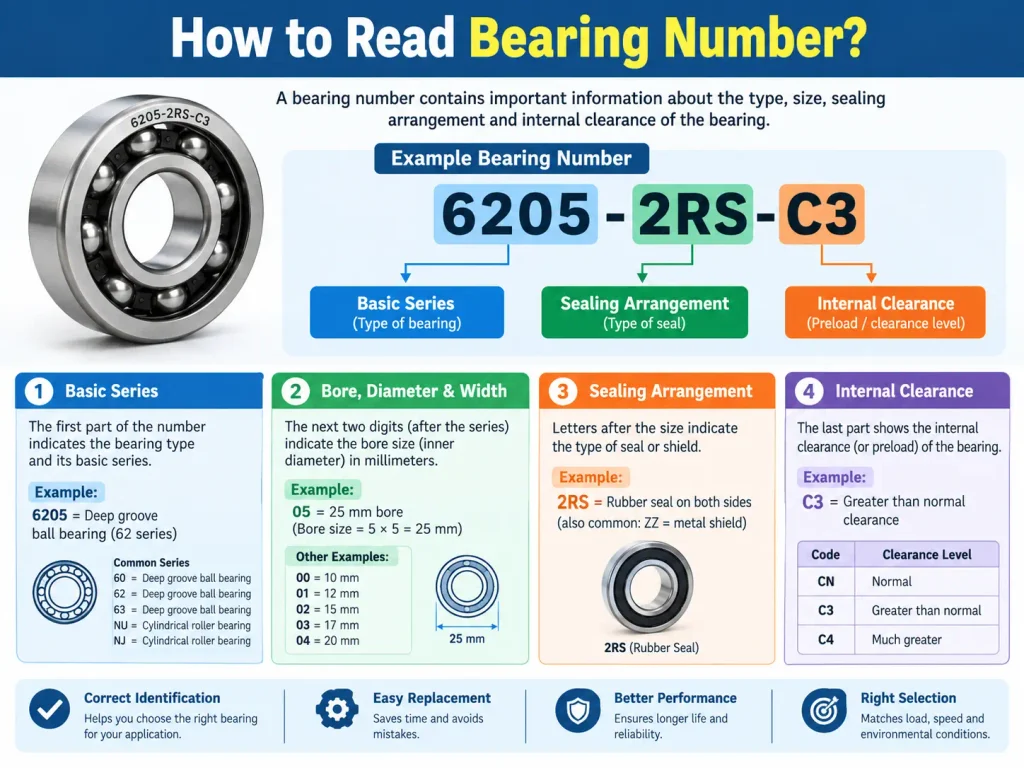
For example: 6205-2RS-C3
Here:
However, this should be treated as a simplified interpretation rather than a universal decoding rule.
Let’s break down the popular example:
1. “6” – Bearing Type / Series Family
Typical applications include:
2. “2” – Dimension Series
3. “05” – Bore Code
This is one of the most useful bearing-number rules.
Here is a useful basic reference:
| Bore Code | Bore Diameter |
|---|---|
| 00 | 10 mm |
| 01 | 12 mm |
| 02 | 15 mm |
| 03 | 17 mm |
| 04 | 20 mm |
| 05 | 25 mm |
| 06 | 30 mm |
| 07 | 35 mm |
| 08 | 40 mm |
| 09 | 45 mm |
| 10 | 50 mm |
| 11 | 55 mm |
| 12 | 60 mm |
| 13 | 65 mm |
| 14 | 70 mm |
| 15 | 75 mm |
| 16 | 80 mm |
For bore codes 04 and above, the common calculation is: Bore diameter = code × 5 mm
For example:
Codes 00, 01, 02 and 03 do not follow the ×5 rule.
They correspond to:
Always verify the manufacturer’s dimensional table before ordering.
In many bearing catalogues, 2RS indicates a bearing with two rubber contact seals, one on each side.
For example: 6205-2RS
generally means:
Rubber seals help protect the bearing from contaminants and help retain lubricant.
They are particularly useful in environments where bearings may encounter:
However, the exact seal designation can vary by manufacturer.
ZZ is commonly used to indicate a bearing with metal shields on both sides.
For example: 6205-ZZ
generally indicates:
A shielded bearing and a sealed bearing are not exactly the same.
| Feature | 2RS | ZZ |
| Protection | Rubber seals | Metal shields |
| Contact | Generally contacting seal | Non-contact/close metal shield arrangement |
| Contaminant protection | Generally better | Generally lower than a contact seal in dirty environments |
| Friction | Usually somewhat higher | Usually lower |
| Typical use | Dust/moisture environments | Cleaner, higher-speed applications |
The exact performance depends on bearing design and manufacturer specifications.
C3 means the bearing has greater-than-normal internal radial clearance. It is commonly used in applications involving higher operating temperatures, higher speeds, or thermal expansion, where standard clearance may be insufficient.
For example: 6205-2RS-C3
means the bearing has a C3 internal clearance specification in addition to its basic designation and seal arrangement.
Internal clearance is the total amount of movement possible between the bearing’s rings and rolling elements before the bearing is installed and operating.
Why is clearance important?
Because bearing operating temperature, shaft and housing fits, speed, load, and thermal expansion can affect the final operating clearance.
C3 clearance is commonly selected in applications where additional clearance is required due to operating conditions, but it should not be selected simply because “C3 is better.”
The correct clearance depends on the application.
A simplified comparison is:
| Clearance | Meaning |
| C2 | Less than normal clearance |
| CN / Normal | Normal clearance |
| C3 | Greater than normal |
| C4 | Greater than C3 |
| C5 | Greater than C4 |
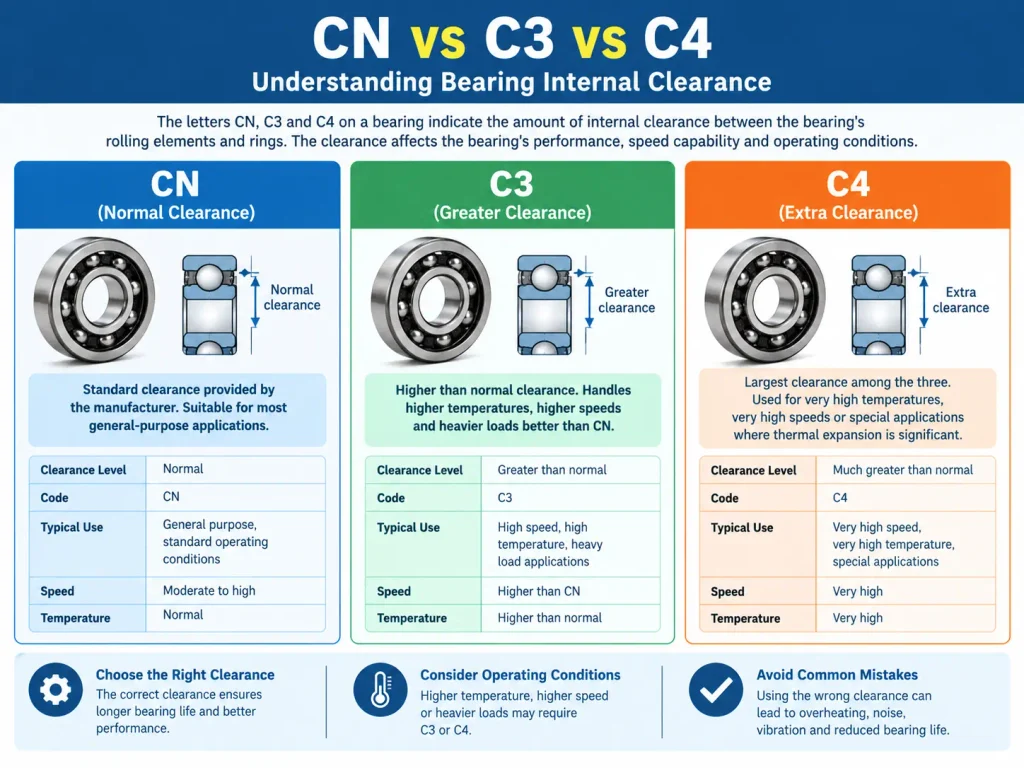
The correct choice depends on:
Using excessive clearance can be just as undesirable as using insufficient clearance.
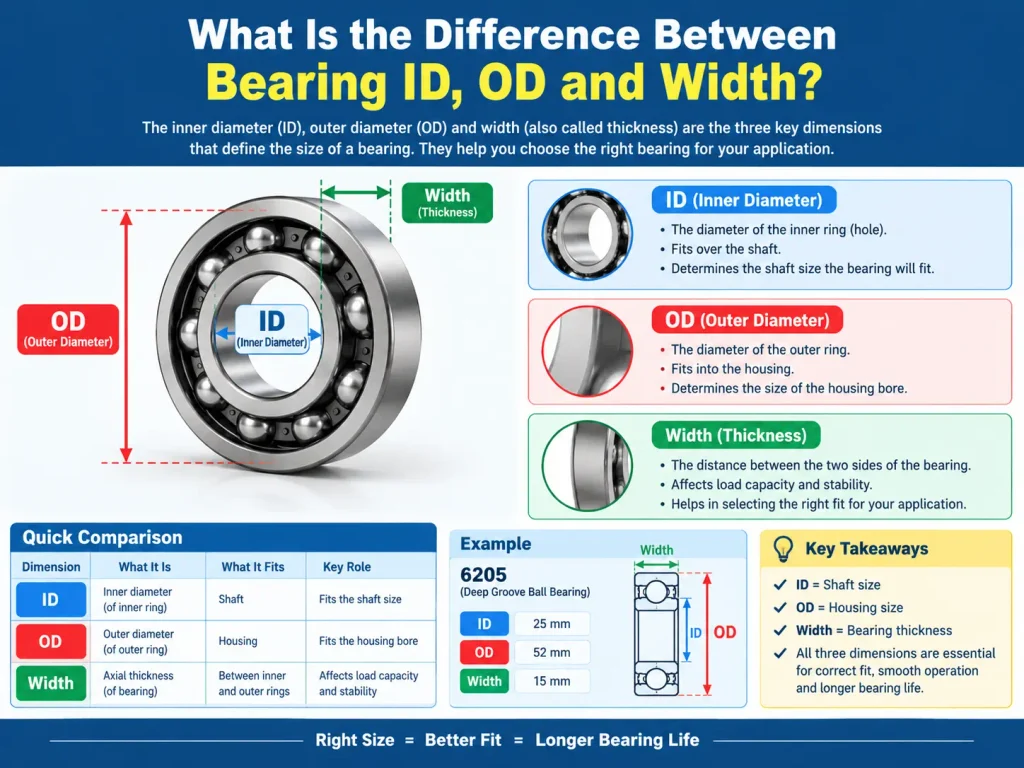
When reading bearing specifications, three dimensions are especially important:
ID – Inner Diameter
OD – Outside Diameter
Width
Always confirm dimensions against the specific manufacturer’s catalogue.
Some commonly encountered deep groove ball bearings include:
| Bearing Number | Bore Code | ID (mm) | OD (mm) | Width (mm) |
|---|---|---|---|---|
| 6000 | 00 | 10 | 26 | 8 |
| 6001 | 01 | 12 | 28 | 8 |
| 6002 | 02 | 15 | 32 | 9 |
| 6003 | 03 | 17 | 35 | 10 |
| 6004 | 04 | 20 | 42 | 12 |
| 6005 | 05 | 25 | 47 | 12 |
| 6006 | 06 | 30 | 55 | 13 |
| 6007 | 07 | 35 | 62 | 14 |
| 6008 | 08 | 40 | 68 | 15 |
| 6200 | 00 | 10 | 30 | 9 |
| 6201 | 01 | 12 | 32 | 10 |
| 6202 | 02 | 15 | 35 | 11 |
| 6203 | 03 | 17 | 40 | 12 |
| 6204 | 04 | 20 | 47 | 14 |
| 6205 | 05 | 25 | 52 | 15 |
| 6206 | 06 | 30 | 62 | 16 |
| 6207 | 07 | 35 | 72 | 17 |
| 6208 | 08 | 40 | 80 | 18 |
| 6209 | 09 | 45 | 85 | 19 |
| 6210 | 10 | 50 | 90 | 20 |
| 6211 | 11 | 55 | 100 | 21 |
| 6212 | 12 | 60 | 110 | 22 |
| 6304 | 04 | 20 | 52 | 15 |
| 6305 | 05 | 25 | 62 | 17 |
| 6306 | 06 | 30 | 72 | 19 |
| 6307 | 07 | 35 | 80 | 21 |
| 6308 | 08 | 40 | 90 | 23 |
| 6309 | 09 | 45 | 100 | 25 |
| 6310 | 10 | 50 | 110 | 27 |
| 6311 | 11 | 55 | 120 | 29 |
| 6312 | 12 | 60 | 130 | 31 |
These are commonly published standard dimensions, but product specifications should always be checked before purchase because designation details can differ across bearing types and manufacturers.
Bearing numbers contain important information about the bearing type, series, bore size, seals and internal clearance. By understanding each part of the designation, you can identify the correct bearing quickly and avoid costly selection mistakes.
Let’s decode the complete example.
Step 1: Identify the basic bearing
Step 2: Identify the dimension series
Step 3: Calculate bore
Step 4: Identify sealing
Step 5: Identify clearance
C3 → greater-than-normal internal clearance. Therefore, the designation provides a useful initial description of the bearing. But for final selection, you should still verify:
Here:
Bore: 06 × 5 = 30 mm
Notice that changing the series from 62 to 63 can change the bearing’s outside diameter, width, load capacity and other characteristics.
Therefore: Never select a bearing based only on bore diameter.
Not every bearing designation starts directly with the basic bearing number. Manufacturers may use prefixes and suffixes to describe special features.
A prefix can identify:
Suffixes can identify:
Common designations that buyers encounter include: 2RS, ZZ, C3, C4, P6, P5, NR, N
However, these codes are not universally identical across every brand. For example, one manufacturer’s suffix may differ from another manufacturer’s suffix.
One of the biggest mistakes is assuming that every manufacturer uses exactly the same designation system.
The basic designation may follow international conventions, while suffixes and special designations can be manufacturer-specific.
Therefore: Bearing number decoding should be treated as a first identification step—not a substitute for the manufacturer’s catalogue.
If you are buying a replacement bearing, verify the manufacturer’s:
Use this simple process whenever you find an unfamiliar bearing.
Step 1: Write Down the Complete Bearing Number
Step 2: Identify the Basic Bearing Type
Look at the main designation and determine whether it is:
Step 3: Identify the Bore Code
Step 4: Check the Bearing Dimensions
Step 5: Check Seals or Shields
Look for designations such as:
Verify the exact meaning with the manufacturer’s catalogue.
Step 6: Check Internal Clearance
Look for:
Choose based on operating conditions rather than automatically selecting C3.
Step 7: Check Load Ratings
Look for:
These values are important for bearing selection and life calculations.
Step 8: Check Speed
Step 9: Check Operating Environment
Consider:
These factors influence the appropriate bearing design.
Step 10: Verify the Manufacturer’s Catalogue
No. A bearing number identifies a particular bearing design and configuration, while bearing size refers to its physical dimensions.
For example: 6205
Therefore:
You need both identification and dimensions when selecting a replacement.
Sometimes, yes. If the bearing number is unreadable, you can measure:
Then compare these measurements against a bearing catalogue.
For example : suppose you measure approximately:
25 mm ID × 52 mm OD × 15 mm width
A common matching bearing designation is: 6205
But dimensions alone may not identify:
Therefore, physical measurements are useful for narrowing down the bearing, but the complete specification should still be verified.
Mistake 1: Assuming the last two digits always mean the same thing
Mistake 2: Ignoring suffixes
Mistake 3: Assuming C3 is always better
Mistake 4: Choosing only by ID
Mistake 5: Ignoring operating conditions
Mistake 6: Assuming all brands use identical codes
Learning how to read bearing numbers makes bearing identification, replacement and selection much easier. Learning how to read bearing numbers makes identification and replacement much easier.
A designation like 6205-2RS-C3 can indicate the bearing series, bore size, seals and internal clearance. For example, 05 usually represents a 25 mm bore in standard metric bearings, while 2RS indicates rubber seals and C3 indicates greater-than-normal internal clearance. However, always verify ID, OD, width, load ratings, speed and suffixes with the manufacturer’s catalogue before selecting a replacement.
The safest approach is simple:
Read the complete bearing number → decode the basic designation → check ID/OD/width → verify suffixes → check load and speed → confirm the manufacturer’s catalogue.
Once you understand this process, identifying common bearings becomes significantly easier and you can make more confident bearing selection decisions for industrial machinery, motors, pumps, conveyors and other rotating equipment.
A bearing number identifies the bearing’s basic design and, depending on the manufacturer, can also indicate dimensions, seals, shields, clearance, precision, or other features.
A commonly used interpretation is that 6205 identifies a single-row deep groove ball bearing, with 05 indicating a nominal 25 mm bore.
In many manufacturers’ systems, 6205-2RS indicates a 6205 bearing with two rubber contact seals. Confirm the exact designation with the manufacturer’s catalogue.
C3 generally means greater-than-normal internal clearance.
ZZ commonly indicates metal shields on both sides.
For many standard metric bearing codes from 04 onward:
Bore diameter = bore code × 5 mm
For example:
6206 → 06 × 5 = 30 mm
A standard 6205 bearing has a nominal bore of 25 mm.
2RS commonly uses rubber seals, while ZZ commonly uses metal shields. Their protection, friction and suitability depend on the exact bearing design and application.
Not necessarily. C3 is simply a higher internal-clearance class than normal. The correct clearance depends on operating conditions.
No. The replacement must match the required ID, OD, width, load capacity, speed, clearance, sealing and application requirements.
Measure the bearing’s ID, OD and width, then compare the measurements with a manufacturer’s catalogue. You should also inspect the bearing for remaining markings.
Basic designation conventions are widely standardized, but manufacturer-specific prefixes and suffixes can differ. Always verify the complete designation with the relevant manufacturer.

Welcome! I am a dedicated entrepreneur running an industrial affiliate product website, helping businesses and professionals find the best tools, equipment, and resources for their needs. With a passion for industrial products and a keen eye for quality, I curate and recommend top-performing items that enhance efficiency and reliability.
Through my platform, I aim to simplify the buying process by providing valuable insights, expert reviews, and trusted affiliate links to high-quality industrial products. Whether you’re looking for the latest machinery, tools, or safety gear, I strive to connect you with the best solutions available.
Thank you for visiting, and I look forward to helping you make informed purchasing decisions!
