Our Location
Killa-Pardi, Dist. Valsad, 396125

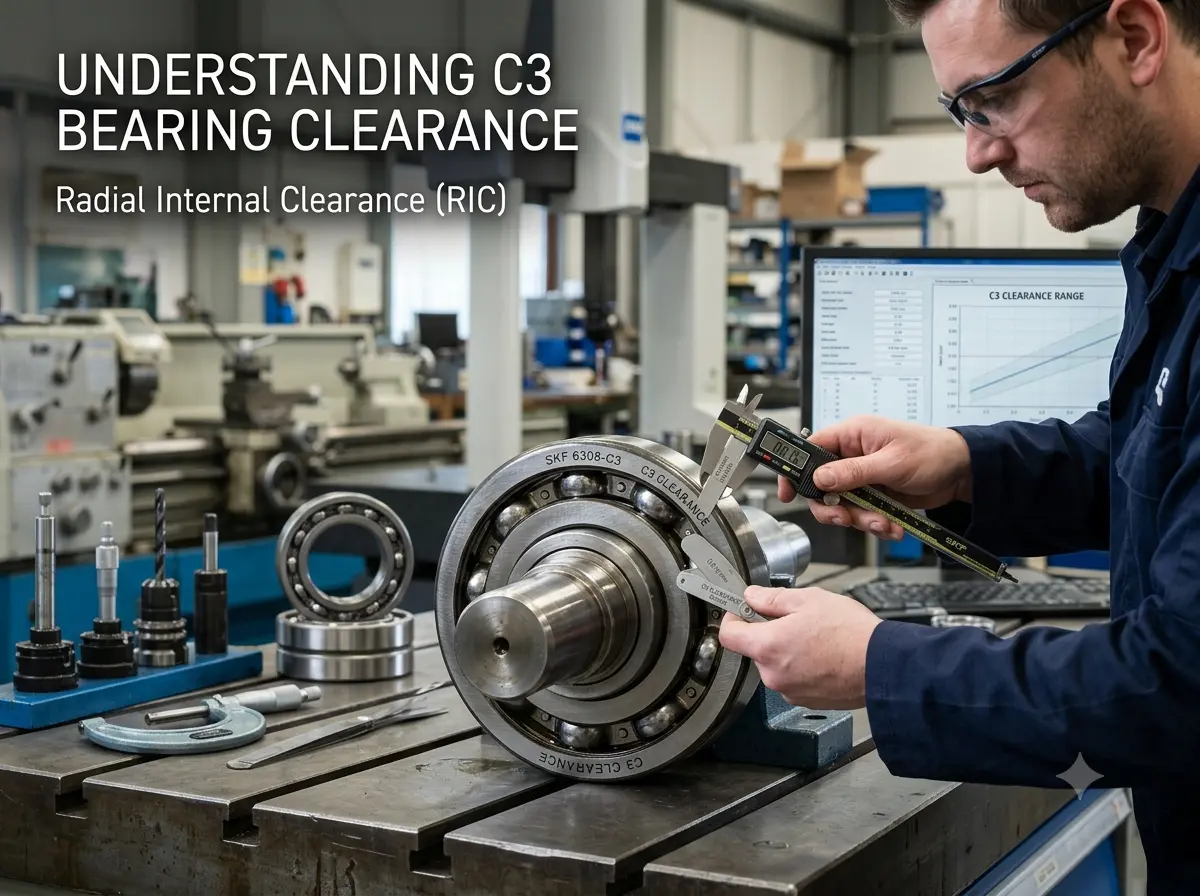
You may have seen designations such as 6205 C3, 6205 CN, 6205 C4, 6306-2RS C3 or similar markings on bearings. But what does C3 actually mean? Is a C3 bearing better than a normal bearing? What is the difference between CN Bearing Clearance and C3 Bearing Clearance? Is C4 better than C3? When should you use C3 bearing clearance?
Bearing selection is not only about choosing the correct bearing size, load rating or brand. Internal clearance is also an important factor that can directly affect bearing temperature, noise, vibration, lubrication and service life.
These are common questions when selecting replacement bearings for motors, pumps, fans, conveyors, gearboxes, agricultural machinery and industrial equipment.
In this guide, we will explain bearing internal clearance, C3 bearing clearance, CN bearing clearance and C4 bearing clearance, their differences, applications, advantages and how to select the correct clearance for your application.
Bearing internal clearance is the total amount of movement possible between the bearing’s inner ring and outer ring before the bearing is installed and operating under normal conditions.
In simple words, it is the small amount of space between the rolling elements and raceways.
Internal clearance is necessary because a bearing can experience:
Without appropriate internal clearance, the bearing may operate with excessive preload after installation and heating.
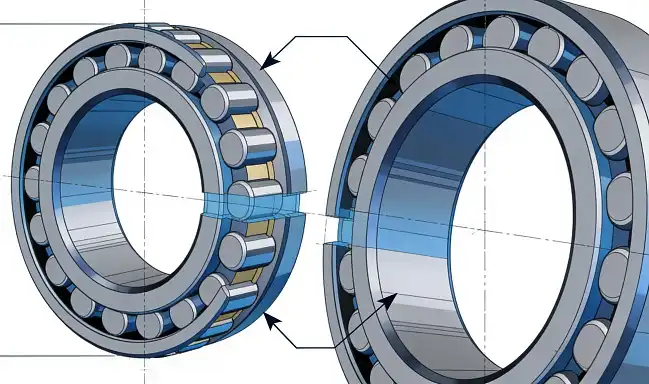
Correct bearing clearance helps maintain:
However, more clearance is not automatically better. Excessive clearance can increase vibration, noise and uneven load distribution.
C3 means that the bearing has greater internal radial clearance than the normal CN clearance range.
For example, a bearing marked:
6205 C3
has the same basic bearing size as a standard 6205 bearing, but its internal radial clearance is higher than the normal clearance class.
This additional clearance can compensate for operating conditions where the bearing becomes hotter or where an interference fit reduces the effective internal clearance.
C3 does not mean:
C3 specifically refers to the internal clearance class.
CN, sometimes called Normal Clearance, represents the standard internal radial clearance range for a bearing.
A bearing without a clearance suffix is often supplied with normal clearance, depending on the manufacturer’s designation system.
For many ordinary applications with normal operating temperatures and fits, CN clearance can be appropriate.
Typical applications can include:
But the correct clearance always depends on the actual application and manufacturer’s specifications.
C4 clearance is greater than C3 clearance.
The general relationship is:
CN < C3 < C4
In other words:
C4 may be selected for applications involving particularly high operating temperatures, heavy interference fits or other conditions where greater internal clearance is required.
However, using C4 simply because it has “more clearance” is not recommended.
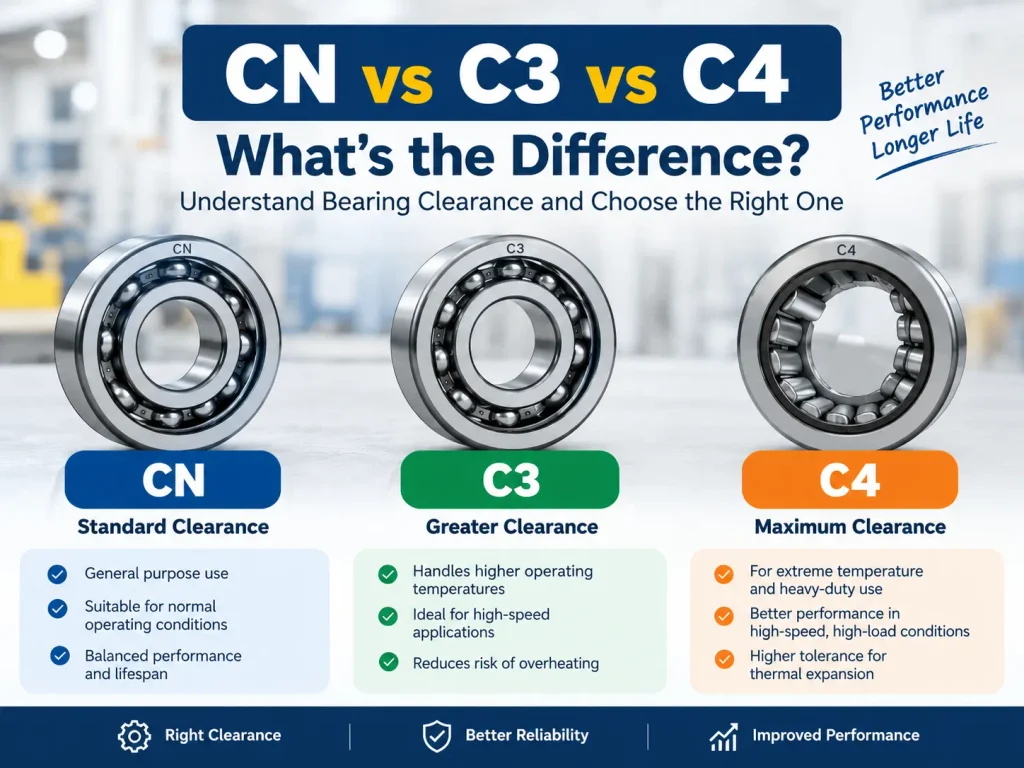
The easiest way to understand the three classes is:
| Clearance Class | Relative Internal Clearance | Typical Use |
|---|---|---|
| CN | Normal | General applications |
| C3 | Greater than CN | Higher temperature/interference-fit applications |
| C4 | Greater than C3 | More demanding thermal/fit conditions |
The exact clearance values depend on the bearing type, bore size and applicable standard/manufacturer specification.
Therefore, you should not assume that every C3 bearing has the same numerical clearance.
There is no universal answer.
C3 is not inherently better than CN. The correct clearance is the one that produces the required operating condition after considering load, speed, temperature, fits and mounting.
Therefore, don’t replace every CN bearing with C3 simply because C3 is commonly used in electric motors.
C4 provides more internal clearance than C3.
But more clearance does not automatically mean longer bearing life.
C3 can be appropriate for many applications where increased clearance is required.
C4 may be considered when operating conditions create greater reduction in effective clearance.
The choice should be based on:
One of the most frequently searched questions is:
“Why are C3 bearings used in motors?”
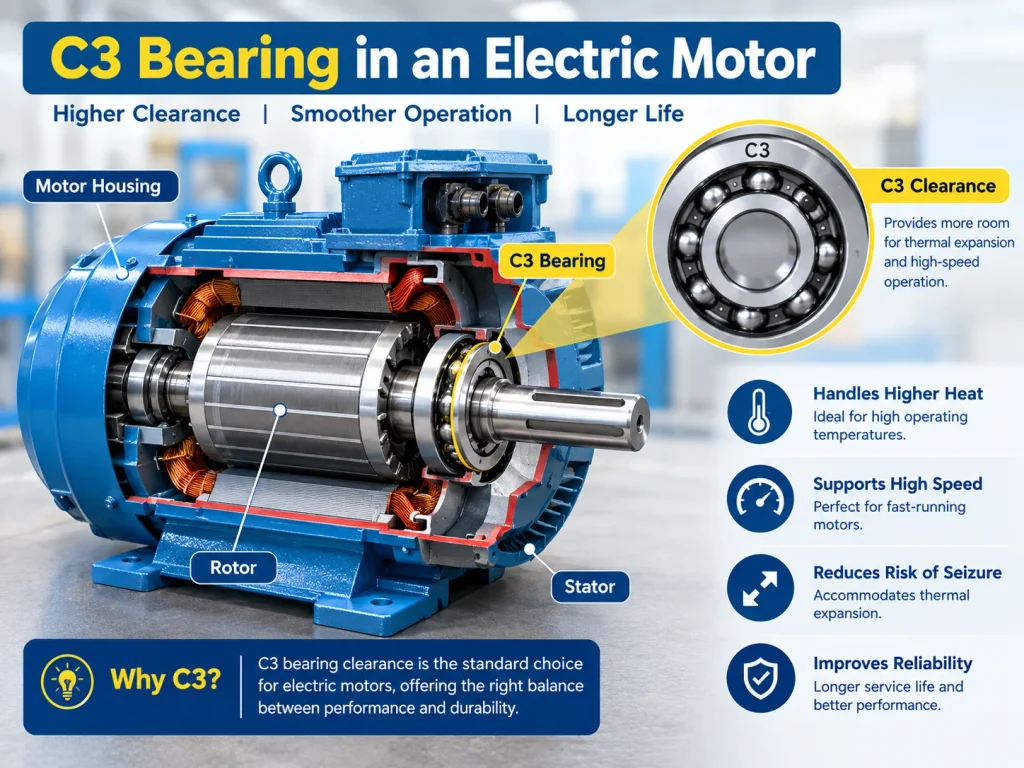
Electric motors can generate heat during operation. The shaft, bearing rings and surrounding components can expand as temperature increases.
An interference fit between the shaft and inner ring can also reduce the bearing’s initial internal clearance.
A C3 bearing provides additional internal clearance that can help accommodate these effects.
However, not every motor requires C3 clearance. The motor manufacturer’s specification should be followed.
Common motor applications where C3 bearings may be specified include:
Not exactly.
A C3 bearing does not itself mean that the bearing is a high-temperature bearing.
C3 describes internal clearance.
A bearing’s temperature capability also depends on factors such as:
Therefore, don’t confuse C3 clearance with high-temperature bearing construction.
C3 clearance can improve bearing performance when it is correctly matched to the application.
For example, if operating temperature and interference fits reduce the clearance excessively, an appropriate C3 bearing may prevent excessive operating preload.
But if a machine actually requires CN clearance and you install C3 unnecessarily, the additional clearance may increase:
So the answer is:
C3 can improve bearing life when the application requires C3 clearance, but C3 does not automatically increase bearing life.
Bearing clearance influences the operating condition of rolling elements and raceways.
If effective clearance becomes too small, the bearing can develop excessive preload. This can increase:
On the other hand, excessive clearance can increase internal movement and produce unfavorable load distribution.
The goal is therefore not maximum clearance but correct operating clearance.
Bearing fits are an important reason why internal clearance needs to be considered.
For example, if the inner ring is mounted tightly onto a shaft, the inner ring may expand slightly. This can reduce the bearing’s initial internal clearance.
Similarly, housing fits can influence the outer ring.
Therefore, bearing selection should consider both:
Initial internal clearance + mounting conditions + operating temperature
rather than looking at the C3 designation alone.
When searching for C3 bearing clearance for electric motor, users often encounter bearings such as:
These bearings can be found in different motor and machinery applications.
However, the correct bearing must match the original specification, including:
Bearing number + clearance + seal/shield + lubrication + dimensions
For example:
6205-2RS-C3
can indicate:
Designation systems vary between manufacturers, so always verify the manufacturer’s catalog.
A common question is:
“What is the difference between C3 bearing and normal bearing?”
The major difference is internal radial clearance.
A normal-clearance bearing generally has CN/normal clearance, while a C3 bearing has a greater internal clearance range.
The external dimensions can remain exactly the same.
For example, a 6205 CN and 6205 C3 can have the same:
But their internal clearance differs.
Sometimes, but not automatically.
A replacement should match the original equipment specification.
If the original machine specifies C3 and you install CN, operating clearance may become insufficient under operating conditions.
If the original machine specifies CN and you install C3, excessive internal clearance may affect vibration and performance.
Before changing clearance class, check:
Generally, you should not substitute C4 for C3 without checking the application requirements.
C4 has more internal clearance than C3.
If the machine was designed around C3, moving to C4 can create excessive internal movement and potentially affect:
Always follow the equipment or bearing manufacturer’s specification.
Use this basic selection process.
| Step 1: Identify the Bearing | Find the complete bearing designation. Example: 6205-2RS-C3 Don’t select clearance independently from the rest of the designation. |
| Step 2: Check the Operating Temperature | Determine the expected bearing operating temperature. Higher temperatures can increase thermal expansion. |
| Step 3: Check Shaft and Housing Fits | Determine whether the bearing rings use loose, transition or interference fits. |
| Step 4: Check Speed and Load | High-speed operation and heavy loads can significantly affect bearing operating conditions. |
| Step 5: Check Lubrication | Grease type, oil viscosity, quantity and lubrication method influence operating temperature. |
| Step 6: Follow Manufacturer Recommendations | The final choice should be based on the bearing manufacturer’s technical data and the machine manufacturer’s specifications. |
| 1. Assuming C3 Is Always Better | C3 is not automatically superior to CN. |
| 2. Using C4 Without Calculation | More clearance isn’t always beneficial. |
| 3. Ignoring Operating Temperature | Thermal expansion can significantly change effective clearance. |
| 4. Ignoring Shaft Fit | An interference fit can reduce internal clearance. |
| 5. Selecting Only by Bearing Size | Two bearings with identical dimensions can have different clearance classes. |
| 6. Mixing Bearing Designations | Don’t focus only on “6205.” Check the complete designation, including seals, shields, clearance and other suffixes. |
| 7. Choosing Based Only on Price | The cheapest bearing is not necessarily the correct bearing. |
Remember:
CN < C3 < C4
This is a relative classification, not a universal numerical clearance measurement.
Suppose a machine uses a 6205 bearing. The original bearing is marked 6205 C3.
A 6205 bearing generally has:
The 6205 CN and 6205 C3 have the same basic external dimensions, but their internal clearance classes are different.
6205 CN: Normal internal clearance
6205 C3: Greater-than-normal internal clearance
If the bearing is installed in an application where operating temperature and interference fit significantly reduce the internal clearance, the C3 version may be the appropriate choice.
Lesson: Same size does not mean same clearance.
Consider a 25 mm shaft electric motor that originally uses a 6205 C3 bearing.
During operation, the motor generates heat. The shaft and bearing components expand, while the interference fit between the shaft and inner ring can further reduce the effective internal clearance.
If a standard CN bearing is installed instead of the specified C3 bearing, the operating clearance may become too small.
This can contribute to:
Therefore, if the motor manufacturer specifies 6205 C3, it is generally better to use the same clearance specification rather than replacing it with a CN bearing.
Practical takeaway: Always match the original motor bearing specification.
Imagine a conveyor roller operating at moderate speed and normal temperature.
The manufacturer specifies a 6204 CN bearing.
In this application, there is no unusual temperature increase and the bearing fits are designed for normal operating conditions.
Using the specified CN bearing provides the intended normal internal clearance.
Replacing it unnecessarily with a C3 bearing could introduce more internal movement than the application requires.
Practical takeaway: C3 is not automatically better than CN.
Suppose an industrial machine operates at a significantly elevated temperature and uses a bearing with a tight interference fit.
The operating conditions can reduce the bearing’s effective internal clearance.
The engineer may therefore consider a higher-clearance class such as C3 or C4, depending on the calculated operating conditions and manufacturer’s recommendations.
Remember:
CN < C3 < C4
If the application requires C3, selecting C4 simply because it provides more clearance may be incorrect.
Practical takeaway: Select clearance according to operating conditions, not simply by choosing the largest value.
Suppose a machine originally contains a 6205 CN bearing, but a replacement supplier offers a 6205 C3.
Both bearings may have:
However, the internal clearance is different.
Therefore, the C3 bearing should not automatically be treated as an equivalent replacement.
Before changing from CN to C3, check:
Practical takeaway: Matching bearing dimensions alone is not enough.
Consider the bearing designation:
6205-2RS-C3
This designation contains several pieces of information.
6205
Identifies the basic bearing type and bore designation.
For a standard 6205 deep groove ball bearing, the bore is 25 mm.
2RS
Generally indicates rubber seals on both sides.
C3
Indicates greater-than-normal internal radial clearance.
Therefore:
6205-2RS-C3 = Deep groove ball bearing + 25 mm bore + two rubber seals + C3 internal clearance
This is why reading the complete bearing number is important.
Consider two bearings:
6205 C3
6305 C3
Both have C3 clearance, but they are not the same bearing.
The 6205 and 6305 belong to different bearing series and have different dimensions and load characteristics.
For example, a standard 6205 has a 25 × 52 × 15 mm basic size, while a standard 6305 is 25 × 62 × 17 mm.
Although both have a 25 mm bore and C3 clearance, the outside diameter and width are different.
Practical takeaway: Never select a bearing based only on the C3 suffix.
Imagine two identical machines.
This can potentially increase:
Therefore:
More clearance ≠ better bearing performance.
The objective is to achieve the correct operating clearance.
Imagine a bearing has a certain initial internal clearance before mounting. The bearing is then mounted with an interference fit on the shaft. The inner ring expands slightly because of the fit. The bearing then operates at an elevated temperature. Both effects can reduce the original internal clearance.
This is why bearing engineers consider:
Initial clearance → Mounting fit → Temperature → Operating clearance
The bearing should be selected so that the resulting operating clearance remains suitable for the application.
Suppose you need a replacement bearing for an industrial machine and you are unsure whether to purchase CN, C3 or C4.
Use this basic decision process:
However, these are only general guidelines.
The final selection should always be based on the bearing manufacturer’s technical specifications and the machine manufacturer’s recommendation.
Suppose your old bearing is marked: 6205-2RS-C3
You find three possible replacements:
Option A: 6205-2RS-CN
Option B: 6205-2RS-C3
Option C: 6205-2RS-C4
All three may have the same basic dimensions and 2RS sealing arrangement. But their internal clearances are different. If the machine manufacturer originally specified 6205-2RS-C3, Option B is the closest like-for-like replacement.
This simple example shows why you should read the complete bearing designation, not just the bearing number.
For clearance classes:
CN < C3 < C4
But don’t interpret this as:
C4 = Best
Instead, think:
Correct clearance = Best clearance for the application
The right internal clearance helps the bearing operate under the intended temperature, load, speed and mounting conditions.
C3 bearing clearance is an important part of bearing selection, particularly for applications where operating temperature, thermal expansion and interference fits can reduce the bearing’s effective internal clearance.
The simplest way to remember the clearance classes is:
CN = Normal clearance
C3 = Greater than normal clearance
C4 = Greater than C3 clearance
But choosing the highest clearance is not the objective. The correct bearing is the one whose operating clearance matches the actual application.
Before buying or replacing a bearing, check the complete designation, shaft and housing fits, operating temperature, speed, load, lubrication and manufacturer recommendations.
For applications such as electric motors, pumps, fans and industrial machinery, selecting the correct C3, CN or C4 bearing clearance can help achieve reliable operation and avoid premature bearing problems.
In short: C3 is not simply “better” than CN, and C4 is not simply “better” than C3. The right clearance depends on the machine.
Relative bearing clearance classes
Conceptual comparison showing the relative order of internal clearance classes. Exact numerical clearance depends on bearing size and specification.
| class | relative |
|---|---|
| CN | 1 |
| C3 | 2 |
| C4 | 3 |
C3 means the bearing has greater internal radial clearance than the normal CN clearance class.
Not necessarily. C3 is better only when the application requires greater internal clearance.
CN is the normal internal clearance class, while C3 provides greater internal clearance than CN.
C4 has greater internal clearance than C3.
CN < C3 < C4
They can accommodate clearance reduction caused by operating temperature and certain interference fits. However, the motor manufacturer’s specification should always be followed.
No. C3 refers to internal clearance, not directly to the bearing’s maximum temperature rating.
It can help improve service life when C3 is correctly matched to operating conditions. It does not automatically provide longer life.
Only when the application allows it. Check the original equipment specification and operating conditions before changing clearance.
Do not assume that C4 is a direct replacement. C4 has more clearance and may change operating performance.
Normal clearance is commonly designated as CN. The actual numerical clearance depends on bearing type and bore size.
It is the internal movement or space between the bearing’s rolling elements and raceways before the bearing is installed and operating.
In many applications where increased clearance is specified, C3 may be appropriate, but the correct choice depends on the motor manufacturer’s design.
It identifies a 6205 bearing with C3 internal clearance. The 6205 portion identifies the bearing’s basic series and bore designation, while C3 specifies the clearance class.
Yes, clearance can influence vibration and noise. Excessive clearance may contribute to increased internal movement and noise under certain conditions.
Yes. Incorrect clearance can negatively affect load distribution, temperature, friction and overall bearing performance.

Welcome! I am a dedicated entrepreneur running an industrial affiliate product website, helping businesses and professionals find the best tools, equipment, and resources for their needs. With a passion for industrial products and a keen eye for quality, I curate and recommend top-performing items that enhance efficiency and reliability.
Through my platform, I aim to simplify the buying process by providing valuable insights, expert reviews, and trusted affiliate links to high-quality industrial products. Whether you’re looking for the latest machinery, tools, or safety gear, I strive to connect you with the best solutions available.
Thank you for visiting, and I look forward to helping you make informed purchasing decisions!
