Our Location
Killa-Pardi, Dist. Valsad, 396125

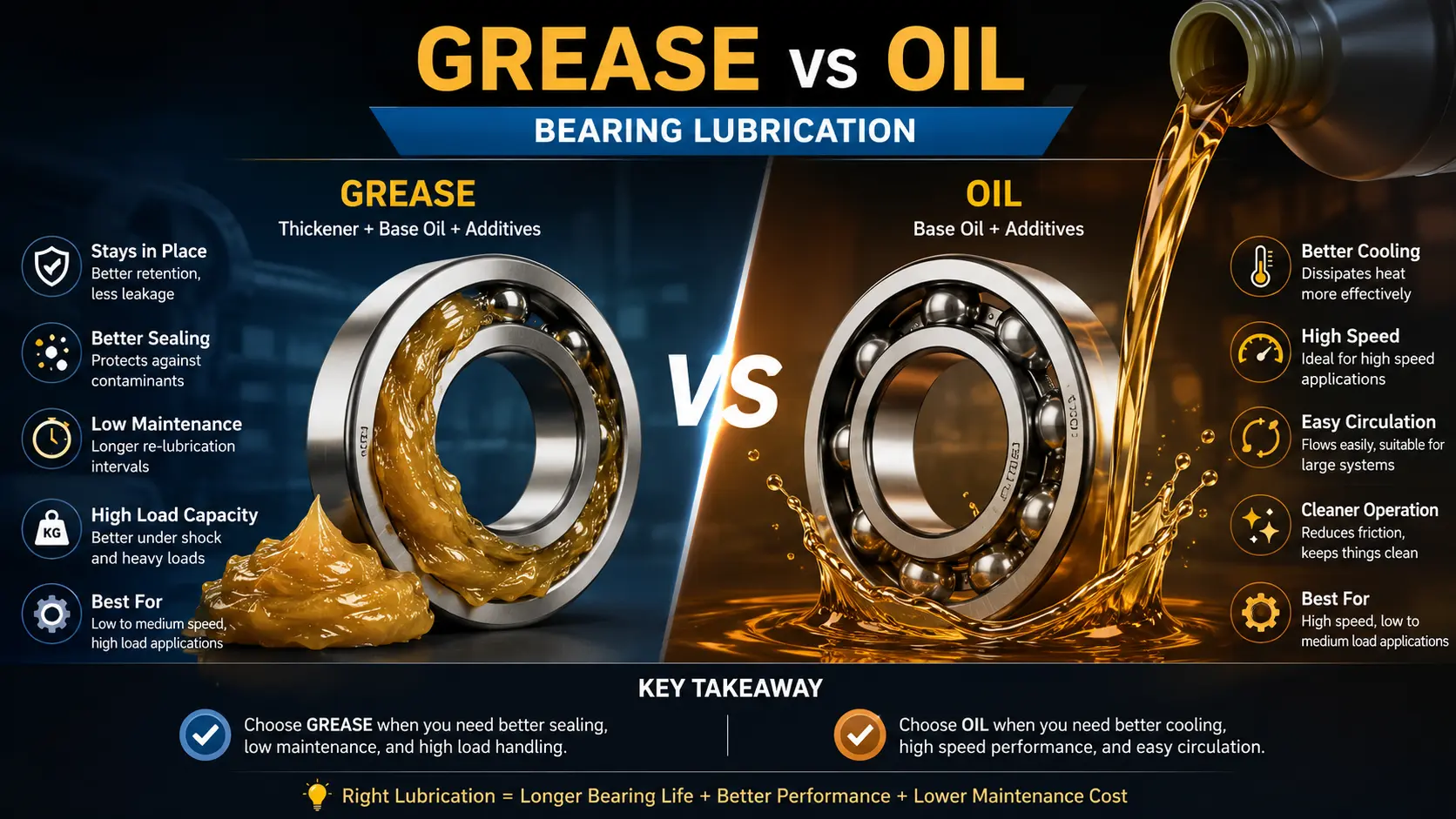
Bearing lubrication is one of the most important factors affecting bearing life, performance, temperature, noise, and reliability. Even a high-quality bearing can fail prematurely if the wrong lubricant is selected, too much or too little lubricant is applied, or the lubrication interval is ignored.
For industrial equipment, choosing between bearing grease or oil is not simply a matter of preference. The correct choice depends on bearing speed, load, operating temperature, contamination, sealing arrangement, maintenance requirements, and the machine’s operating environment.
So, which is better: grease or oil lubrication? In most general industrial and machinery applications, grease is the practical choice because it is easy to apply and provides good retention. However, oil can be the better solution for high-speed, high-temperature, or continuously lubricated applications where heat removal and precise lubrication are important.
This complete guide explains bearing lubrication methods, the differences between grease and oil, lubricant selection, viscosity, temperature, common mistakes, and a practical industrial example.
Bearing lubrication is the process of supplying a suitable lubricant between the rolling elements, raceways, cage, and other contacting surfaces of a bearing.
The primary purpose of lubrication is to create a protective film between moving surfaces. This film reduces direct metal-to-metal contact and helps minimize:
The two most common lubricants used in rolling bearings are grease and oil.
Common bearing lubrication methods include:
The appropriate method depends on the bearing design and operating conditions.
Lubrication is critical because bearings operate under repeated rolling and sliding contact. Without adequate lubrication, friction and temperature can increase rapidly.
A good lubricant performs several important functions.
| 1. Reduces Friction | Lubricant forms a film between contacting surfaces, reducing friction and energy loss. |
| 2. Reduces Wear | A proper lubricant minimizes direct contact between the rolling elements and raceways. |
| 3. Controls Temperature | Excessive friction produces heat. Proper lubrication helps control friction and, in some systems, allows heat to be carried away from the bearing. |
| 4. Protects Against Corrosion | Many bearing lubricants contain additives that help protect metal surfaces from corrosion. |
| 5. Reduces Noise | Insufficient or unsuitable lubrication can increase bearing noise and vibration. |
| 6. Extends Bearing Life | Correct lubrication can significantly improve bearing reliability and service life. |
In fact, lubrication-related problems are among the important causes that should be considered when investigating premature bearing failure.
There is no universal answer to whether grease or oil is better. The correct choice depends on the application.
| Feature | Grease | Oil |
|---|---|---|
| Application | Easy | More complex |
| Retention | Excellent | Requires containment |
| High-speed applications | Moderate to limited | Usually better |
| Heat removal | Limited | Excellent with circulation |
| Maintenance | Generally simpler | Can require monitoring |
| Leakage risk | Lower | Higher |
| Automatic lubrication | Easy | Possible |
| Contamination protection | Good with proper seals | Depends on system |
| Typical machinery | Motors, conveyors, pumps, general equipment | Gearboxes, turbines, high-speed machinery |
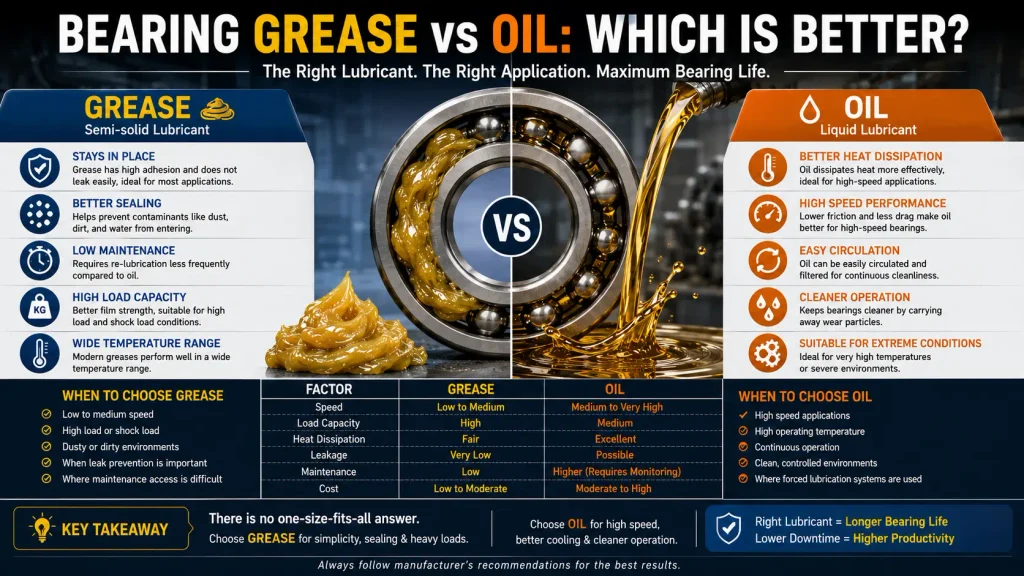
Simple Answer:
1. Consistency and Retention
2. High-Speed Performance
Therefore, for very high-speed applications, oil lubrication may be preferred.
3. Heat Dissipation
4. Maintenance Requirements
Oil-lubricated systems can require:
However, automatic oil systems can provide excellent lubrication control in sophisticated machinery.
5. Leakage
This makes grease attractive for equipment where lubricant leakage would create contamination or maintenance problems.
6. Contamination Protection
7. Lubricant Quantity
Too little lubricant can result in:
Too much grease can also be harmful because excessive grease churning can increase temperature and energy consumption.
Therefore, more lubricant does not always mean better lubrication.
Grease is often the preferred choice for general-purpose bearing applications. Consider grease when:
1. The bearing operates at moderate speed
2. Simple maintenance is important
3. Leakage must be minimized
4. The bearing is difficult to access
5. The application needs good sealing
Oil may be preferred when operating conditions demand continuous lubrication or cooling. Consider oil when:
1. Bearing speed is very high
2. Heat removal is important
3. Continuous lubrication is required
4. The machine already uses an oil system
5. Precise lubricant delivery is required
Choosing the best lubricant for bearings requires more than simply selecting a popular grease or oil. Consider these factors.
1. Bearing Type
Different bearing designs have different lubrication requirements.
Examples include:
The bearing manufacturer’s recommendations should always be considered.
2. Operating Speed
Speed has a major effect on lubricant selection. A bearing operating at low or moderate speed may work well with grease, while a high-speed spindle bearing may require a specialized oil or low-friction grease.
Always consider the manufacturer’s permissible speed and lubrication recommendations.
3. Operating Temperature
Temperature affects lubricant viscosity, oxidation, consistency, and service life. High temperatures can accelerate lubricant degradation. Low temperatures can make grease harder and increase starting torque.
Therefore, select a lubricant whose operating temperature range is suitable for the application.
Lubricant viscosity describes a fluid’s resistance to flow. For oil-lubricated bearings, viscosity is one of the most important selection parameters.
(1) High viscosity oil : Can provide a stronger lubricant film under suitable conditions but may increase friction and heat generation.
(2) Low viscosity oil : Can reduce viscous drag at high speed but may not provide adequate film thickness under heavy loads or certain operating conditions.
The correct viscosity depends on factors such as:
For grease, the base-oil viscosity, thickener type, consistency, additives, and temperature range all matter.
Important Rule :
Never select bearing lubricant based only on temperature. Speed, load, environment, compatibility, and manufacturer recommendations should also be evaluated.
Different machines require different bearing lubrication methods.
(1) Grease Lubrication
(2) Oil Bath
(3) Oil Circulation
(4) Oil Mist
(5) Oil-Air Lubrication
Incorrect lubrication can shorten bearing life even when the bearing itself is correctly selected.
Mistake 1: Using Too Much Grease
Solution: Follow the bearing or equipment manufacturer’s recommended grease quantity.
Mistake 2: Using Too Little Lubricant
Solution: Establish an appropriate relubrication interval.
Mistake 3: Mixing Incompatible Greases
Solution: Verify compatibility before changing grease types.
Mistake 4: Ignoring Contamination
Solution: Maintain seals and keep lubrication equipment clean.
Mistake 5: Selecting Lubricant Only by Price
Solution: Consider total operating cost rather than purchase price alone.
Mistake 6: Ignoring Temperature
Solution: Check the manufacturer’s recommended temperature range.
Mistake 7: Using the Wrong Lubrication Interval
Solution: Establish a lubrication schedule based on operating conditions and manufacturer guidance.
Consider an industrial conveyor operating in a manufacturing facility. The conveyor uses sealed deep groove ball bearings and operates at moderate speed under normal industrial conditions.
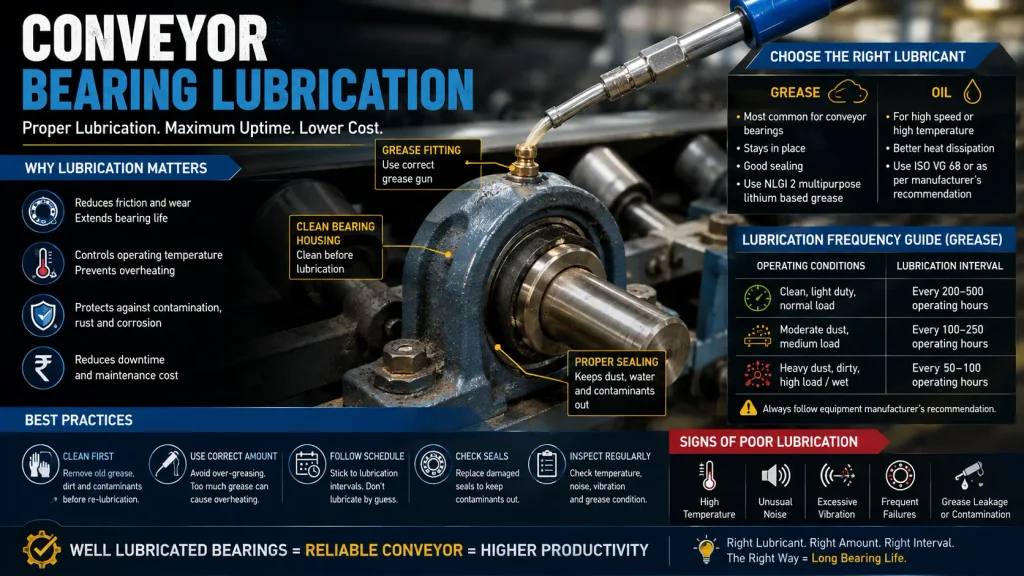
The maintenance team notices:
An inspection reveals that the bearing lubrication condition is poor.
The team changes the lubricant without checking compatibility and continues applying excessive grease.
Instead of solving the issue, excessive grease increases churning and temperature.
The bearing continues operating under unfavorable conditions.
A proper lubrication review should consider:
For a typical moderate-speed conveyor bearing, a suitable industrial grease may be more practical than an oil circulation system because grease is easier to retain and maintain.
However, the final lubricant selection should follow the bearing and equipment manufacturer’s specifications.
Bearing lubrication is not simply about adding more grease. It is about selecting the correct lubricant, applying the correct quantity, and maintaining the correct lubrication interval.
Use this simple decision framework:
| Choose Grease If: | Choose Oil If: |
| Speed is low to moderate Simple maintenance is preferred Lubricant retention is important Leakage should be minimized The bearing operates in a relatively conventional environment Long relubrication intervals are desirable | Speed is very high Heat removal is important Continuous lubrication is required Filtration is beneficial The machine already has an oil circulation system Precise lubricant delivery is required |
No. More lubricant does not automatically increase bearing life. Both under-lubrication and over-lubrication can cause problems.
Under-lubrication may lead to:
Lubricant starvation → increased friction → heat → wear → bearing damage
Over-lubrication may lead to:
Excess grease → churning → temperature rise → lubricant degradation → performance problems
The goal is correct lubrication, not maximum lubrication.
There is no single lubrication interval that applies to every bearing. The correct interval depends on:
For critical industrial equipment, lubrication intervals should ideally be based on engineering calculations, manufacturer recommendations, condition monitoring, and actual operating conditions.
Lubrication directly influences the operating condition of the bearing. A properly lubricated bearing can operate with lower friction and reduced wear. However, lubricant is only one part of bearing reliability.
Bearing life also depends on:
Therefore, a complete bearing maintenance strategy should combine lubrication with proper installation and condition monitoring.
A steel wire manufacturing plant was experiencing repeated bearing failures in the roller assemblies of its wire-drawing machinery. As a result, the plant was facing approximately 75 stoppages per month, leading to significant production downtime and maintenance costs.
An investigation revealed that the existing lubricant was a graphite-based grease, which was not suitable for this particular application. The combination of high operating loads and continuous wire-drawing operations was placing additional stress on the bearings and lubrication system.
To address the problem, NSK recommended sealed double-row cylindrical roller bearings combined with a specially selected lithium grease designed to better suit the application’s operating conditions.Practical Results
| Parameter | Before | After |
|---|---|---|
| Bearing life | Baseline | +40% |
| Machine stoppages | ~75/month | Significantly reduced |
| Lubricant | Graphite-based grease | Selected lithium grease |
| Application | Steel wire drawing | Same |
| Annual saving | — | €1,202,455 |
The improved bearing-and-grease combination delivered a 40% improvement in bearing life, while the resulting reduction in lost production, maintenance labour and technical support produced annual savings of €1,202,455.
Lesson:
Simply having “grease applied” is not enough. Proper bearing lubricant selection requires matching the grease type with the bearing’s load, operating temperature, speed, and overall operating conditions.
Bearing Life Improvement After Lubrication Optimization
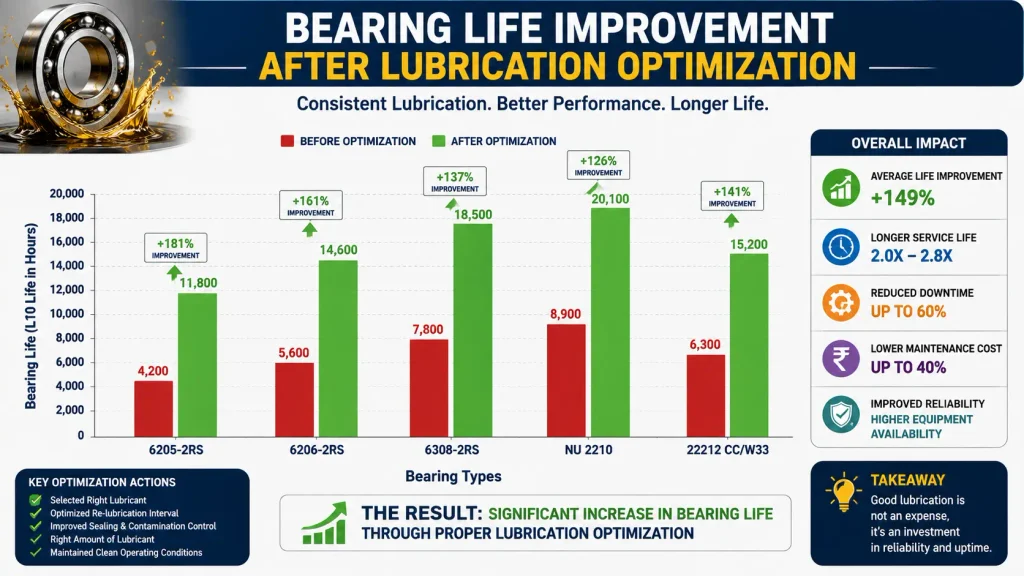
Steel wire-drawing application: documented 40% improvement in bearing life after changing from unsuitable graphite-based grease to a specially selected lithium-grease and bearing solution.
A British pet-food manufacturing plant was experiencing repeated bearing failures in its pellet extruder, resulting in increased production losses and maintenance costs.
The plant was using grease lubrication, but an analysis by NSK found that the existing grease was not providing the required service life for the bearings under the application’s demanding operating conditions.
Following an engineering review, high-viscosity oil was recommended as a more suitable lubrication solution. The plant also installed appropriate NSK spherical roller bearings and spherical thrust roller bearings to better withstand the operating conditions.
| Parameter | Before | After |
|---|---|---|
| Bearing failure interval | Every 10–12 weeks | No failures for 7 months |
| Lubricant | Existing grease | High-viscosity oil |
| Equipment | Pellet extruder | Same application |
| OEE improvement | Baseline | +3 percentage points |
| Cost saving | — | £70,000 |
After the new bearing and lubrication solution was installed, the extruder operated for 7 months without bearing failures, generating approximately £70,000 in savings and improving OEE by 3 points.
This example demonstrates that grease is not always the best lubricant for every bearing application. In heavy-duty and high-temperature environments, factors such as lubricant viscosity, load-carrying capacity, and film-forming ability can play a critical role in maintaining bearing performance and service life.
Lesson:
When a bearing operates under high loads, elevated temperatures, and demanding continuous-duty conditions, oil lubrication may provide a better solution than grease. However, lubricant selection should always be application-specific and based on the bearing type, speed, load, temperature, and operating environment.
A large aluminium beverage-can manufacturing plant was experiencing repeated bearing seizures in its spray-head coating machines.
At first, the problem appeared to be a conventional bearing failure. However, a detailed bearing and grease analysis revealed that high-pressure air was forcing the grease out of the bearing, resulting in insufficient lubrication and premature bearing seizure.
The existing ZZ shields were not providing adequate grease retention under these operating conditions.
To address the problem, NSK recommended VV non-contact sealed deep-groove ball bearings with C3 internal clearance. This solution was designed to improve grease retention and provide more reliable bearing performance under the machine’s demanding operating environment.
| Parameter | Before | After |
|---|---|---|
| Bearing life | 7 days | 110 days |
| Improvement | — | ~15.7× |
| Lubrication issue | Grease purging | Improved grease retention |
| Seal | ZZ shield | VV non-contact seal |
| Annual saving | — | €240,000 |
Bearing operating life increased from 7 days to 110 days, while the manufacturer achieved annual savings of approximately €240,000.
The main cause of the lubricant failure was not poor grease quality.
Problem = High-pressure air + inadequate grease retention
Therefore, instead of simply changing the lubricant, the solution focused on improving bearing sealing and lubricant retention to prevent grease from being forced out of the bearing.
Lesson:
Bearing lubrication should not be viewed as a lubricant-only issue. Seal design, contamination, air pressure, operating environment, and grease retention are equally important factors in achieving reliable bearing performance and longer service life.
🔥 What These 3 Industrial Examples Prove ?
These three real-world examples lead to one important conclusion:
| Application | Problem | Better Approach |
|---|---|---|
| Steel wire drawing | Unsuitable grease | Correctly selected lithium grease |
| Pet-food pellet extruder | Grease insufficient for application | High-viscosity oil |
| Can manufacturing | Grease expelled by high-pressure air | Better sealing + grease retention |
There is no one-size-fits-all solution for bearing lubrication. The right lubrication strategy depends on the bearing type, load, speed, temperature, contamination, sealing arrangement, operating environment, and lubricant retention requirements.
Choosing the correct lubricant is important, but achieving long bearing life requires a complete lubrication and sealing strategy tailored to the specific application.
There is no single “best lubricant for bearings.”
Practical Bearing Lubricant Selection Formula
Bearing type + Load + Speed + Temperature + Environment + Contamination + Seal arrangement = Lubricant selection
The answer to “bearing grease vs oil—which is better?” depends on the application.
For many general-purpose industrial bearings, grease lubrication offers an excellent combination of simplicity, retention, protection, and low maintenance. It is widely suitable for motors, conveyors, fans, pumps, and many standard machines.
Oil lubrication becomes more attractive when the bearing operates at very high speed, generates significant heat, requires continuous lubrication, or benefits from oil circulation and filtration.
The most important principle is simple:
Choose the lubricant based on the bearing and operating conditions—not simply on whether it is grease or oil.
Before selecting a lubricant, evaluate the bearing type, load, speed, temperature, environment, sealing arrangement, lubricant viscosity, compatibility, and manufacturer’s recommendations.
Correct bearing lubricant selection can help reduce friction, control temperature, prevent premature wear, improve reliability, and support longer equipment service life.
For industrial maintenance teams, proper industrial bearing lubrication should therefore be treated as a planned maintenance activity rather than an occasional task.
Grease is generally better for many standard and moderate-speed bearing applications because it is easy to apply and remains in place. Oil is often preferred for high-speed, high-temperature, continuously lubricated, or heat-sensitive applications because it can circulate and remove heat. However, the correct choice depends on bearing type, load, speed, temperature, contamination and manufacturer recommendations.
Not automatically. The bearing housing, seals, speed, temperature, lubricant viscosity, and manufacturer’s specifications must be checked before changing from grease to oil.
The best lubricant for bearings is the one that matches the bearing type, load, speed, temperature, environment, and manufacturer’s requirements.
Excess grease can cause churning, increased friction, temperature rise, and lubricant degradation.
Insufficient lubricant can increase friction and wear and may lead to overheating and premature bearing failure.
Bearing lubrication is the controlled application of grease or oil to reduce friction, wear, heat, and surface damage between bearing components.
Important factors include bearing type, speed, load, temperature, contamination, sealing, lubricant compatibility, and operating environment.
No. A high-temperature grease is not automatically the best choice. The lubricant must match the complete operating conditions, including speed, load, base oil viscosity, thickener, additives, and temperature.
They should not be mixed without verifying compatibility. Different grease formulations can behave differently when combined.
Use the correct lubricant, correct quantity, correct lubrication method, appropriate relubrication interval, and clean application practices. Follow the bearing manufacturer’s recommendations whenever available.
Neither is universally better. Grease is generally preferred for many standard and moderate-speed applications, while oil can be better for high-speed, high-temperature, or continuously lubricated applications.

Welcome! I am a dedicated entrepreneur running an industrial affiliate product website, helping businesses and professionals find the best tools, equipment, and resources for their needs. With a passion for industrial products and a keen eye for quality, I curate and recommend top-performing items that enhance efficiency and reliability.
Through my platform, I aim to simplify the buying process by providing valuable insights, expert reviews, and trusted affiliate links to high-quality industrial products. Whether you’re looking for the latest machinery, tools, or safety gear, I strive to connect you with the best solutions available.
Thank you for visiting, and I look forward to helping you make informed purchasing decisions!
