Our Location
Killa-Pardi, Dist. Valsad, 396125

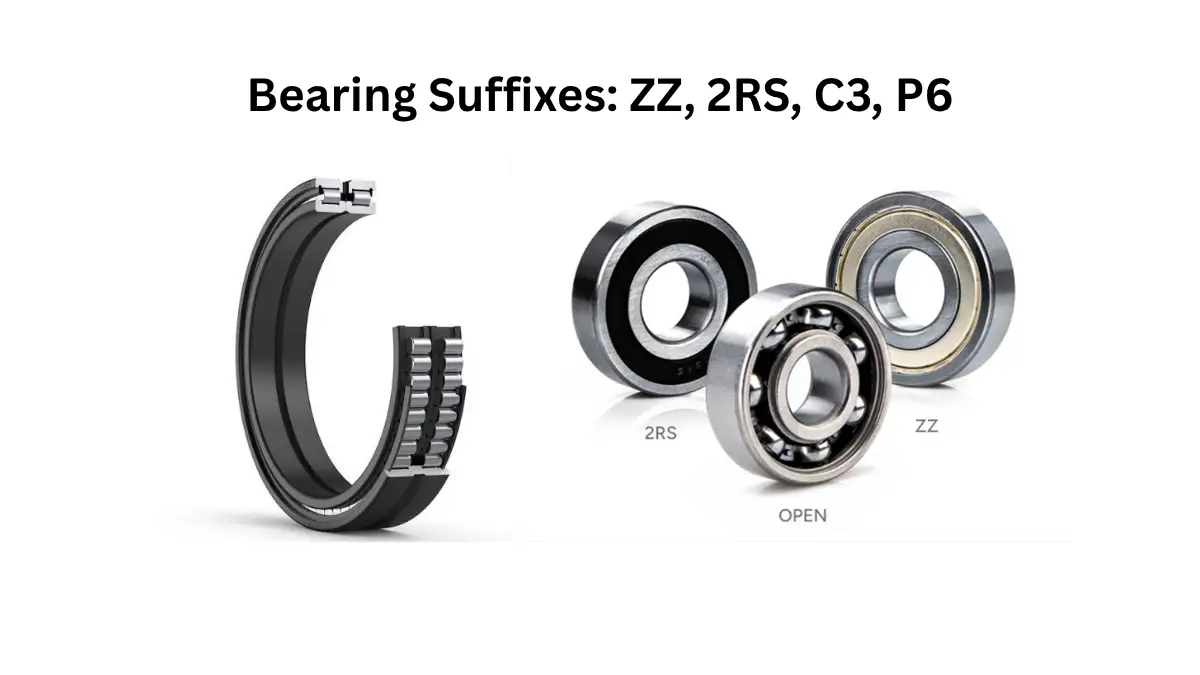
When selecting or replacing a bearing, the bearing suffix is just as important as the main bearing number. Suffixes such as ZZ, 2RS, C3 and P6 indicate features like shielding, sealing, internal clearance and tolerance.
For example, 6200ZZC3P6 is a 10 × 30 × 9 mm bearing with ZZ shields, C3 clearance and P6 tolerance. Understanding bearing suffix meaning helps engineers, technicians and buyers select the correct bearing for each application.
This guide explains bearing suffixes, ZZ bearing meaning, 2RS bearing meaning, C3 bearing meaning, P6 bearing, ZZ vs 2RS, C3 vs CN and how to correctly read a complete bearing designation.
Understanding bearing suffix meaning is therefore essential for engineers, maintenance technicians, machine builders, mechanics and industrial buyers.
A bearing suffix is a letter, number or combination of letters and numbers added to the basic bearing designation to identify a specific feature or configuration of the bearing.
In simple words:
The basic bearing number tells you what bearing it is, while the suffix tells you how that bearing is configured.
For example: 6205-2RS-C3
can be interpreted as:
The exact meaning of a suffix depends on the bearing manufacturer and product family. Therefore, a code should always be checked against the manufacturer’s official catalogue before purchasing a replacement.
Bearing suffixes are used because two bearings having the same basic size may be designed for very different operating conditions.
Consider these examples:
The basic bearing designation may be related to the same dimensional series, but the sealing and clearance characteristics can be different. This is why reading only the first four digits of a bearing can lead to an incorrect replacement.
| Suffix Category | What It Can Describe |
|---|---|
| Shield/seal | Protection from contaminants |
| Internal clearance | Internal radial clearance |
| Tolerance | Dimensional/rotational precision |
| Cage | Cage material or design |
| Snap ring | Mounting arrangement |
| Lubrication | Factory lubricant or special lubrication |
| Special design | Application-specific construction |
Different manufacturers use different designation systems. Consequently, bearing suffixes should always be interpreted according to the manufacturer’s documentation.
| Suffix | General Meaning |
|---|---|
| Z | Shield/seal on one side, depending on manufacturer |
| ZZ / 2Z | Shields on both sides |
| RS | Rubber contact seal on one side |
| 2RS | Rubber contact seals on both sides |
| C2 | Clearance smaller than normal |
| CN / C0 | Normal internal clearance |
| C3 | Clearance greater than normal |
| C4 | Clearance greater than C3 |
| C5 | Clearance greater than C4 |
| P6 | Higher dimensional/rotational precision tolerance class |
| M | Often machined brass cage in SKF designation |
| N | Snap-ring groove in many designation systems |
However, these codes should not automatically be assumed identical across every brand. NSK, for example, lists ZZ as shields on both sides, while its designation system also uses other seal codes such as RSR, 2RSR and 2ZR for particular bearing families.
Therefore, the safest practice is to decode a bearing number using the specific manufacturer’s catalogue.
The ZZ bearing meaning generally refers to a bearing equipped with shields on both sides.
For NSK bearings, the designation ZZ specifically identifies a shield on both sides. NSK also explains that shielded bearings provide protection for bearing components and help maintain lubrication.
A typical ZZ bearing provides:
An open bearing has no shields or seals. A ZZ bearing adds metal shields on both sides. This makes ZZ useful where the environment is relatively clean and low friction is important.
A ZZ shield should not be treated as a completely waterproof seal.
If the application involves:
a contact-sealed bearing may be more appropriate.
A shield is a protective component fitted close to the bearing’s rotating parts.
Its purpose is to help:
A shielded bearing is different from a contact-sealed bearing.
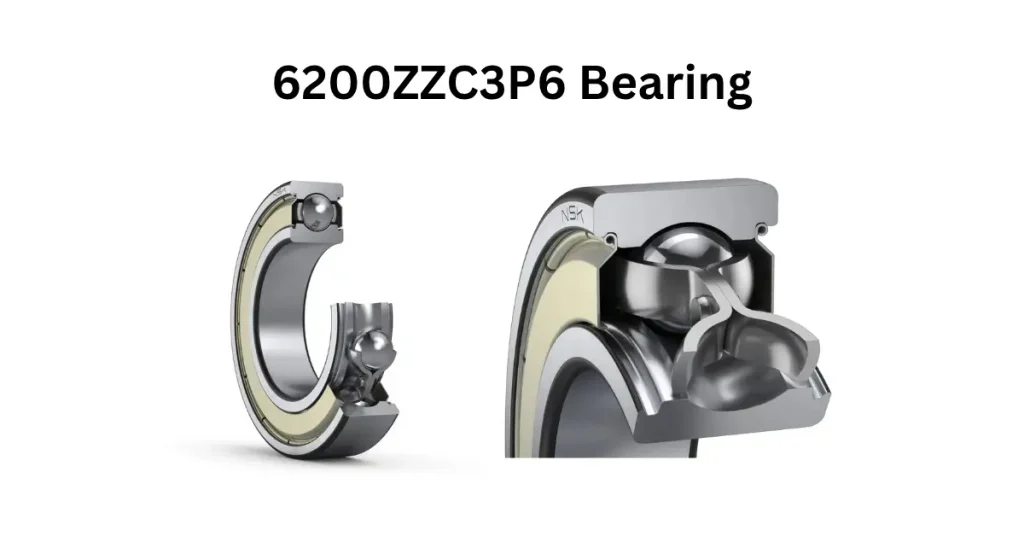
NSK lists the following technical information for the 6200ZZC3P6:
| Specification | Technical Data |
|---|---|
| Bearing type | Single-row deep groove ball bearing |
| Bore | 10 mm |
| Outside diameter | 30 mm |
| Width | 9 mm |
| Shield | ZZ – both sides |
| Internal clearance | C3 |
| Tolerance | P6 |
| Dynamic load rating | 5,600 N |
| Static load rating | 2,390 N |
| Grease limiting speed | 28,000 rpm |
| Approx. mass | 0.032 kg |
ZZ bearings are commonly found in applications where protection from ordinary dust is required without using a contacting rubber seal.
Typical applications include:
NSK lists deep groove ball bearings in applications including motors, agricultural machinery, textile machines and conveying equipment.
ZZ does not mean waterproof. A shield provides protection, but it should not automatically be considered equivalent to a rubber contact seal designed for stronger contamination or moisture protection.
The 2RS bearing meaning generally refers to a bearing having rubber contact seals on both sides.
The purpose of the rubber seals is to provide additional protection against contaminants while helping retain the lubricant inside the bearing.
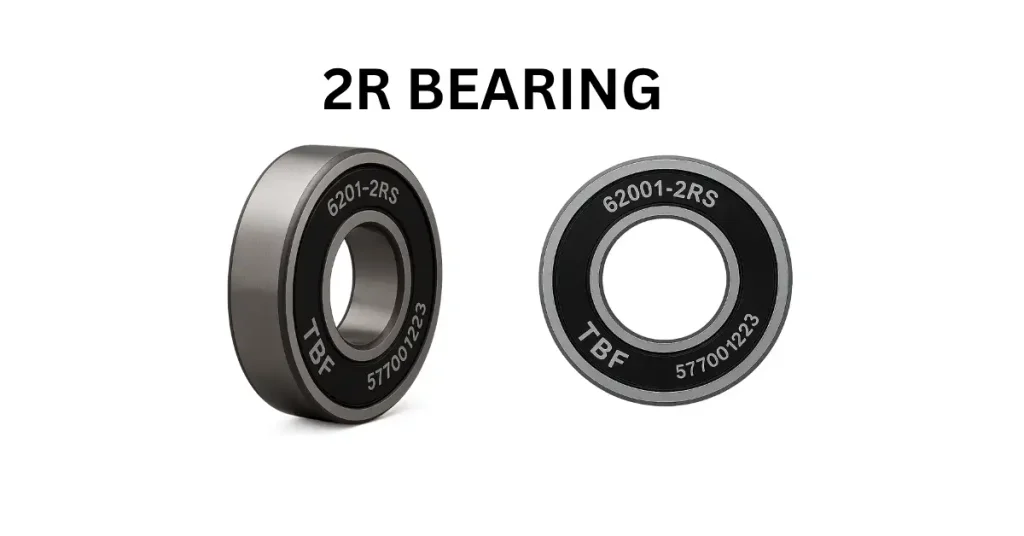
A rubber seal is positioned between the bearing ring and rotating assembly. Unlike a simple shield, a contact seal makes contact with the rotating component. This can improve protection against:
However, contact seals can also produce more friction than non-contact shielding.
2RS bearings are commonly considered for applications where environmental contamination is a concern, such as:
The correct choice still depends on speed, temperature, lubricant and manufacturer’s specifications.
One of the most common bearing questions is: Is ZZ better than 2RS ?There is no universal winner. The correct choice depends on the application.
| Feature | ZZ | 2RS |
|---|---|---|
| Protection type | Shield | Rubber seal |
| Seal contact | Generally non-contact | Contact |
| Dust protection | Good for many clean environments | Generally stronger |
| Moisture protection | Limited | Generally better |
| Friction | Generally lower | Generally higher |
| Heat generation | Generally lower | Can be higher |
| Speed suitability | Often favorable | Application-dependent |
| Dirty environment | Moderate | Generally more suitable |
Suppose a bearing is installed inside a relatively clean electric motor.
A ZZ bearing may be suitable when low friction and speed are important. Now consider a conveyor bearing operating in a dusty environment. A 2RS bearing may be more appropriate because contamination protection becomes more important.
The important principle is:
Choose the suffix according to the operating environment, not simply because one suffix sounds better.
The C3 bearing meaning is:
C3 indicates radial internal clearance greater than normal clearance.
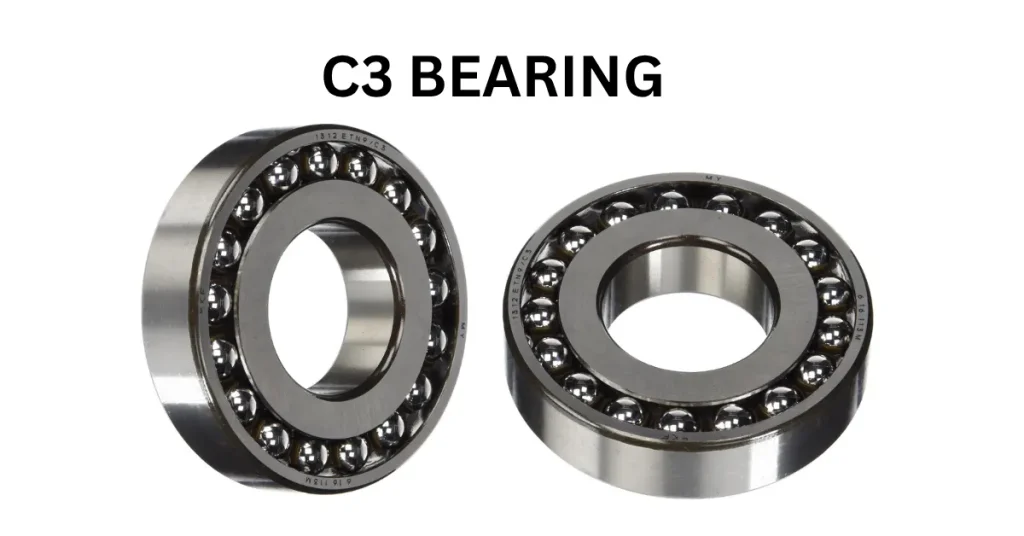
This is one of the most misunderstood bearing suffixes. C3 does not mean that the bearing is automatically stronger, better quality or suitable for every machine. It describes the bearing’s internal clearance condition.
Bearing internal clearance is the amount of relative movement between the bearing rings and rolling elements before the bearing is subjected to operating conditions. When a bearing operates, several factors can change its effective operating clearance.
These include:
If the bearing becomes hotter during operation, thermal expansion can reduce the available internal clearance. This is one reason why bearings with greater initial clearance may be specified for particular applications.
A simplified clearance sequence is:
C2 < CN < C3 < C4 < C5
Where:
| Clearance Code | General Meaning |
|---|---|
| C2 | Smaller than normal |
| CN / C0 | Normal clearance |
| C3 | Greater than normal |
| C4 | Greater than C3 |
| C5 | Greater than C4 |
No. C3 is not a quality rating.
For example, if a machine is designed for normal internal clearance and you install a C3 bearing without considering the application, excessive clearance may contribute to unwanted noise, vibration or reduced running accuracy.
On the other hand, an application with higher operating temperature or particular interference fits may require C3 clearance. Therefore:
C3 should be selected because the application requires it—not because C3 appears to be a higher specification.
P6 is a tolerance or precision classification used in certain bearing designation systems.
In simple terms, the P6 designation indicates a tighter tolerance class than the normal standard class in the applicable system.
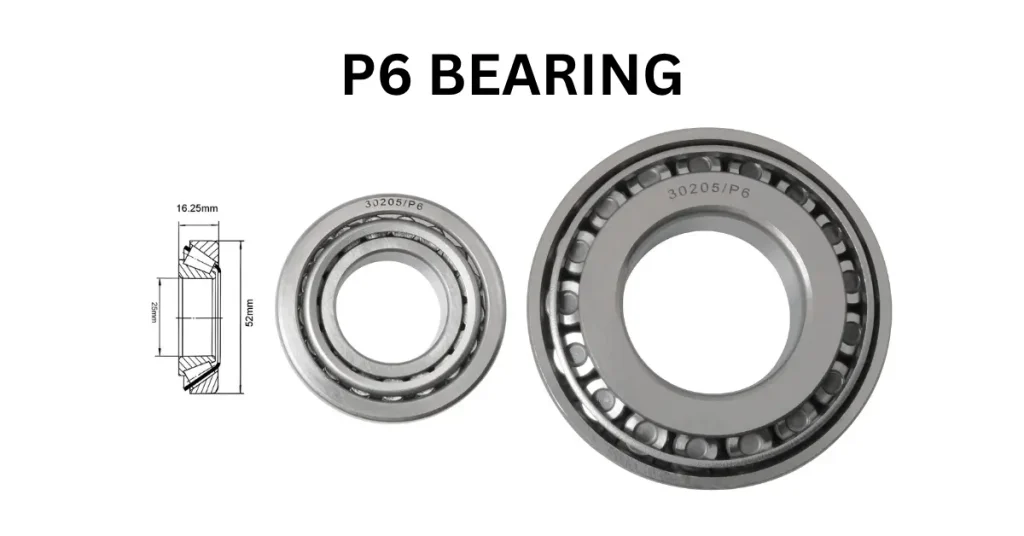
For example, NSK lists P6 as the tolerance class for its 6200ZZC3P6 bearing.
This distinction is extremely important.
C3 = internal clearance
P6 = tolerance class
They describe two completely different characteristics.
A bearing can therefore have both:
C3 + P6
at the same time.
Let’s decode the complete bearing designation: 6200ZZC3P6
The designation can be understood as a combination of the basic bearing designation and additional specifications.
6200
NSK identifies this as a single-row deep groove ball bearing in the 62 series. The dimensions are:
ZZ = shields on both sides
C3 = radial internal clearance greater than normal
P6 = tolerance class
So, in simplified form: 6200 + ZZ + C3 + P6
means:
Basic bearing + double shielding + increased internal clearance + specified precision/tolerance class
This is an excellent real-world example of why understanding the bearing number suffix is important.
According to NSK’s published product data:
| Parameter | Value |
|---|---|
| Bearing number | 6200ZZC3P6 |
| Bearing type | Single-row deep groove ball bearing |
| Bore diameter | 10 mm |
| Outside diameter | 30 mm |
| Width | 9 mm |
| Minimum chamfer | 0.6 mm |
| Dynamic load rating | 5,600 N |
| Static load rating | 2,390 N |
| Grease limiting speed | 28,000 rpm |
| Oil-bath speed | 34,000 rpm |
| Number of balls | 8 |
| Ball diameter | 4.762 mm |
| Approx. mass | 0.032 kg |
| Shield | ZZ |
| Internal clearance | C3 |
| Tolerance | P6 |
This data demonstrates that suffixes are not merely decorative letters. They identify engineering characteristics that can affect bearing selection and application suitability.
When you see a complete bearing number, do not immediately assume every letter has the same meaning across all manufacturers.
For example:
6205-2RS-C3
can generally be interpreted as:
6205 → basic bearing designation
2RS → double rubber contact sealing arrangement in the applicable designation system
C3 → greater-than-normal internal clearance
However, the exact code should be confirmed using the manufacturer’s catalogue.
| Step 1: Identify the basic bearing number | Determine the bearing family and dimensional designation. |
| Step 2: Identify the seal or shield | Look for codes such as ZZ, 2Z, RS or 2RS, depending on manufacturer. |
| Step 3: Identify internal clearance | Look for codes such as C2, CN, C3, C4 or C5. |
| Step 4: Identify precision/tolerance | Look for applicable tolerance codes such as P6. |
A bearing may fit physically into a machine but still be unsuitable for the application.
For example, two bearings size can have the same:
but different:
This means dimensional compatibility does not always equal functional compatibility.
Suppose an original machine uses:
6205-2RS-C3
If you replace it with:
6205-ZZ
the dimensions may be compatible, but the sealing arrangement and internal clearance may not be the same. That difference could matter if the machine operates in:
Therefore, replacement should ideally match the complete original designation unless an engineering-approved alternative is specified.
These four codes do not compete with each other because they describe different features.
| Code | Main Function | Category |
|---|---|---|
| ZZ | Metal shields | Protection |
| 2RS | Rubber contact seals | Protection |
| C3 | Greater internal clearance | Clearance |
| P6 | Higher tolerance class | Precision |
This means a bearing can contain multiple codes at the same time.
For example: 6200ZZC3P6
can be interpreted as:
6200 + ZZ + C3 + P6
or:
Basic bearing + shields + clearance specification + tolerance class
Choosing the correct bearing suffixes should be based on the application rather than simply selecting the most advanced-looking code.
Always follow the manufacturer’s engineering recommendation rather than choosing a suffix solely from a general rule.
| Mistake 1: Thinking C3 Means Better Quality | C3 describes clearance, not overall bearing quality. |
| Mistake 2: Assuming ZZ Means Waterproof | ZZ is a shield configuration, not automatically a waterproof seal. |
| Mistake 3: Choosing 2RS for Every Application | 2RS can offer strong contamination protection, but contact sealing can affect friction and speed characteristics. |
| Mistake 4: Confusing C3 With P6 | C3 concerns internal clearance. P6 concerns tolerance/precision classification. |
| Mistake 5: Ignoring the Manufacturer | A suffix must be interpreted according to the applicable manufacturer’s designation system. |
| Mistake 6: Buying Only by Bore Size | A 20 mm bore alone is not enough to identify the correct industrial bearing. |
Understanding bearing suffixes is an important part of professional bearing selection.
The letters and numbers following a basic bearing designation can provide information about the bearing’s protection, internal clearance, precision and other design characteristics.
The most important codes discussed in this guide are:
A real example such as 6200ZZC3P6 shows how several specifications can be combined into one complete bearing designation. NSK lists this bearing as a 10 × 30 × 9 mm deep groove ball bearing with ZZ shields, C3 internal clearance and P6 tolerance.
The key lesson is simple:
Never select an industrial bearing by size alone. Always check the complete bearing number and its suffixes.
Finally, because bearing suffix conventions can vary between manufacturers and bearing families, the manufacturer’s official catalogue should always be treated as the final reference when identifying or ordering a bearing.
Bearing suffix meaning refers to the additional letters or numbers after a basic bearing designation that identify features such as shields, seals, internal clearance, tolerance, cage or special construction.
Not necessarily. C3 is simply a greater internal clearance class. The correct clearance depends on the operating conditions.
Yes. NSK’s 6200ZZC3P6 is a real example combining all three specifications.
C3 refers to internal radial clearance, whereas P6 refers to tolerance/precision classification.
No. C3 describes internal clearance. It should not be interpreted as an increase in the bearing’s basic dynamic or static load rating.
Not automatically. The replacement should match the machine’s original engineering requirements.
Manufacturers use designation systems to identify different bearing configurations and engineering characteristics. Their codes are not necessarily identical.
Read the complete bearing number from the existing bearing, then verify every code using the manufacturer’s catalogue or technical documentation.

Welcome! I am a dedicated entrepreneur running an industrial affiliate product website, helping businesses and professionals find the best tools, equipment, and resources for their needs. With a passion for industrial products and a keen eye for quality, I curate and recommend top-performing items that enhance efficiency and reliability.
Through my platform, I aim to simplify the buying process by providing valuable insights, expert reviews, and trusted affiliate links to high-quality industrial products. Whether you’re looking for the latest machinery, tools, or safety gear, I strive to connect you with the best solutions available.
Thank you for visiting, and I look forward to helping you make informed purchasing decisions!
