Our Location
Killa-Pardi, Dist. Valsad, 396125

Bearings are critical components in motors, pumps, gearboxes, conveyors, fans, compressors, machine tools and other rotating equipment. A bearing may be small compared with the complete machine, but its failure can cause excessive vibration, overheating, noise, shaft damage, unplanned downtime and costly production losses.
The good news is that many bearing failures are preventable. Modern bearing failure analysis focuses not only on replacing a damaged bearing but also on identifying the root cause of bearing failure so that the same problem does not happen again.
Recent technical guidance continues to identify improper lubrication, contamination, incorrect mounting, misalignment, excessive load and operating-condition problems as major contributors to premature bearing damage. Condition monitoring using vibration, temperature, noise and lubrication inspection is also increasingly important for early detection.
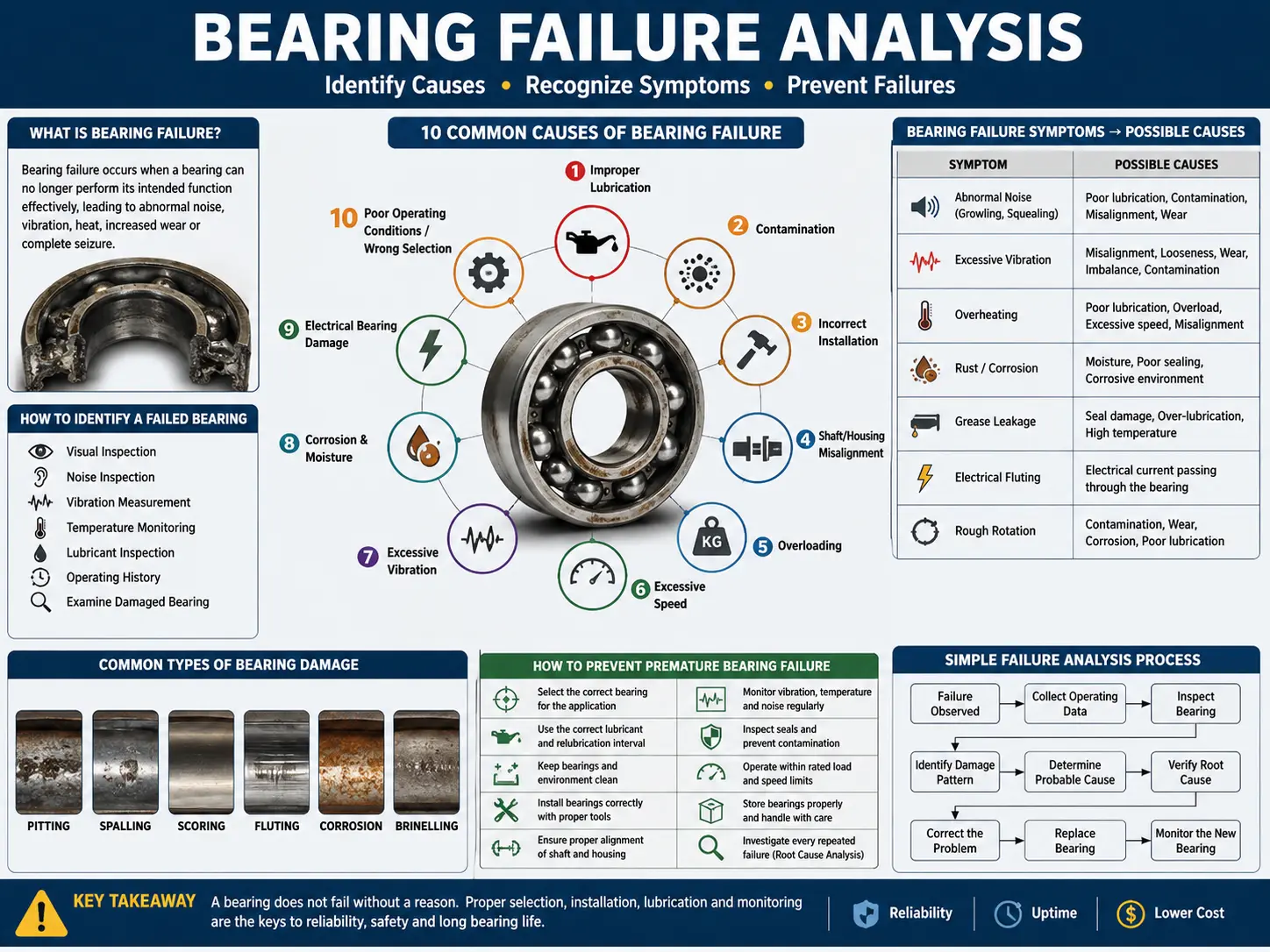
Bearing failure occurs when a bearing can no longer perform its intended function safely, smoothly or reliably. A failed bearing may show excessive wear, pitting, spalling, cracking, corrosion, overheating, abnormal noise, increased vibration or complete seizure.
It is important to understand the difference between normal bearing fatigue life and premature bearing failure.
A rolling bearing is designed to operate for a calculated life under specific load, speed, lubrication and environmental conditions. When it fails significantly earlier because of contamination, improper installation, lubrication problems, overload, misalignment or another avoidable factor, it is generally considered a premature bearing failure.
Bearing failure analysis therefore asks three important questions:
Research reviewing bearing failure mechanisms identifies wear and fatigue among the most common failure modes, while incorrect assembly, operation and maintenance are important causes of premature damage.
Bearing failure can occur due to several mechanical, operating, and maintenance-related problems. The most common causes include improper lubrication, contamination, incorrect installation, shaft or housing misalignment, overloading, excessive vibration, corrosion, electrical damage, improper clearance, and normal fatigue. Identifying these causes early helps prevent unexpected breakdowns, reduce maintenance costs, and extend bearing service life.
Improper lubrication is one of the most common causes of bearing failure.
Lubrication creates a protective film between the rolling elements and raceways. If this film becomes inadequate, metal-to-metal contact can increase friction, heat and wear.
Lubrication failure does not simply mean “not enough grease.” It can include:
Too little lubricant can cause overheating, scoring and surface damage. Too much grease can also create problems because excessive churning generates heat and increases energy losses.
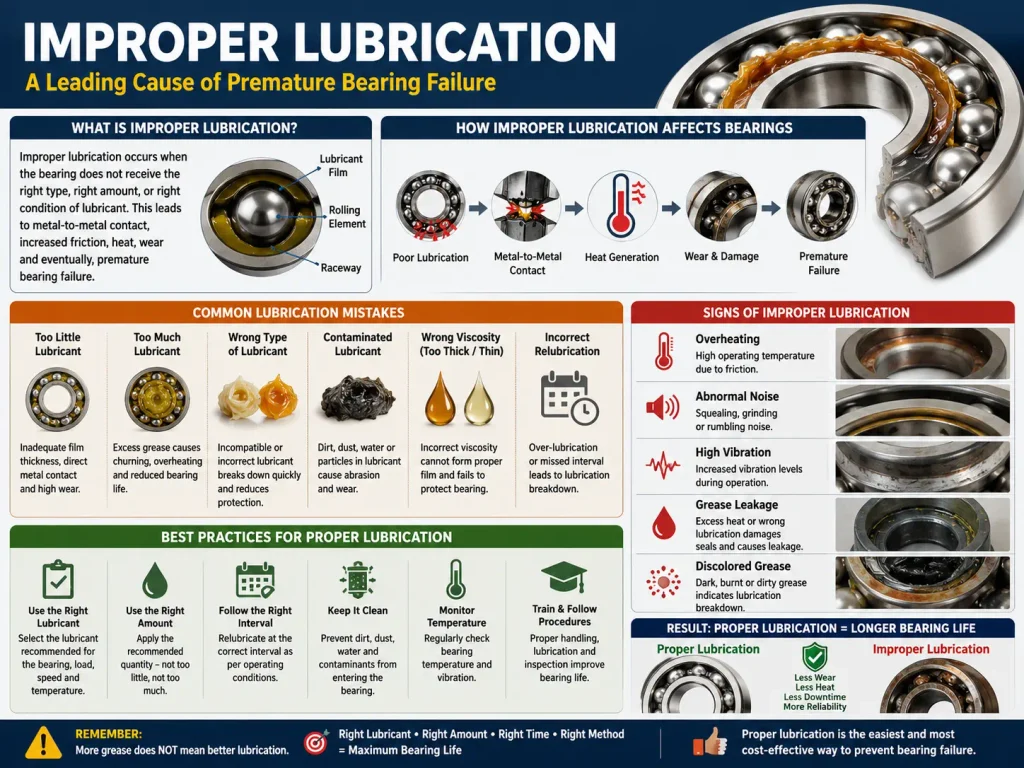
Look for:
Use the lubricant recommended for the bearing and application. Check load, speed, operating temperature, environment and lubricant compatibility before selecting grease or oil.
Contamination is another major cause of premature bearing failure.
Dust, dirt, metal particles, water, chemicals and other foreign materials can enter the bearing through damaged seals, poor handling or contaminated lubricant.
Even relatively small particles can create dents on raceways. These damaged areas can become stress concentration points and contribute to wear, vibration and surface fatigue.
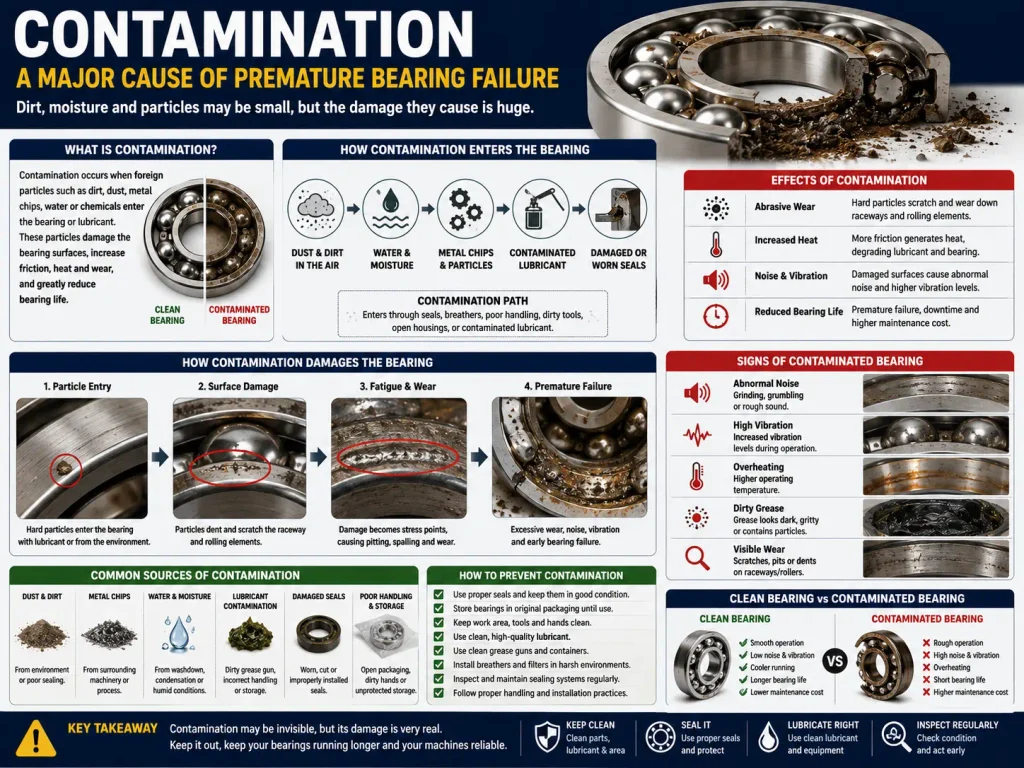
A contaminated bearing may produce:
Keep bearings in their original packaging until installation. Use clean tools, clean hands and clean work areas. Inspect seals regularly and prevent water or process contaminants from entering the bearing.
A high-quality bearing can fail quickly if it is installed incorrectly.
Common installation mistakes include:
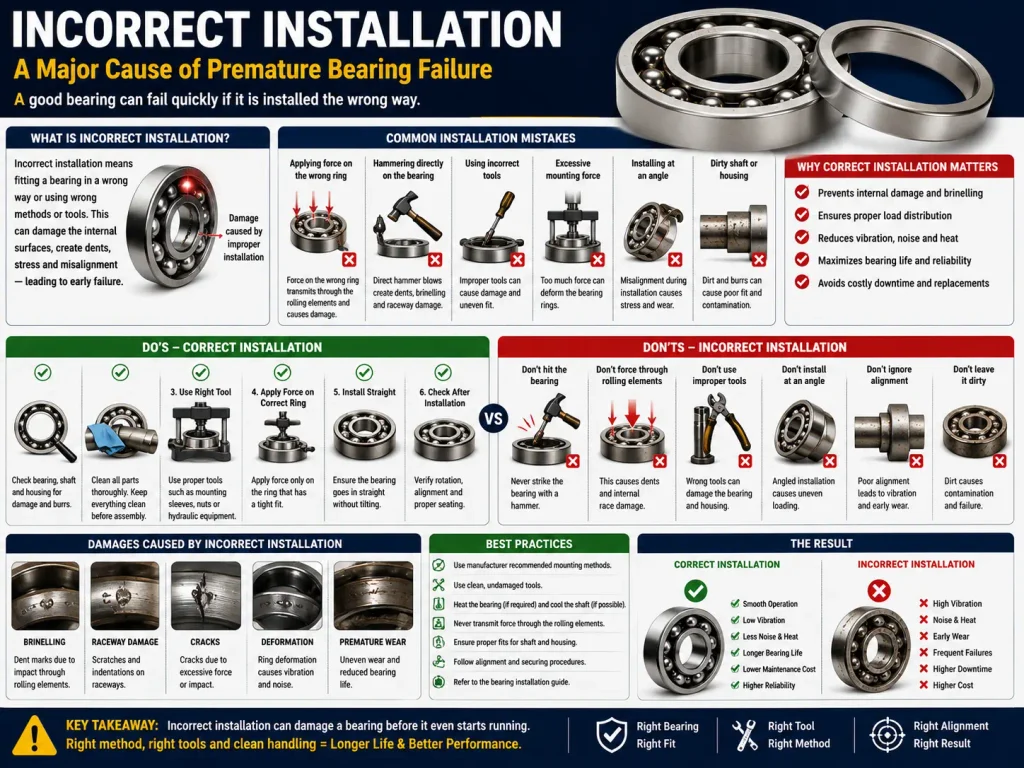
Incorrect mounting can create dents, deformation, brinelling, raceway damage and internal clearance problems.
The bearing should be installed using the appropriate tools and mounting procedure for the specific application. NSK also identifies improper mounting and handling as important causes of premature bearing damage.
Before installation:
Bearing misalignment occurs when the shaft and housing are not correctly aligned.
Misalignment can produce uneven load distribution across the bearing. This increases localized stress, friction and wear.
Typical causes include:
Misalignment may cause abnormal vibration, temperature rise and uneven raceway wear.
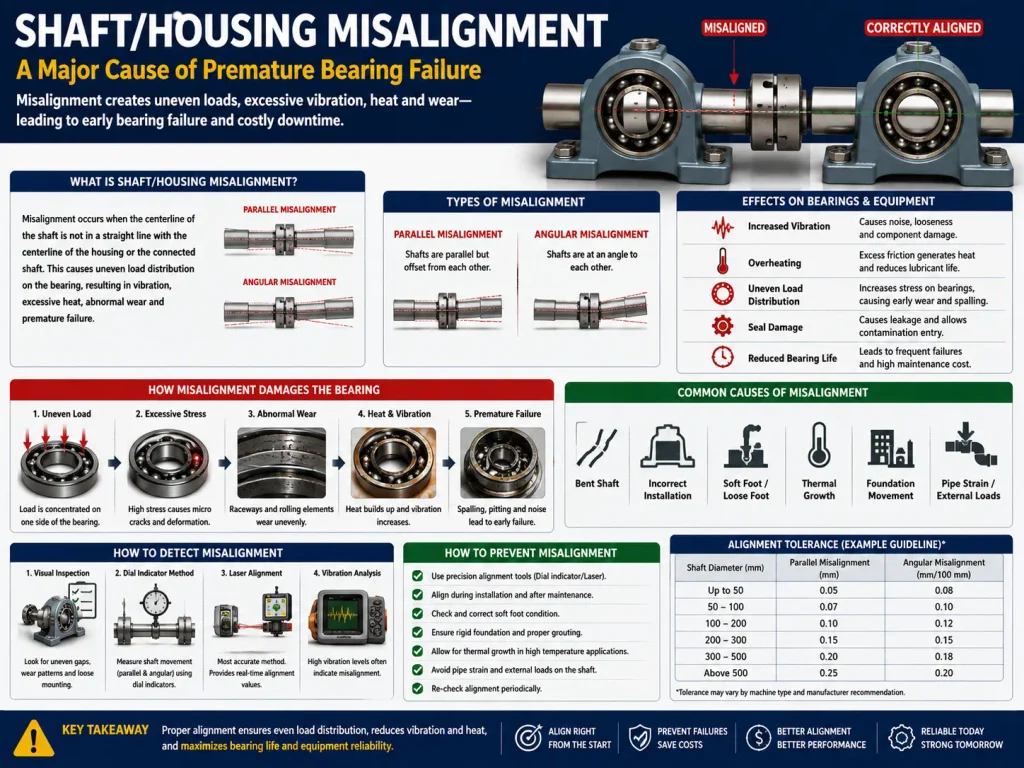
Watch for:
Check shaft straightness, housing geometry and mounting alignment. For critical machinery, use appropriate alignment and condition-monitoring methods rather than relying only on visual inspection.
Every bearing has load-carrying limits. Excessive radial load, axial load or combined loading can significantly reduce bearing life.
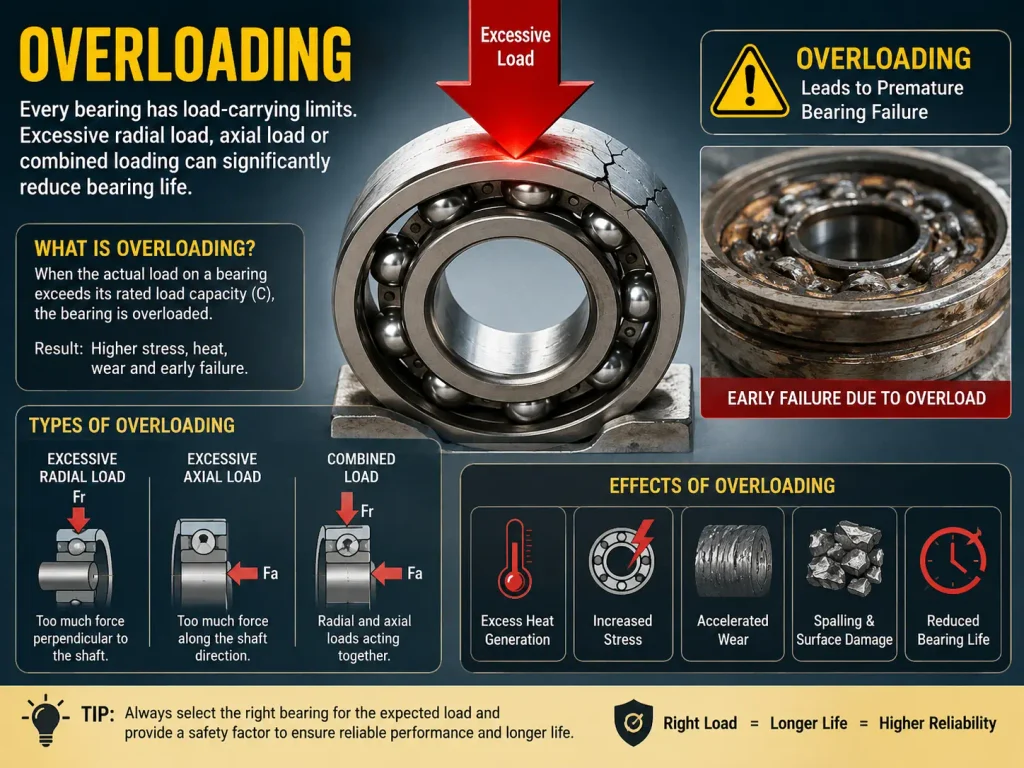
Overloading can result from:
For rolling bearings, calculated fatigue life is strongly influenced by the relationship between the bearing’s dynamic load rating and the equivalent dynamic bearing load.
For many ball-bearing applications, the basic rating-life relationship is:
L10 = (C/P)³
where:
Because load has a strong influence on calculated life, increasing the operating load can dramatically reduce theoretical bearing life.
Calculate the actual radial, axial and combined loads before selecting a bearing. Consider shock loads, acceleration, moment loads and operating conditions rather than using only the nominal machine load.
Bearing speed affects friction, temperature, lubrication and cage behavior.
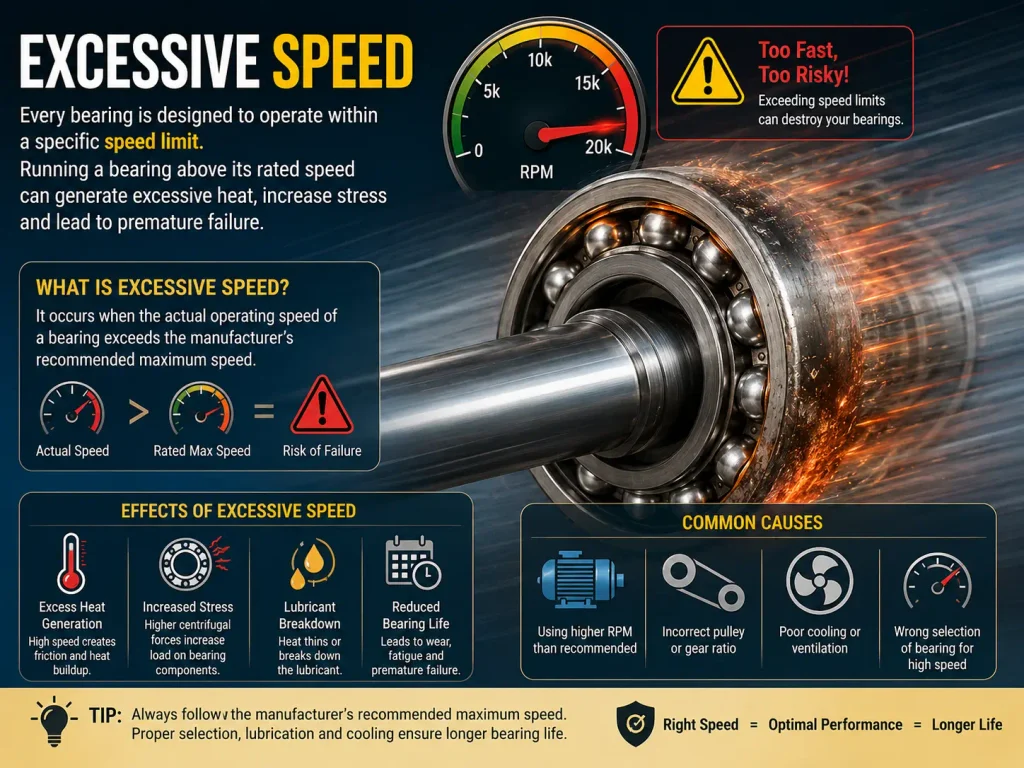
When a bearing operates above its suitable speed range, it may experience:
High-speed applications require careful consideration of bearing type, internal clearance, lubricant, cage design, cooling and operating temperature.
Check the manufacturer’s recommended speed limits and select the lubricant and bearing configuration according to the actual operating speed.
Do not assume that a bearing suitable for a low-speed application will automatically perform well at high speed.
Excessive vibration can both indicate and contribute to bearing failure.
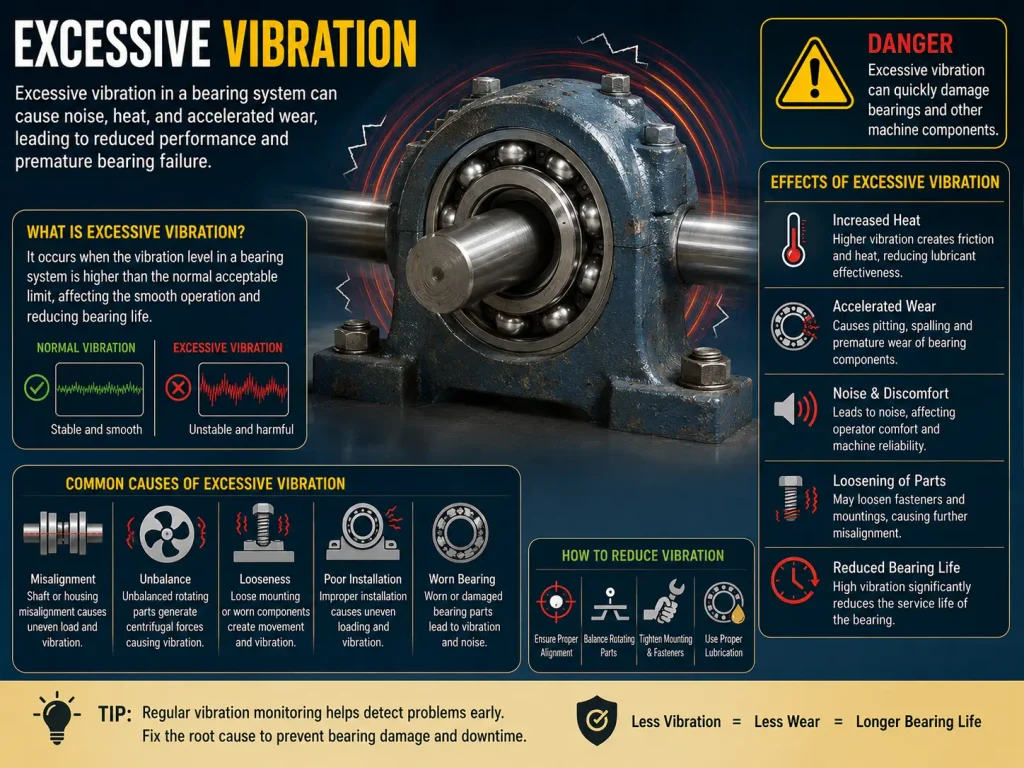
A rising vibration level may be associated with:
This is why bearing vibration analysis is an important part of predictive maintenance.
Modern maintenance programs often monitor vibration, temperature, noise and lubrication condition to detect abnormalities before catastrophic failure.
Establish a baseline vibration level for healthy equipment and monitor changes over time. A sudden or progressive increase should trigger investigation rather than simply waiting for the bearing to fail.
Water and moisture can cause corrosion on bearing rings and rolling elements.
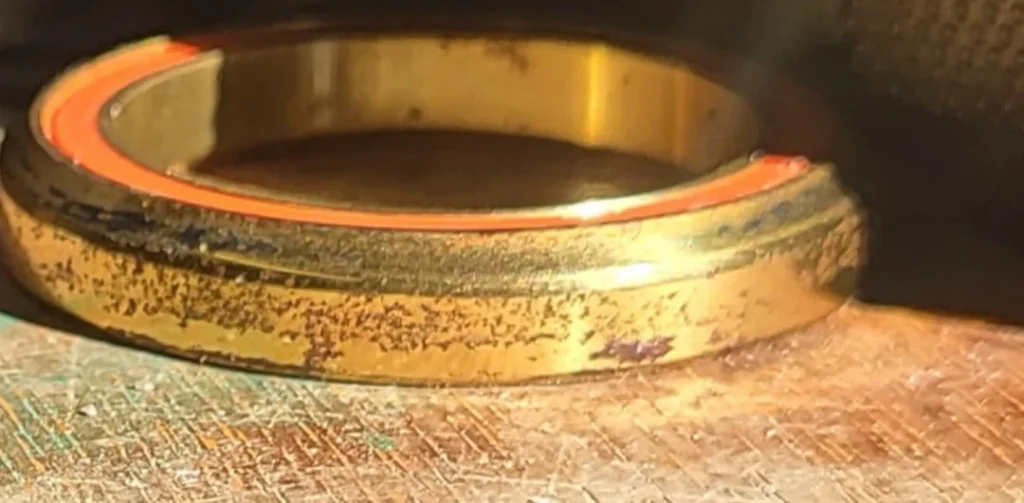
Moisture may enter through:
Corrosion can produce rust spots, staining, surface roughness and eventually fatigue damage.
Common signs include:
Use appropriate seals and corrosion protection. Protect bearings during storage and prevent moisture from entering the housing.
In washdown environments, inspect sealing systems carefully and use lubricants appropriate for the environment.
Electrical damage is particularly important in electric motors, variable-frequency-drive (VFD) systems and other electrically driven rotating equipment.
Electrical current passing through a bearing can produce localized arcing and surface damage. A common visual indication is electrical fluting, which can appear as repetitive grooves or a washboard-like pattern on the raceway.
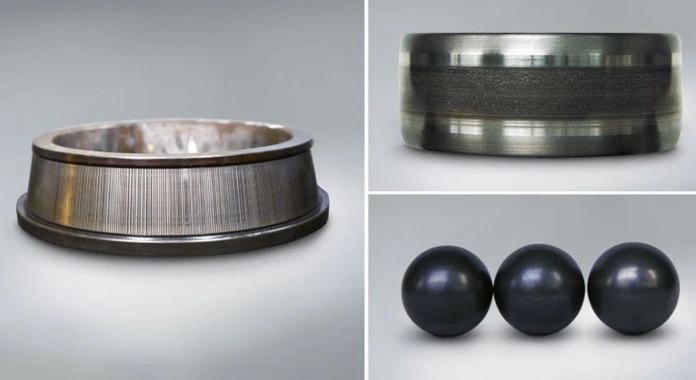
Electrical erosion can cause:
NSK identifies electrical damage among bearing failure conditions and notes that changes in sound, vibration and temperature can help identify developing damage.
For motor applications, evaluate the electrical system and bearing arrangement. Depending on the application, solutions may include appropriate insulation, grounding arrangements, electrically insulated bearings or ceramic rolling elements.
The correct solution depends on the motor, drive system, shaft voltage and electrical configuration.
Although lubrication, contamination and installation are frequently discussed, bearing selection itself is also critical.
A bearing can fail prematurely when it is not suitable for:
Incorrect internal clearance can also create problems. Clearance that is too small can contribute to heat generation and preload-related problems, while excessive clearance can affect running accuracy and load distribution.
Therefore, bearing selection should be based on the complete application—not simply bearing ID and OD.
Identifying bearing failure requires more than simply looking at whether the bearing feels rough.
A practical bearing failure analysis should combine:
A professional failure investigation may also involve lubricant or particle analysis and detailed examination of damaged surfaces.
Look for:
Do not immediately label every damaged bearing as simply “worn out.” The damage pattern often provides clues about the root cause.
| Bearing Failure Symptom | Possible Cause |
|---|---|
| High-pitched squealing | Poor lubrication, incorrect lubricant, tight clearance |
| Growling or rumbling | Contamination, raceway damage, corrosion |
| Clicking once per revolution | Dent, spall or damaged rolling element |
| Excessive vibration | Misalignment, contamination, wear, spalling, looseness |
| Overheating | Poor lubrication, overload, excessive preload, misalignment |
| Brown/red rust | Moisture or corrosion |
| Dark fluting marks | Electrical current damage |
| Grease leakage | Seal damage, excessive grease, high temperature |
| Rough rotation | Contamination, raceway damage, corrosion |
| Sudden seizure | Severe lubrication failure, overload, overheating or major damage |
| Uneven raceway wear | Misalignment or incorrect load distribution |
| Cage damage | Improper installation, excessive speed, lubrication problems or abnormal loading |
These symptoms should be treated as diagnostic clues rather than definitive diagnoses. A single symptom can have multiple possible causes.
The best bearing failure prevention strategy combines correct selection, installation, lubrication and condition monitoring.
Check:
Do not select a bearing based only on bearing ID and OD.
Follow the bearing manufacturer’s recommendations for:
Both under-lubrication and over-lubrication can cause problems.
Use clean tools and clean workspaces. Keep lubricant and grease equipment protected from dust and moisture.
Use suitable mounting tools and procedures. Never apply mounting force through the rolling elements unnecessarily.
Verify shaft and housing alignment before putting equipment into service.
A rising bearing temperature can be an early indication of lubrication, load, clearance or alignment problems.
Bearing vibration analysis can help identify developing defects before they become catastrophic.
Good seals help prevent contamination and lubricant loss. Damaged seals should be corrected promptly.
Do not operate beyond the bearing’s intended load and speed range.
If a replacement bearing fails in the same location repeatedly, do not simply install another bearing.
Perform a bearing root cause analysis.
Ask:
A replacement bearing cannot permanently solve a machine problem if the underlying cause remains.
A useful practical workflow is:
Failure observed → Collect operating data → Inspect bearing → Identify damage pattern → Determine probable cause → Verify root cause → Correct the problem → Replace bearing → Monitor the new bearing
Document:
Do not clean away important evidence before documenting the damage.
Photograph the bearing and record the location of:
For example:
Rust + moisture → investigate sealing and water ingress.
Fluting + motor/VFD application → investigate electrical current.
Overheating + lubricant problems → investigate lubrication.
Uneven wear + alignment problem → investigate shaft/housing alignment.
Replacing the bearing is only the final repair. The actual goal is to eliminate the condition that caused the failure.
Bearing failures rarely need to become sudden catastrophic events if the equipment is properly monitored.
Changes in:
can provide useful early warning signals.
This is the foundation of predictive maintenance, where maintenance decisions are based on the actual condition of equipment rather than simply replacing components at fixed intervals.
For industrial machinery, early detection can help reduce:
Bearing failure analysis is much more than identifying a damaged bearing. The real objective is to understand why the bearing failed and how to prevent the next failure.
The most important areas to investigate are lubrication, contamination, installation, shaft/housing alignment, load, speed, vibration, moisture, electrical damage and bearing selection.
A bearing showing abnormal noise, vibration or temperature should not be ignored. These can be early warning signs of developing damage. Regular inspection and condition monitoring can help identify problems before they become expensive equipment failures.
For maintenance professionals, engineers and machine operators, the most effective approach is simple:
Select correctly → Install correctly → Lubricate correctly → Keep clean → Monitor continuously → Analyze failures → Fix the root cause.
That approach can improve bearing reliability, bearing service life, machine uptime and maintenance efficiency.
Common causes include improper lubrication, contamination, incorrect installation, misalignment, excessive load and abnormal operating conditions. The dominant cause can vary significantly by machine and application.
Common bad bearing symptoms include abnormal noise, increasing vibration, overheating, rough rotation, excessive play, lubricant leakage, corrosion and visible raceway damage.
Yes. Too much grease can cause churning, heat generation and lubricant degradation. Therefore, more grease does not always mean better lubrication.
Dust, dirt, metal particles and moisture can damage raceways and rolling elements. Contamination may produce dents, scratches, wear and increased vibration.
Yes. Shaft or housing misalignment can create uneven loading and localized stress, resulting in abnormal wear, heat and vibration.
Possible causes include insufficient lubrication, excessive lubrication, excessive load, excessive speed, incorrect clearance, preload, misalignment and contamination.
Electrical fluting is a form of electrical erosion caused when electrical current passes through the bearing. It can create repetitive grooves on raceways and eventually cause noise, vibration and premature failure.
Use the correct bearing, install it properly, maintain correct lubrication, protect it from contamination, control load and speed, maintain alignment and monitor vibration and temperature.
Not necessarily without investigation. Noise can result from lubrication problems, contamination, clearance, alignment or actual bearing damage. Determine the cause before replacing the component.
Bearing root cause analysis is the process of determining why a bearing failed instead of simply identifying that it failed. It combines operating history, visual evidence, vibration, temperature, lubrication and installation information to identify the underlying failure mechanism.

Welcome! I am a dedicated entrepreneur running an industrial affiliate product website, helping businesses and professionals find the best tools, equipment, and resources for their needs. With a passion for industrial products and a keen eye for quality, I curate and recommend top-performing items that enhance efficiency and reliability.
Through my platform, I aim to simplify the buying process by providing valuable insights, expert reviews, and trusted affiliate links to high-quality industrial products. Whether you’re looking for the latest machinery, tools, or safety gear, I strive to connect you with the best solutions available.
Thank you for visiting, and I look forward to helping you make informed purchasing decisions!
