Our Location
Killa-Pardi, Dist. Valsad, 396125

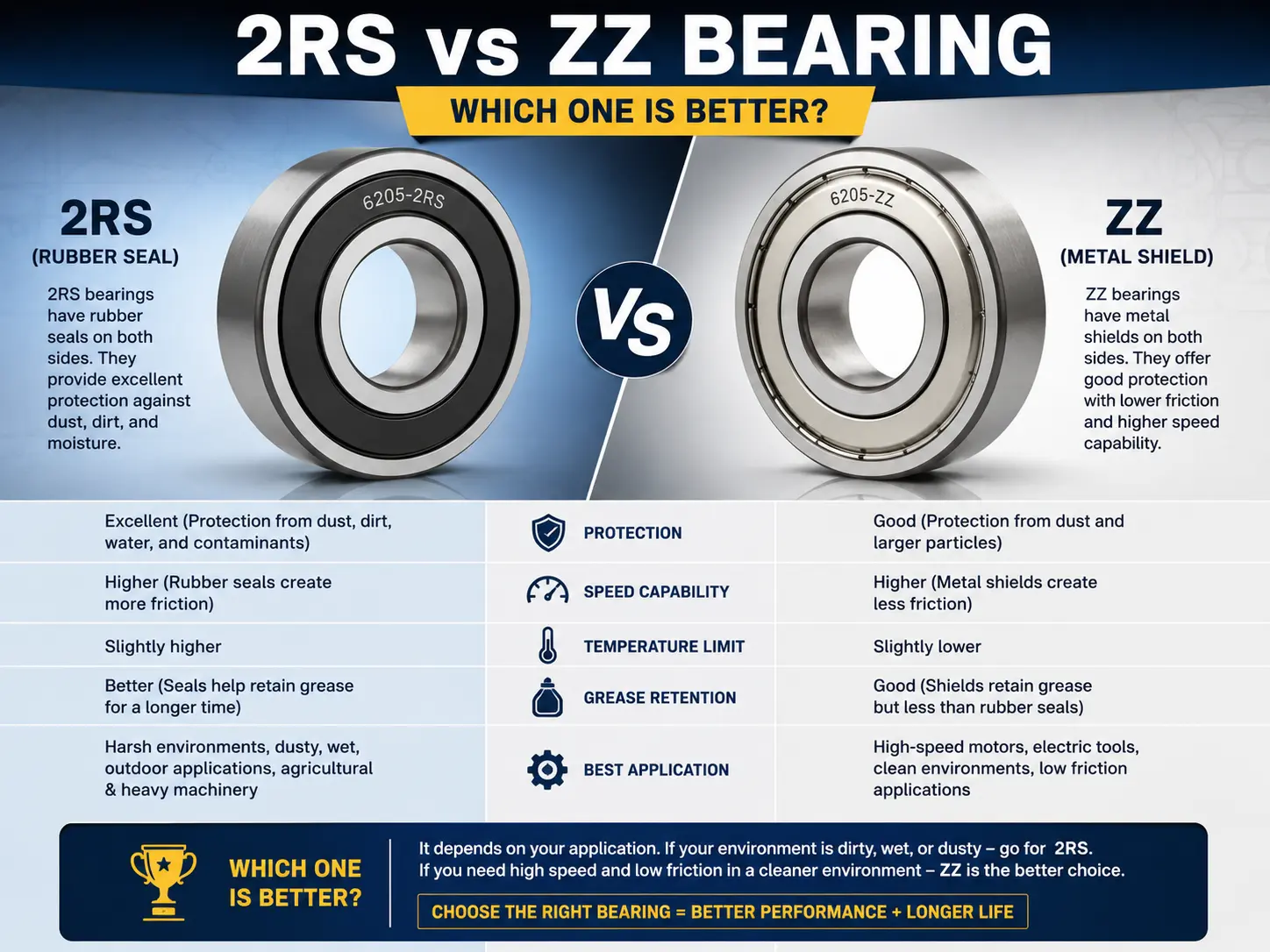
The 2RS vs ZZ comparison mainly depends on the operating environment. In a 2RS vs ZZ bearing comparison, 2RS bearings use rubber seals on both sides for better protection against dust, dirt, and moisture, making them ideal for harsh or contaminated environments.
For example, an NSK 6205ZZ has a 25 mm bore, 52 mm outside diameter and 15 mm width, with a basic dynamic load rating of 15,400 N and a basic static load rating of 7,850 N. NSK lists a grease limiting speed of 15,000 min⁻¹ for this ZZ version. A corresponding contact-sealed 6205 configuration can have a substantially lower limiting speed because the rubber seal creates additional friction.
If the bearing operates in a wet, dirty or dusty environment, 2RS is generally the better choice. If the application requires low friction, high rotational speed and relatively clean conditions, ZZ can be the better option.
2RS generally means that the bearing has two rubber contact seals, one on each side.
The exact designation varies between manufacturers. For example, NSK commonly uses DDU for a double-sided contact seal, while SKF uses designations such as 2RS1 or 2RSH depending on the seal design. Schaeffler/FAG may use other designations. Therefore, the complete manufacturer designation should always be checked before cross-referencing a bearing.
The important point is the construction:
2RS = rubber contact seal on both sides
The rubber seal contacts the rotating inner-ring surface. This contact creates a barrier that helps prevent contaminants from entering the rolling-element area and helps retain grease inside the bearing.
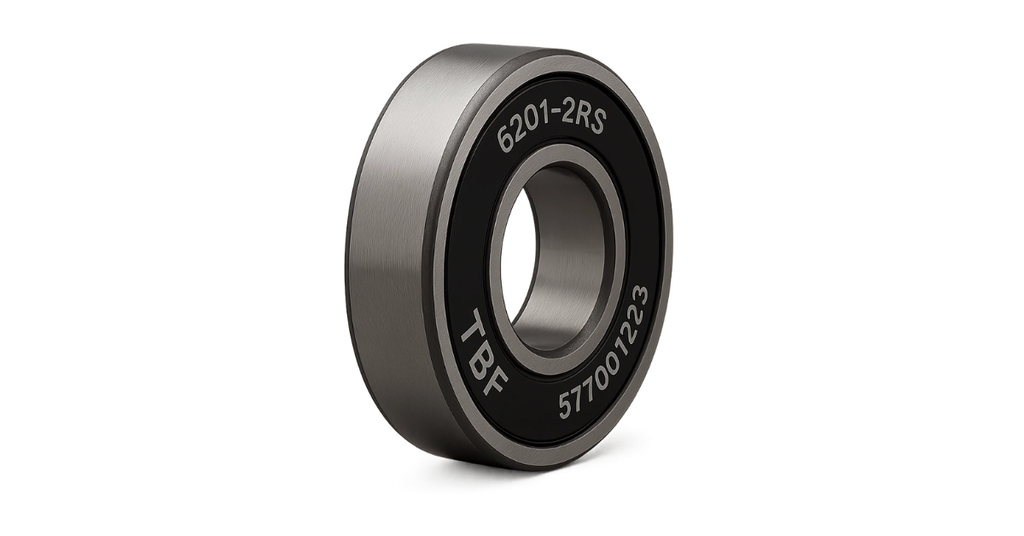
The disadvantage is that the seal physically contacts the rotating ring. This produces additional friction and heat compared with a non-contact metal shield. NSK’s bearing documentation specifically identifies higher torque and lower speed capability for contact-sealed bearings compared with ZZ shielded bearings.
ZZ generally means that the bearing has two metal shields, one on each side.
NSK, for example, identifies 6205ZZ as a bearing with shields on both sides.
Unlike a rubber contact seal, a conventional metal shield normally does not rub directly against the inner ring. Instead, it forms a narrow sealing gap.
This non-contact construction produces very little additional friction.
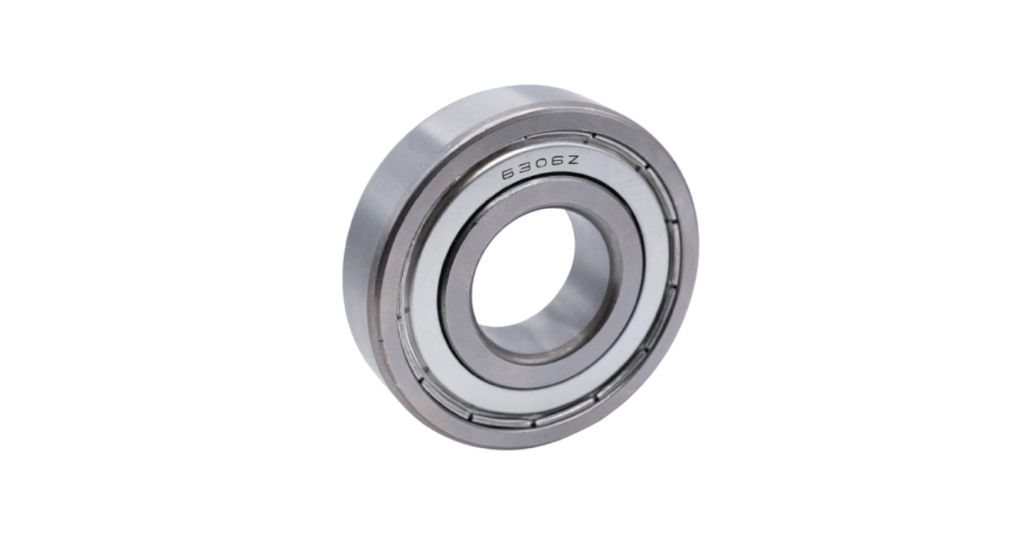
However, the gap means that a ZZ shield does not provide the same contamination barrier as a properly designed contact seal.
SKF describes shielded bearings as using sheet-steel shields that form a narrow sealing gap with the inner ring. SKF also notes that shielded bearings are primarily intended for applications where the inner ring rotates.
The easiest way to understand the difference is:
2RS = contact rubber seal
ZZ = non-contact metal shield
This small structural difference creates several important performance differences.
| Feature | 2RS Bearing | ZZ Bearing |
|---|---|---|
| Closure | Rubber seal | Metal shield |
| Number of sides | Both sides | Both sides |
| Contact with inner ring | Yes | Normally no |
| Friction | Higher | Lower |
| Starting torque | Higher | Lower |
| Dust protection | Excellent | Good |
| Fine contamination protection | Better | Lower |
| Water/moisture protection | Better | Limited |
| Grease retention | Excellent | Good |
| High-speed capability | Lower | Higher |
| Seal wear | Possible | Very low shield wear |
| Typical environment | Dirty/wet | Clean/dry |
| Common applications | Conveyors, wheels, agricultural equipment | Motors, fans, electric machinery |
| Maintenance | Usually factory lubricated | Usually factory lubricated |
The exact performance depends on the manufacturer, seal design, grease, bearing size, internal clearance and operating conditions. Therefore, the table should be used as a selection guide rather than as a universal numerical specification.
A 2RS bearing contains an elastomeric sealing element installed on both sides.
The sealing lip contacts the inner-ring surface.
Imagine a rotating shaft passing through the centre of the bearing. The inner ring rotates with the shaft, while the rubber seal remains mounted in the outer-ring region. The sealing lip therefore slides against the rotating surface.
This creates a physical barrier.
It performs two important jobs:
This is particularly valuable in environments containing:
The price for this protection is additional seal friction.
SKF explains that contact-sealed bearings use seals fitted into recesses in the outer ring and designed to seal against the inner-ring geometry.
A ZZ bearing uses steel shields instead of rubber contact seals.The shield creates a narrow gap around the inner ring. Because there is normally no rubbing contact, friction is considerably lower.
This makes ZZ bearings particularly attractive for applications where rotational speed and low friction are important. However, the narrow gap is not equivalent to a fully contacting rubber seal.
For example, water under pressure or very fine contamination can potentially pass through the shield arrangement. Therefore:
ZZ is not a waterproof bearing.
This is one of the most important points to understand when selecting between ZZ and 2RS.
Let’s take a real industrial bearing as an example.
The NSK 6205ZZ is a single-row deep groove ball bearing.
According to NSK’s product information:
This example demonstrates an important point:
The 6205 bearing number describes the fundamental bearing size and series, while the suffix ZZ describes its shielding arrangement. So:
6205 + ZZ = 6205 bearing with shields on both sides.
The same basic 6205 geometry can be offered with different closure arrangements, but the permissible speed and friction characteristics can change.
For a practical comparison, NSK lists the 6205ZZ with a grease limiting speed of 15,000 min⁻¹, while NSK’s 6205DDU contact-sealed configuration is listed at 9,000 min⁻¹ in its calculation database. Both configurations retain the same basic 25 × 52 × 15 mm boundary dimensions and 15,400 N dynamic and 7,850 N static load ratings in the referenced NSK data.
This is a very useful real-world example.
The bearing’s fundamental load-carrying geometry can remain the same, while the closure system changes the permissible operating speed. The approximate difference between these two published grease speed values is:
15,000 − 9,000 = 6,000 rpm
or approximately:
40% lower for the contact-sealed version relative to the ZZ value in this particular NSK example.
This does not mean every 2RS bearing is exactly 40% slower than every ZZ bearing. Seal design, bearing series, grease, temperature and manufacturer all affect the actual limit. But it clearly demonstrates why the seal suffix should not be ignored.
A practical example is the NSK 6206 deep groove ball bearing. The 6206 has a 30 mm bore, 62 mm outside diameter and 16 mm width. NSK lists a basic dynamic load rating of 21,400 N and basic static load rating of 11,300 N. For the ZZ version, the published grease limiting speed is 12,000 rpm.
NSK’s industrial-bearing data also shows the 6206 family with ZZ, VV and DDU closure options and gives different speed values for these configurations. The listed values are 12,000 rpm for ZZ, 7,500 rpm for VV and 15,000 rpm for DDU in that particular table’s speed columns. Because manufacturer tables can present speed limits under different conditions, the exact catalogue for the selected bearing should always be used rather than assuming one universal value.
Practical application:
Suppose a 6206 bearing is being used in an industrial motor operating around 3,000 rpm in a relatively clean environment. A ZZ configuration can be attractive because its metal shields provide protection while maintaining low seal-related friction.
Now consider the same basic bearing in a dusty conveyor environment. The priority changes from minimum friction to contamination protection. A suitable contact-sealed version may therefore be preferable, provided its speed and temperature limits are compatible with the machine.
Engineering lesson:
The bearing dimensions and load ratings alone do not determine the best bearing. The closure type must match the operating environment.
Another useful example is the NSK 6306ZZ.
NSK specifies the 6306ZZ with:
This is a good example for explaining why ZZ bearings are commonly considered for electric motors and other clean rotating equipment. NSK specifically identifies deep-groove ball bearings as suitable for applications such as industrial motors, servomotors, electric machinery and other rotating equipment where low friction and high rotational speed are important.
Assume this 6306 bearing experiences an equivalent dynamic load of 2,000 N.
For a ball bearing, the basic rating-life equation is:
L10 = (C/P)³
Therefore:
L10 = (29,300 / 2,000)³
L10 ≈ 3,140 million revolutions
If the bearing operates continuously at 3,000 rpm:
L10h = (L10 × 10⁶) / (60 × n)
So:
L10h ≈ 17,440 hours
This is a theoretical basic rating life (L10) based on the assumed load. It is not a guaranteed service life because actual bearing life can be affected by contamination, lubrication, installation, temperature, vibration, misalignment and other factors.
For this particular application, if the motor is clean and operating well below the published 11,000 rpm grease limit, the ZZ configuration can be a sensible choice.
Practical lesson:
For a clean industrial motor, the low-friction characteristics of a ZZ shield can be more valuable than the stronger contamination protection of a contact seal.
| Real application | Better choice | Main reason |
|---|---|---|
| 6206 in clean industrial motor | ZZ | Low friction + good speed capability |
| 6206 in dusty conveyor | 2RS/contact seal | Better contamination protection |
| 6306ZZ industrial motor | ZZ | Low-friction shielded design |
| Outdoor/agricultural machinery | 2RS/contact seal | Better protection from dirt and moisture |
Important: These examples demonstrate the selection principle; they do not mean ZZ or 2RS is universally better. Always verify the exact manufacturer’s speed, temperature, grease and sealing specifications before substitution.
Consider a conveyor roller operating inside a manufacturing facility.
Suppose the conveyor carries:
The bearing may continuously encounter airborne particles. A ZZ shield can block many larger particles, but its non-contact gap provides less protection than a contact seal.
A 2RS bearing provides a stronger physical barrier. Therefore, in a dusty environment:
2RS is generally the safer choice.
However, the correct design should also consider whether the bearing is exposed to extreme temperature, high speed or chemical contamination.
The major advantage of ZZ is low friction.
Because the metal shield does not normally rub against the inner ring, there is no significant rubbing torque generated by the closure itself.
This makes ZZ attractive in:
For example, NSK lists the 6205ZZ at 15,000 min⁻¹ grease limiting speed, whereas its 6205DDU contact-sealed configuration is listed at 9,000 min⁻¹.
At high rotational speed, seal friction generates heat. If heat generation becomes excessive, lubricant performance and bearing life can be affected. Therefore, selecting 2RS merely because it “seals better” can be the wrong engineering decision for a high-speed motor.
Dust protection is one of the most important differences.
ZZ provides good protection against larger dust particles and foreign objects.
It is appropriate when the environment is reasonably clean and the machine does not experience significant moisture or fine contamination.
2RS provides significantly better contamination exclusion because the rubber seal contacts the rotating ring.
This makes it more appropriate for:
NSK’s comparison of sealed bearing designs rates the contact-sealed configuration as having the best dust resistance among the listed ZZ, rubber non-contact and rubber contact arrangements.
If water is present, 2RS normally has a major advantage.
Examples include:
A metal shield is not designed to provide the same level of water exclusion as a properly designed contact seal. However, even a 2RS bearing should not automatically be considered waterproof.
A high-pressure washdown can exceed the sealing capability of the bearing. If the equipment experiences direct high-pressure water jets, the complete housing and external sealing system must be considered.
This is where ZZ has a significant advantage. Because 2RS uses a contacting rubber lip, the seal produces additional rotational resistance.
That resistance becomes particularly important at:
ZZ generally produces lower friction because the shield does not contact the inner ring.
NSK explicitly lists the torque of ZZ shielded bearings as lower than contact-sealed DDU bearings.
Friction produces heat. More friction generally means more heat generation, although the actual bearing temperature also depends on:
Because ZZ has very low seal friction, it is often preferred for applications where speed and temperature management are important.
SKF states that shielded bearings are intended for applications involving high temperatures and high speeds, while its contact-sealed bearing designs have specified seal temperature ranges that depend on the particular seal material and design.
Therefore, do not select a bearing based only on “2RS is more protected.” The thermal environment matters.
Another important difference is grease retention. A 2RS seal provides a stronger barrier around the grease-filled bearing cavity. This helps reduce lubricant leakage and contamination ingress.
ZZ bearings also retain grease effectively for many applications, but the shield arrangement is not as strong a contamination barrier as a contacting seal. This is one reason both types are commonly supplied as factory-greased bearings.
However: Factory-greased does not mean lifetime under every operating condition. Bearing life depends on load, speed, temperature, contamination, lubrication and installation quality.
No. This is perhaps the biggest misconception. Many buyers think: “2RS has better sealing, therefore 2RS is always better.” That is incorrect. The bearing should be selected according to the operating environment.
Suppose a motor operates at approximately 3,000 rpm in a relatively clean indoor factory. The motor needs:
A ZZ bearing can be a strong candidate. If the motor operates in a dusty cement plant, however, the decision may change. In that environment, contamination protection becomes more important, and a properly selected sealed bearing may provide better service.
Imagine a conveyor roller operating at moderate speed in a dusty warehouse. The speed requirement is not extremely high.nThe main problem is dust.
In this case, 2RS is usually preferable because the rubber contact seals provide better contamination exclusion. This can reduce the chance of abrasive particles reaching the raceway and rolling elements.
Agricultural machinery can encounter:
This is a challenging environment for bearings. A ZZ bearing may not provide enough protection if contamination reaches the bearing directly. A 2RS/contact-sealed bearing is generally more appropriate for such conditions, provided its speed and temperature ratings are suitable.
Consider a small high-speed cooling fan. The bearing must rotate rapidly while generating minimal friction. The surrounding environment is relatively clean. Here, a ZZ bearing can be advantageous because its non-contact shield generates less additional friction than a contact seal.
A 2RS bearing could still work if its speed rating and temperature are adequate, but it may introduce unnecessary seal drag.
There is no universal answer.
Bearing fatigue life (Bearing Life) is strongly influenced by load and bearing dynamic load rating. For a basic rating life calculation for a ball bearing:
L10 = (C/P)³
where:
For the NSK 6205 example:
C = 15,400 N
Suppose the equivalent dynamic load is:
P = 1,000 N
Then:
L10 = (15,400 / 1,000)³
L10 ≈ 3,652 million revolutions
At 3,000 rpm, the theoretical basic rating life in hours would be approximately:
L10h = L10 × 10⁶ / (60 × n)
L10h ≈ 20,289 hours
This is a theoretical bearing-fatigue calculation under the specified load assumptions. It should not be interpreted as a guaranteed field service life. Contamination can dramatically affect actual bearing performance. This is another reason 2RS can outperform ZZ in dirty environments even when their basic load ratings are similar.
Potentially, yes.
But not simply because the rubber seal itself makes the rolling elements stronger. The seal can indirectly increase service life by preventing contamination from entering the bearing.
Contaminants can cause:
Therefore, in a contaminated environment, the improved sealing of 2RS may provide a significant practical advantage. In a clean, high-speed environment, however, ZZ may provide better overall performance because of its lower friction and higher speed capability.
Sometimes, but not automatically.
Before replacing:
6205ZZ → 6205-2RS
check:
The basic dimensions may be identical, but the permissible operating conditions can be different. Do not assume that two bearings with the same number and different suffixes are performance-equivalent.
Technically, a ZZ bearing may fit dimensionally, but the application may no longer have sufficient contamination protection.
For example:
6205-2RS → 6205ZZ
may be a poor substitution if the machine operates outdoors or in a wet environment.
The bearing may physically fit but fail earlier because contamination protection has been reduced.
This is another common mistake.
Consider:
6205-2RS-C3
It contains different pieces of information.
Now consider:
6205ZZ-C3
Here:
Therefore:
ZZ/2RS describes the closure. C3 describes internal clearance. They are completely different specifications.
Mistake 1: Selecting only by bearing number
A buyer may search for “6205 bearing” and purchase the first result. But 6205 may be available as:
The complete designation matters.
Mistake 2: Assuming ZZ is waterproof
It is not. ZZ is a metal shield arrangement, not a high-grade water seal.
Mistake 3: Assuming 2RS can run at any speed
It cannot. Contact seals create friction and heat, so the manufacturer’s limiting speed must be checked.
The NSK example demonstrates this clearly: 6205ZZ is listed at 15,000 min⁻¹ grease limiting speed, while 6205DDU is listed at 9,000 min⁻¹.
Mistake 4: Ignoring temperature
Rubber seal materials have temperature limitations. For example, SKF lists specific temperature ranges for its NBR-based low-friction and contact seal designs, illustrating why the exact seal construction matters.
Mistake 5: Cross-branding without checking suffixes
A ZZ bearing from one manufacturer may not use exactly the same suffix system as another. For example, NSK identifies ZZ as shields on both sides and DDU as a contact-seal arrangement, while SKF uses its own seal/shield suffix conventions.
Therefore, always check the manufacturer’s catalogue.
Use this simple rule:
| Clean + High Speed → ZZ | If the machine is clean and high speed is important, consider ZZ |
| Dusty + Dirty → 2RS | If contamination is the major concern, consider 2RS |
| Wet + Outdoor → 2RS | If moisture and water splash are expected, a contact seal is generally preferable. |
| High-Speed Motor → ZZ | If speed, low torque and heat reduction are priorities, ZZ can be advantageous. |
| Conveyor → 2RS | For many dusty conveyor applications, 2RS is a practical choice. |
| Agricultural Machinery → 2RS | Outdoor contamination generally makes better sealing valuable. |
| Fan → ZZ | For clean, high-speed rotating fans, ZZ can be suitable. |
There is no universal winner. The correct selection depends on the machine’s operating conditions.
2RS wins on contamination protection.
ZZ wins on low friction and high-speed capability.
A 2RS bearing uses rubber contact seals that physically contact the inner ring. This provides stronger protection against dust, dirt and moisture, but creates additional friction and can reduce the permissible speed.
A ZZ bearing uses metal shields with a non-contact arrangement. It provides good protection against larger contaminants while maintaining low friction and good high-speed performance.
The real NSK 6205 example illustrates the engineering trade-off. The 6205ZZ has dimensions of 25 × 52 × 15 mm, a 15,400 N dynamic load rating, 7,850 N static load rating and a published grease limiting speed of 15,000 min⁻¹. NSK’s 6205DDU contact-sealed version retains the same basic dimensions and load ratings in the referenced data but has a published grease limiting speed of 9,000 min⁻¹.
Therefore, if your machine operates in a clean environment at high speed, ZZ may be the better choice.
If your machine operates in dust, moisture or contamination, 2RS is generally the better choice.
The most important lesson is:
Do not ask only “Which bearing is better—2RS or ZZ?” Ask “Which bearing closure is better for my operating environment?” That is the engineering approach that leads to better bearing selection, longer service life and lower maintenance costs.
2RS bearings use rubber contact seals on both sides, while ZZ bearings use metal shields on both sides. 2RS generally provides better contamination protection, while ZZ generally provides lower friction and better high-speed capability.
Not always. 2RS is generally better for dusty or wet environments. ZZ is often better for clean, high-speed applications.
No. ZZ is a shielded, non-contact arrangement and should not be treated as a waterproof bearing.
It can be, but its permissible speed depends on the specific seal design and manufacturer. Contact seals normally generate more friction than ZZ shields.
For a clean, high-speed electric motor, ZZ can be an excellent choice. For a motor operating in a contaminated environment, a properly specified contact-sealed bearing may be preferable.
In dusty or dirty conveyor applications, 2RS is commonly preferable because of its stronger contamination protection.
Generally, yes. The “2” indicates both sides and RS identifies a rubber contact-seal arrangement, although exact suffix meanings vary by manufacturer.
Yes. ZZ commonly identifies a bearing with metal shields on both sides. NSK explicitly uses ZZ for shields on both sides.
6205-2RS generally means a 6205 deep groove ball bearing with rubber contact seals on both sides. Always confirm the exact manufacturer’s suffix.
6205ZZ is a 6205 deep groove ball bearing with metal shields on both sides. NSK’s 6205ZZ is 25 × 52 × 15 mm.
2RS describes the bearing’s sealing arrangement, while C3 describes increased internal radial clearance. They are different specifications and can appear together, such as 6205-2RS-C3.
Only after checking speed, temperature, contamination and manufacturer specifications. The dimensions may be the same, but operating limits can differ.
You can sometimes make the dimensional substitution, but doing so may reduce contamination and moisture protection. It should be evaluated based on the application.
Neither is universally longer-lasting. In a clean, high-speed application, ZZ can perform very well. In a contaminated environment, 2RS may deliver longer practical service life because it better protects the lubricant and rolling surfaces.
Choose 2RS for dust, dirt and moisture protection and choose ZZ for clean, high-speed and low-friction applications. Always verify the manufacturer’s exact specifications before purchase.

Welcome! I am a dedicated entrepreneur running an industrial affiliate product website, helping businesses and professionals find the best tools, equipment, and resources for their needs. With a passion for industrial products and a keen eye for quality, I curate and recommend top-performing items that enhance efficiency and reliability.
Through my platform, I aim to simplify the buying process by providing valuable insights, expert reviews, and trusted affiliate links to high-quality industrial products. Whether you’re looking for the latest machinery, tools, or safety gear, I strive to connect you with the best solutions available.
Thank you for visiting, and I look forward to helping you make informed purchasing decisions!
