Our Location
Killa-Pardi, Dist. Valsad, 396125

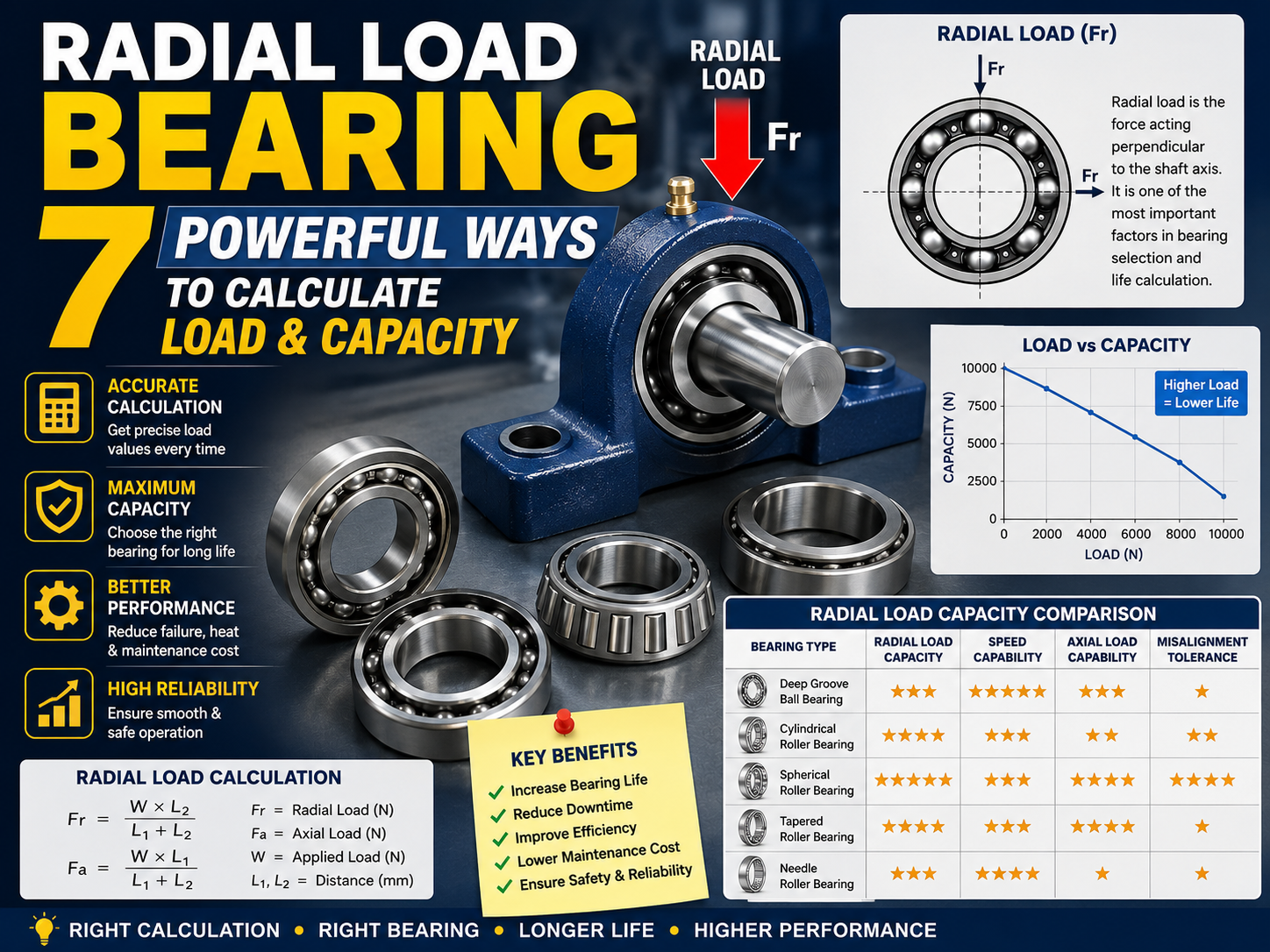
A radial load is a force acting perpendicular to the axis of a rotating shaft. In simple terms, if a shaft rotates horizontally and a force pushes the shaft downward or sideways, the bearing supporting that shaft experiences a radial load.
Radial loading is one of the most important factors in bearing selection, bearing life, shaft design and machine reliability.
Common sources of radial load include:
For example, in an electric motor, the weight of the rotor creates a radial force on the bearings. In a belt-driven machine, belt tension can produce a much larger radial load than the rotor weight.
The direction of radial load is perpendicular to the shaft axis, whereas axial load acts parallel to the shaft axis.
Selecting a bearing only by its bore diameter is a dangerous mistake.
Two bearings may both have a 30 mm bore but have dramatically different radial load capabilities because their internal construction, rolling elements, dimensions and load ratings are different.
A bearing exposed to excessive radial load can experience:
Bearing life is particularly sensitive to load. Under the basic ISO 281 rating-life relationship, the theoretical basic rating life is:
L₁₀ = (C/P)ᵖ
Where:
This means that a relatively small increase in load can produce a surprisingly large reduction in theoretical fatigue life.
Different bearing designs are optimized for different combinations of radial load, axial load, speed and operating conditions.
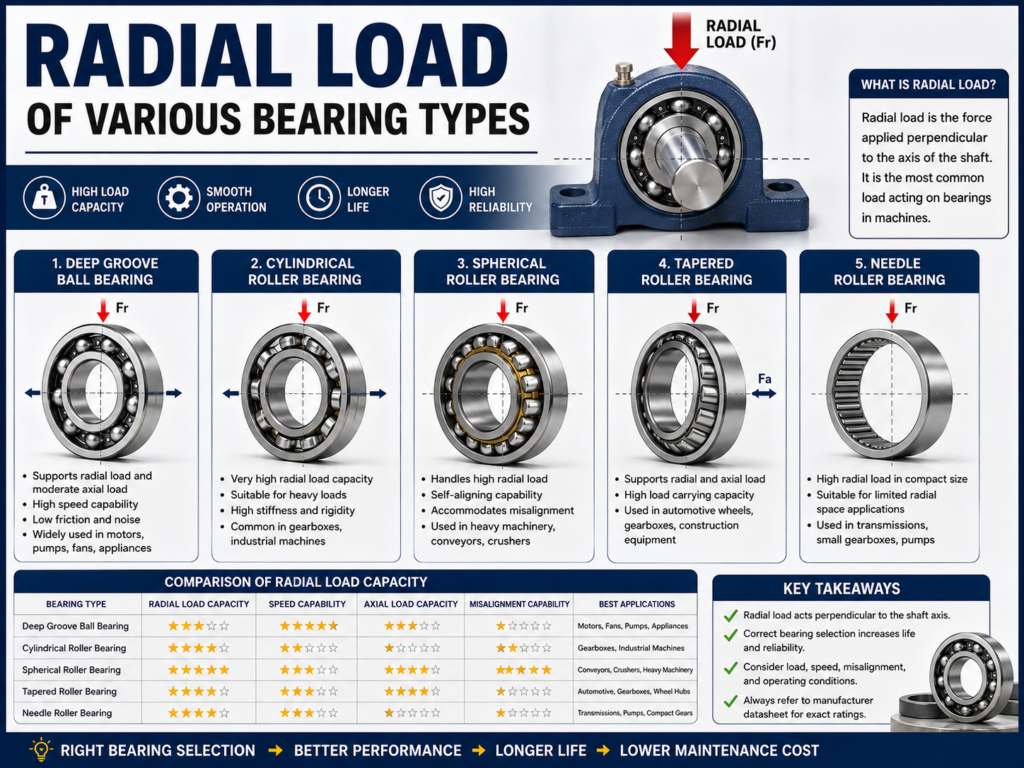
Deep groove ball bearings are among the most widely used bearing types.
They can support radial loads and also accommodate a certain amount of axial load in both directions.
Deep groove ball bearings provide:
However, their point contact means that their radial-load capacity is generally lower than that of similarly sized heavy-duty roller bearings.
Cylindrical roller bearings are designed primarily for high radial loads.
Instead of balls, they use cylindrical rollers. The larger contact area between roller and raceway allows them to carry substantially higher radial loads than many ball-bearing designs of comparable size.
For a machine where radial load is the dominant design requirement, cylindrical roller bearings can be an extremely powerful choice.
Spherical roller bearings are designed for heavy radial loads and can also accommodate significant axial loads.
Their self-aligning capability makes them particularly valuable when shaft deflection, housing deformation or small alignment errors are expected.
Spherical roller bearings are especially attractive when high radial load + misalignment + heavy-duty operation occur together.
Tapered roller bearings use tapered rollers and raceways.
They are particularly useful when both radial and axial forces are significant.
A major engineering characteristic is that radial loading can generate an axial reaction inside the bearing arrangement. Therefore, tapered roller-bearing calculations require more than simply checking the external radial force.
Needle roller bearings use long, relatively small-diameter rollers.
Their greatest advantage is their ability to provide high radial-load capacity in a compact radial space.
| Bearing Type | Radial Load Capacity | Speed Capability | Axial Load Capability | Misalignment Capability | Best Use |
|---|---|---|---|---|---|
| Deep Groove Ball | Medium | Very High | Medium | Low | Motors, fans, pumps |
| Cylindrical Roller | Very High | High | Low–Medium* | Low–Medium* | Heavy radial loads |
| Spherical Roller | Very High | Medium | High | Very High | Heavy industrial machinery |
| Tapered Roller | Very High | Medium | Very High | Low | Combined loads |
| Needle Roller | High for size | Medium–High | Low* | Low | Compact machinery |
Capacity depends strongly on the specific bearing design and arrangement.
Important: This table is a practical qualitative comparison, not a substitute for the manufacturer’s catalog rating.
Consider an example bearing-selection comparison.
Suppose a shaft has an applied radial force of:
F = 4,000 N = 4 kN
The shaft is supported by two bearings.
Distance between Bearing A and the force:
a = 200 mm
Distance between the force and Bearing B:
b = 300 mm
Total span:
L = 200 + 300 = 500 mm
The bearing reactions are:
Rₐ = F × b / L
Rₐ = 4,000 × 300 / 500
Rₐ = 2,400 N
Rᵦ = F × a / L
Rᵦ = 4,000 × 200 / 500
Rᵦ = 1,600 N
Therefore:
Rₐ + Rᵦ = 2,400 + 1,600 = 4,000 N
This demonstrates an important engineering principle:
The external radial load on the shaft is not necessarily equal to the load carried by each bearing.
The position of the force determines how the load is distributed.
For a simple two-support shaft:
R₁ = F × L₂ / (L₁ + L₂)
R₂ = F × L₁ / (L₁ + L₂)
Where:
For real machinery, the calculation can become much more complicated because there may be:
Therefore, a free-body diagram should be created before selecting the bearing.
A bearing may experience radial and axial loads simultaneously.
Let:
Fᵣ = radial load
Fₐ = axial load
For many radial bearings, the equivalent dynamic bearing load can be expressed generally as:
P = X Fᵣ + Y Fₐ
where X and Y are bearing-specific factors.
For some conditions, particularly when the axial-to-radial load ratio is below the applicable limiting factor, the calculation can simplify to:
P = Fᵣ
The exact values of X, Y and the limiting factor depend on the bearing type and manufacturer’s catalog.
This is extremely important because you should not simply assume that:
P = radial load
when a significant axial load is also present.
The basic rating-life equation is:
L₁₀ = (C/P)ᵖ
Assume:
C = 20 kN
P = 5 kN
For a ball bearing:
p = 3
Therefore:
L₁₀ = (20/5)³
L₁₀ = 4³
L₁₀ = 64 million revolutions
At 1,500 rpm:
L₁₀h = 64,000,000 × 60 / 1,500
L₁₀h = 2,560 hours
This is a basic rating-life calculation, not a guarantee of actual service life.
This is one of the most powerful concepts in bearing engineering.
Suppose:
C = 20 kN
Initially:
P = 5 kN
Then:
L₁₀ = (20/5)³ = 64 million revolutions
Now double the radial load:
P = 10 kN
Then:
L₁₀ = (20/10)³
L₁₀ = 8 million revolutions
Therefore, for this ball-bearing example:
64 / 8 = 8
The theoretical rating life becomes only 1/8 of the previous value.
For roller bearings, because the exponent is 10/3, doubling load produces an even stronger reduction:
2^(10/3) ≈ 10.08
So, approximately, doubling equivalent load can reduce the basic rating life by about 90% in this idealized comparison.
The following comparison illustrates the general engineering trend: roller-bearing designs normally provide higher radial-load capability than ball-bearing designs, while ball bearings commonly offer higher speed capability.
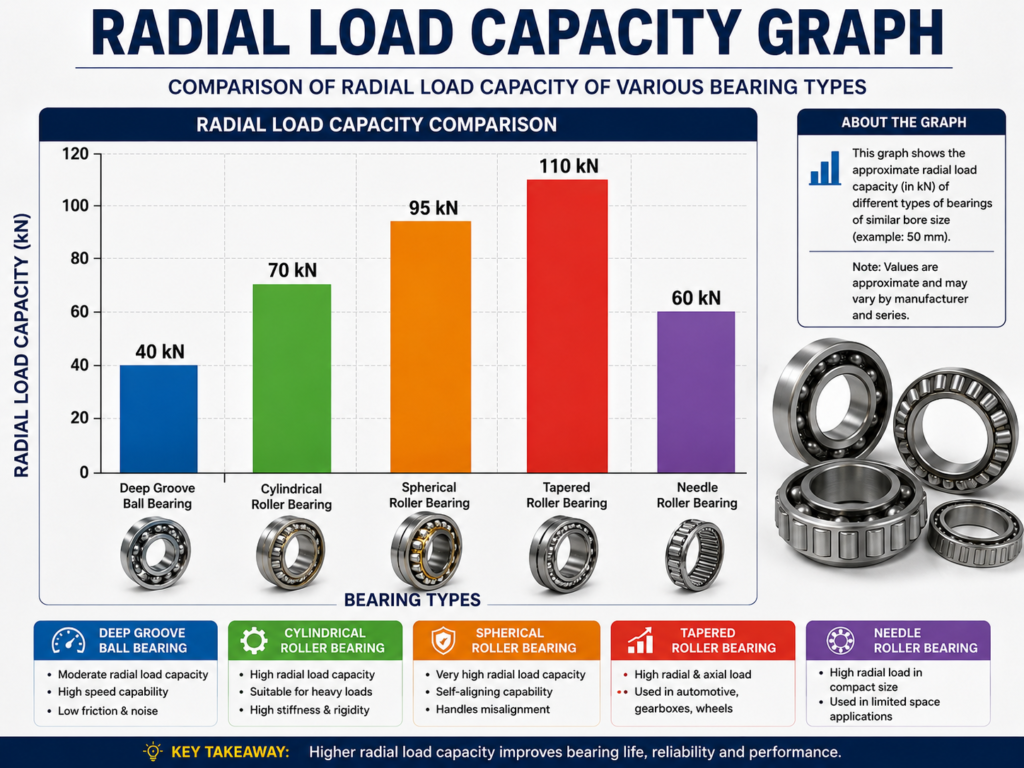
Note: The graph uses a normalized illustrative index rather than claiming a universal numerical load rating. Actual radial-load capacity must be taken from the exact bearing manufacturer’s catalog.
Radial-load problems are common in many machines.
Excessive belt tension can increase bearing radial load.
Solution: Check belt tension, pulley alignment and bearing load.
Gear mesh forces create radial forces.
Solution: Calculate gear forces and distribute the loads correctly between bearings.
High belt tension and pulley loads can create substantial radial forces.
Solution: Verify bearing rating, shaft bending and bearing spacing.
Impeller forces can create radial and axial loads.
Solution: Calculate both radial and axial components.
Rotor imbalance creates periodic radial loading.
Solution: Perform balancing and inspect bearing alignment.
Shock loading can be much more severe than normal operating loading.
Solution: Evaluate static load capacity, shock factors, shaft stiffness and bearing arrangement.
A practical troubleshooting process is:
Determine whether the load comes from:
Mark:
Use equilibrium equations:
ΣF = 0
ΣM = 0
For combined loading, use the appropriate manufacturer equation such as:
P = X Fᵣ + Y Fₐ
Calculate:
L₁₀ = (C/P)ᵖ
For stationary, oscillating, very-low-speed or shock-loaded conditions, the static load rating C₀ must also be considered.
A bearing with excellent radial capacity may not be the best choice if the machine operates at very high rpm.
A correctly rated bearing can still fail prematurely because of:
Suppose an industrial conveyor has:
A small deep groove ball bearing may not be the most suitable solution if its dynamic load rating is insufficient.
A cylindrical roller bearing could be considered when radial loading dominates.
If misalignment is significant and the application also contains axial loading, a spherical roller bearing may be more appropriate.
The final selection should consider:
Load + speed + life + alignment + lubrication + temperature + mounting + environment
—not radial load alone.
A 30 mm bore does not tell you whether the bearing can safely carry the required radial load.
The location of a pulley or gear can dramatically change bearing reactions.
Combined loading can increase equivalent bearing load.
A crusher and an electric fan cannot be treated as having identical loading conditions.
A flexible shaft can change bearing load distribution.
Bearing life depends strongly on the ratio C/P.
A bearing that passes a dynamic-life calculation may still be unsuitable for high static or shock loading.
| Requirement | Recommended Bearing Type |
|---|---|
| High speed + moderate radial load | Deep groove ball |
| Very high radial load | Cylindrical roller |
| High radial load + misalignment | Spherical roller |
| Heavy radial + axial load | Tapered roller |
| High radial load in limited radial space | Needle roller |
| General-purpose motor | Deep groove ball |
| Heavy conveyor | Spherical/cylindrical roller depending on design |
| Automotive wheel hub | Tapered roller or suitable hub bearing |
This is a preliminary selection guide. The exact bearing designation should always be selected using the manufacturer’s engineering catalog.
The most important lessons are:
Understanding the radial load of various bearings is essential for reliable machine design and maintenance.
Deep groove ball bearings provide an excellent combination of speed, low friction and moderate radial-load capacity. Cylindrical roller bearings are powerful choices for heavy radial loading. Spherical roller bearings become particularly attractive when high radial load and misalignment occur together. Tapered roller bearings are highly effective where radial and axial loads act simultaneously, while needle roller bearings offer impressive radial capacity when installation space is limited.
The most important point is that bearing selection should never be based simply on shaft diameter.
Engineers should calculate the actual bearing reaction forces, determine the equivalent dynamic load, evaluate bearing life, check static load capacity, and then consider speed, lubrication, temperature, alignment and shock.
A correctly calculated radial load can prevent premature bearing failure, reduce maintenance costs, improve machine efficiency and dramatically increase equipment reliability.
Radial load is a force acting perpendicular to the axis of the bearing shaft.
Cylindrical roller, spherical roller and tapered roller bearings are commonly used for high radial-load applications, depending on the complete loading and operating conditions.
Yes. Deep groove ball bearings are widely used for radial loads, especially when high speed and low friction are important.
There is no universal winner because capacity depends on bearing size, series, internal design and operating conditions. Heavy-duty roller bearings generally provide much higher radial-load capacity than comparable ball bearings.
For a simple two-bearing shaft, first calculate bearing reactions using static equilibrium. Then calculate equivalent bearing load when combined or varying loads are present.
The basic rating-life formula is:
L₁₀ = (C/P)ᵖ
where p is 3 for ball bearings and 10/3 for roller bearings.
Yes. Bearing life is highly sensitive to load. Increasing equivalent load can cause a very large reduction in theoretical rating life.
Common causes include excessive belt tension, gear forces, heavy rotor weight, shaft imbalance, pulley loads, process forces and shock.
Some bearing types can handle combined loads. Deep groove ball, angular-contact, spherical roller and tapered roller bearings can accommodate various combinations depending on their design.
Identify the forces, calculate bearing reactions, determine equivalent dynamic load, check C and C₀ ratings, verify bearing life, and inspect alignment, lubrication, shaft deflection and mounting.

Welcome! I am a dedicated entrepreneur running an industrial affiliate product website, helping businesses and professionals find the best tools, equipment, and resources for their needs. With a passion for industrial products and a keen eye for quality, I curate and recommend top-performing items that enhance efficiency and reliability.
Through my platform, I aim to simplify the buying process by providing valuable insights, expert reviews, and trusted affiliate links to high-quality industrial products. Whether you’re looking for the latest machinery, tools, or safety gear, I strive to connect you with the best solutions available.
Thank you for visiting, and I look forward to helping you make informed purchasing decisions!
