Our Location
Killa-Pardi, Dist. Valsad, 396125


Bearings are essential mechanical components used in motors, pumps, gearboxes, conveyors, automobiles, machine tools and thousands of industrial machines. Their primary function is to support rotating or moving components while reducing friction and controlling motion. so, How to Choose the Right Bearing?
However, choosing a bearing is not simply a matter of selecting a bearing that fits the shaft. The correct bearing must match the application’s load, speed, operating temperature, available space, lubrication, environment, required service life, mounting arrangement and alignment conditions.
A bearing that physically fits may still fail prematurely if its load capacity, clearance, lubrication or operating speed is unsuitable. Koyo/JTEKT’s bearing-selection procedure, for example, considers load direction and magnitude, speed, installation space, running accuracy, rigidity, misalignment, temperature, lubrication, fit and mounting requirements.
This complete bearing selection guide explains how to choose the right bearing step by step.
A bearing is a mechanical component designed to permit controlled relative movement between machine parts while reducing friction. Rolling bearings generally contain an inner ring, outer ring, rolling elements and a cage.
Rolling bearings are broadly divided into ball bearings and roller bearings. They can also be classified according to whether they primarily carry radial or axial loads. NSK explains that ball bearings generally offer good speed capability, while roller bearings generally provide higher load capacity.
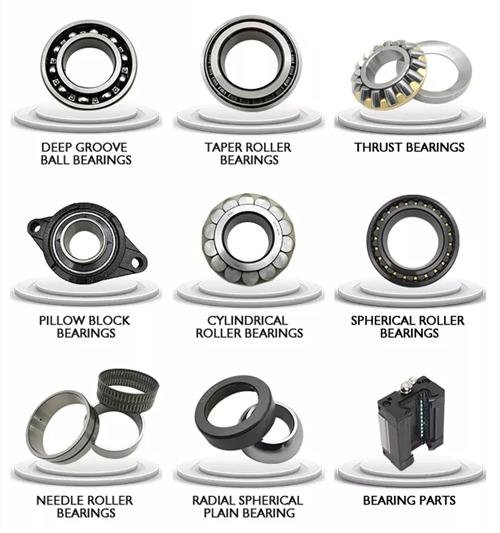
The most common types of bearings include:
Selecting the right bearing can improve machine reliability, operating efficiency and maintenance performance.
An incorrectly selected bearing can experience:
SKF notes that bearing selection involves much more than rating life; lubricant and supply method, shaft and housing fits, internal clearance, cage, sealing, precision and mounting method can also influence performance.
Therefore, the objective should not be simply to find the cheapest bearing. The objective is to select a bearing that provides the required performance and service life at an appropriate total cost.
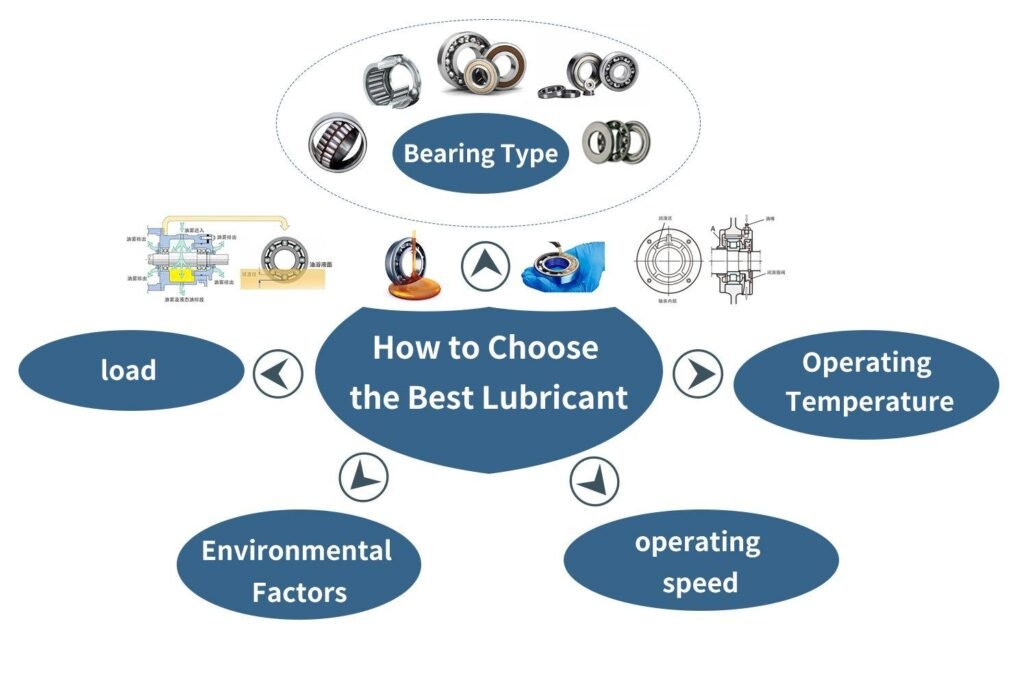
The first question is:
What type of load will the bearing carry?
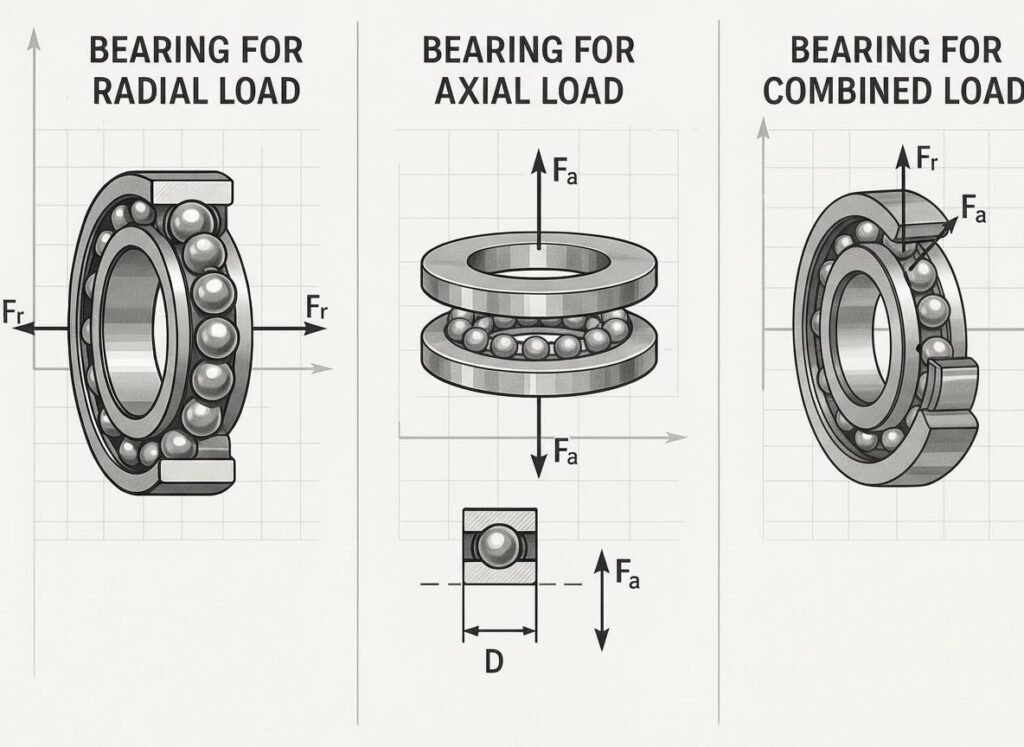
There are three common loading conditions.
A radial load acts perpendicular to the shaft.
Examples include:
For predominantly radial loads, deep groove ball bearings or appropriate roller bearings may be considered depending on load magnitude and speed.
An axial load acts parallel to the shaft.
Examples include:
Thrust bearings are designed primarily for axial loads.
Some applications experience both radial and axial loads.
Examples include:
Angular-contact and tapered roller bearings are common choices when both radial and axial loads must be accommodated.
Different bearing designs have different strengths.
| Bearing Type | Radial Load | Axial Load | Speed Capability | Typical Advantage |
|---|---|---|---|---|
| Deep Groove Ball | Good | Moderate | High | Versatile |
| Angular Contact Ball | Good | Good | High | Combined loading |
| Cylindrical Roller | Excellent | Limited/Design dependent | High | Heavy radial load |
| Tapered Roller | Excellent | Excellent | Moderate | Combined heavy loads |
| Spherical Roller | Excellent | Good | Moderate | Misalignment |
| Needle Roller | Good | Limited | High | Limited radial space |
| Thrust Ball | Low/None | Excellent | Moderate | Axial loading |
These are general characteristics rather than universal performance limits. Actual capability depends on bearing size, design, load, speed, lubrication and manufacturer specifications. Koyo notes that allowable speed varies with bearing type, size, cage, accuracy, load and lubrication.
Bearing size should be selected according to the shaft, housing, load and required service life—not only by measuring the shaft diameter.
Three important dimensions are:
For example, a bearing designation such as 6205 identifies a particular bearing design and dimensional series. However, buyers should always verify the complete manufacturer specification before purchasing.
The selected bearing must fit:
A bearing with the correct bore can still be unsuitable if its outside diameter, width or load rating does not match the machine.
After determining the load direction, estimate the actual operating load.
Important factors include:
Roller bearings generally provide higher load capacity than similarly sized ball bearings because of their larger effective contact area. NSK similarly describes roller bearings as higher-load-capacity designs compared with ball bearings.
For engineering applications, the manufacturer’s basic dynamic load rating (C) and basic static load rating (C₀) should be checked.
A simplified basic rating-life relationship for rolling bearings is commonly expressed as:
L₁₀ = (C/P)ᵖ × 10⁶ revolutions
where:
Actual bearing-life calculations can be more complex because lubrication, contamination, material, temperature and operating conditions can affect service life. Manufacturer catalogs and engineering calculators should therefore be used for final selection.
Speed is another critical factor.
A bearing designed for heavy loads may not necessarily be the best choice for a very high-speed application.
High-speed applications can include:
Deep groove ball bearings and angular contact ball bearings are commonly used in high-speed applications, while roller bearings are often selected when higher load capacity is more important.
Koyo emphasizes that allowable speed depends on multiple factors including bearing size, cage, accuracy, load and lubrication.
Important: Never select a bearing based only on a generic RPM number found online. Always check the specific manufacturer’s limiting or reference speed for the exact bearing.
Lubrication reduces friction and wear and helps control operating temperature.
The two most common lubrication methods are:
Grease is widely used because it is relatively simple and can remain in the bearing for extended periods.
Advantages:
Disadvantages:
Oil may be preferred when heat removal, high speed or continuous lubrication is important.
Advantages:
Disadvantages:
SKF engineering guidance emphasizes the relationship between speed, operating temperature, lubricant viscosity and lubrication condition.
Temperature can significantly affect bearing performance.
Consider:
A bearing operating at elevated temperature may require a different internal clearance, lubricant or material specification.
The bearing should therefore be selected according to the actual operating temperature, not simply the room temperature.
Internal clearance refers to the amount of internal movement between bearing components before the bearing is mounted and operating.
Common clearance classes include:
The correct clearance depends on factors such as:
SKF documentation notes that internal clearance requirements are influenced by factors including shaft and housing fits, speed, alignment and mounting conditions.
Do not automatically choose C3 simply because it is popular. Clearance must match the application.
Industrial machines often operate in environments containing:
A sealed bearing can provide better protection against contamination than an open bearing, depending on the design.
Common designations include:
Seals can help keep contaminants out and retain lubricant, but contact seals may influence friction and speed capability.
Therefore, choose the seal configuration according to the operating environment and speed requirement.
Correct bearing fit is essential.
The bearing must be properly matched with:
An incorrect fit can change internal clearance and may lead to unwanted movement, overheating or damage.
Koyo specifically includes fit and internal clearance as key parts of bearing selection.
For critical industrial machinery, always follow the bearing manufacturer’s recommended shaft and housing tolerances.
| Bearing | Advantages | Disadvantages |
| Deep Groove Ball | High speed, versatile, widely available | Limited heavy-load capability compared with rollers |
| Angular Contact Ball | Good combined-load capability, high precision | Usually requires correct orientation/arrangement |
| Cylindrical Roller | Very high radial-load capacity | Axial capability depends on design |
| Tapered Roller | Excellent combined-load capacity | More sensitive to adjustment and installation |
| Spherical Roller | High load capacity, accommodates misalignment | Generally larger and more friction than ball bearings |
| Needle Roller | Compact radial design | Installation and shaft requirements can be demanding |
| Thrust Ball | Good axial-load solution | Primarily designed for axial loading |
For many general electric motors, a deep groove ball bearing is a common starting point because it combines good radial-load capability with high-speed performance.
Gearboxes can experience radial, axial and combined loads. Depending on the design, cylindrical, tapered, spherical or angular-contact bearings may be appropriate.
Conveyor systems may require bearings that tolerate continuous operation, contamination and varying loads. Sealing and lubrication become especially important.
Pump bearing selection depends on radial and axial loads, speed, temperature, lubrication and shaft arrangement.
Heavy-duty machinery may require roller bearings because of their high load-carrying capability.
A bearing may fit the shaft but still have insufficient load or speed capacity.
A bearing designed for heavy load may not be appropriate for very high RPM.
Lubricant compatibility, viscosity, temperature and operating speed must be considered.
Dust and water can severely affect bearing life.
Incorrect clearance can lead to excessive heat, vibration or premature failure.
Even a high-quality bearing can be damaged during improper mounting.
The lowest purchase price may not provide the lowest total operating cost.
Before purchasing a bearing, answer these questions:
High speed + moderate radial load → Deep groove ball bearing
Combined radial + axial load → Angular contact or tapered roller bearing
Very high radial load → Cylindrical or spherical roller bearing
Heavy combined load → Tapered roller bearing
Misalignment → Self-aligning or spherical bearing designs
Limited radial space → Needle roller bearing
Primarily axial load → Thrust bearing
These are starting points rather than universal rules. Final selection should always be verified against the manufacturer’s technical data.
Correct bearing selection can provide:
The biggest benefit is not simply longer bearing life—it is improved reliability of the entire machine.
An incorrect bearing can result in:
This is why bearing selection should be treated as an engineering decision rather than simply a purchasing decision.
Choosing the right bearing requires more than matching the bearing bore to the shaft. A reliable selection process starts by understanding the load direction and magnitude, followed by speed, bearing size, required life, temperature, lubrication, clearance, sealing, environment, fit and mounting conditions.
Deep groove ball bearings are excellent general-purpose choices for many applications, while angular contact, cylindrical roller, tapered roller, spherical roller, needle and thrust bearings each provide advantages for specific operating conditions.
The most important rule is simple:
Choose the bearing according to the machine’s operating conditions—not merely according to size or price.
For critical machinery, always verify the final bearing selection using the manufacturer’s catalog, load ratings, speed limits, lubrication recommendations and mounting specifications.
Determine the load, speed, shaft size, housing size, temperature, lubrication, environment, required life and mounting conditions. Then compare suitable bearing types using the manufacturer’s specifications.
Deep groove ball and angular contact ball bearings are commonly used for high-speed applications, but the exact bearing’s speed capability must be checked in the manufacturer’s catalog.
Roller bearings generally provide higher load capacity than similarly sized ball bearings. Cylindrical, tapered and spherical roller bearings are common choices depending on the load direction and application.
Bearing clearance is the internal space or play between bearing components. The correct clearance depends on temperature, fits, speed, mounting and other operating conditions.
Not necessarily. C3 provides greater internal clearance than normal clearance, but it is not automatically better. The correct clearance depends on the application.
A replacement may be possible if the dimensional, load, speed, clearance, sealing and other specifications are compatible. Always verify the complete specification rather than relying only on the bearing number.
Common causes include incorrect selection, inadequate or excessive lubrication, contamination, improper mounting, incorrect fits, excessive load, overheating and misalignment.
No. The cheapest bearing may have a higher total cost if it fails early or requires frequent replacement. Selection should consider reliability, application requirements and total operating cost.

Welcome! I am a dedicated entrepreneur running an industrial affiliate product website, helping businesses and professionals find the best tools, equipment, and resources for their needs. With a passion for industrial products and a keen eye for quality, I curate and recommend top-performing items that enhance efficiency and reliability.
Through my platform, I aim to simplify the buying process by providing valuable insights, expert reviews, and trusted affiliate links to high-quality industrial products. Whether you’re looking for the latest machinery, tools, or safety gear, I strive to connect you with the best solutions available.
Thank you for visiting, and I look forward to helping you make informed purchasing decisions!
