Our Location
Killa-Pardi, Dist. Valsad, 396125

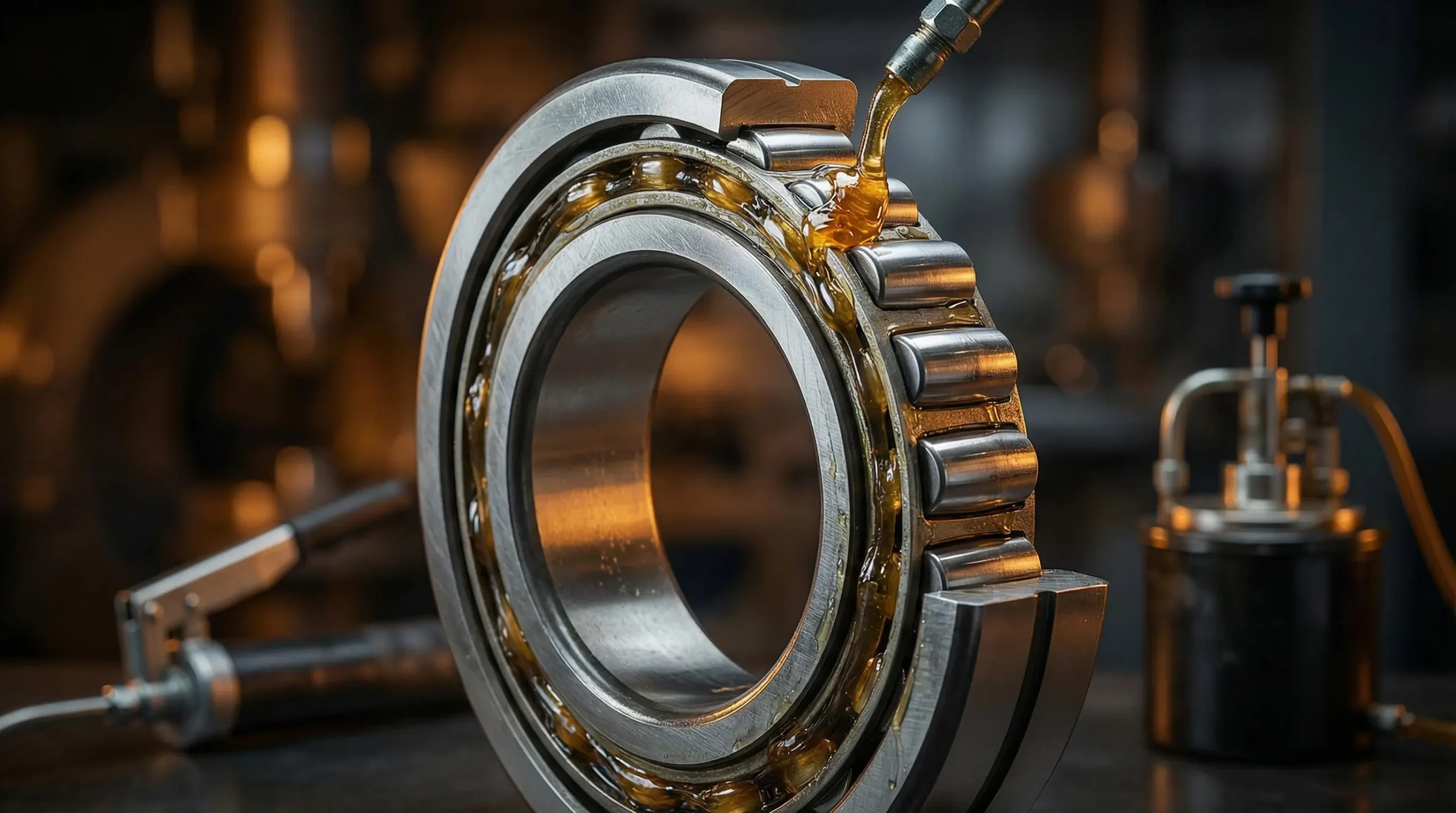
Lubrication is one of the most important factors affecting the performance, reliability, and service life of a bearing. Although bearings are designed to reduce friction between moving components, they still require a suitable lubricant to operate efficiently under real working conditions.
The importance of Greasing in bearing function becomes especially clear in industrial machinery where bearings operate continuously under heavy loads, high speeds, temperature variations, vibration, and contamination. The correct lubricant creates a protective film between contacting surfaces, helping minimize metal-to-metal contact, reduce friction, control heat, prevent wear, and protect against corrosion.
Poor Oiling is one of the most common causes of premature bearing problems. Using too little lubricant can cause excessive friction and overheating, while using too much can also increase temperature and energy losses. Therefore, selecting the correct lubricant and applying the right quantity at the right interval is essential.
This guide explains why bearing Greasing matters, the different types of lubricants, Greasing methods, common mistakes, maintenance practices, and how proper Greasing can improve bearing life.
It is the process of applying a suitable grease, oil, or other lubricant to the bearing to reduce friction and protect its internal surfaces.
During operation, rolling elements move between the inner and outer raceways. Even though rolling contact generates less friction than sliding contact, there is still friction at various contact points.
A lubricant forms a protective layer that separates surfaces and helps control the heat and wear generated during operation.
The primary objectives are :
Proper Greasing is therefore not simply an additional maintenance task—it is an essential part of bearing operation.
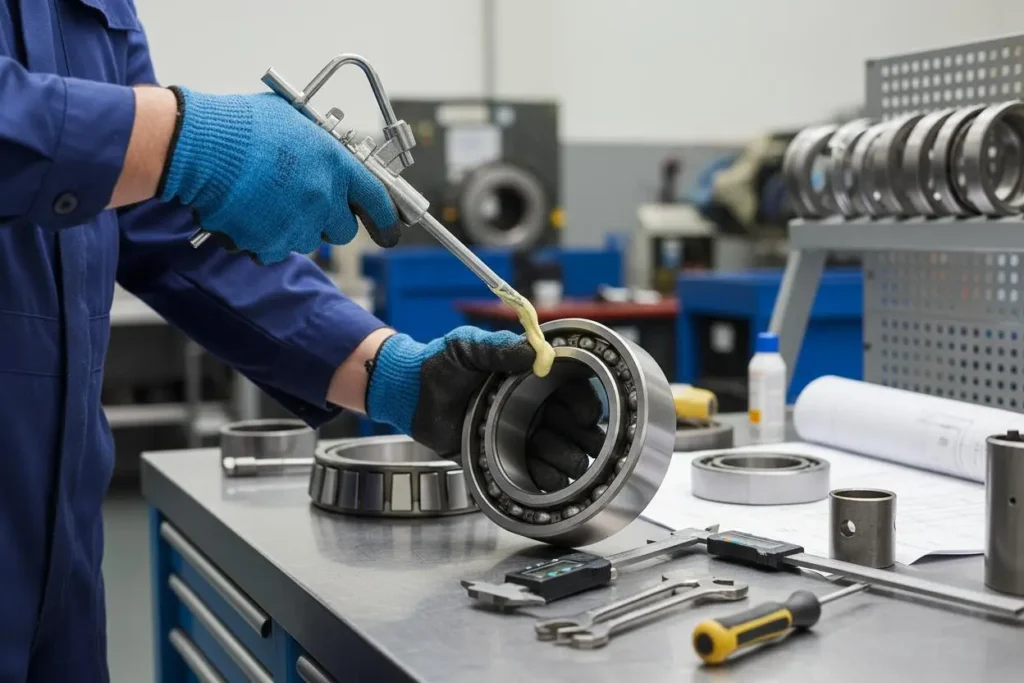
The most fundamental function of Greasing is reducing friction.
When bearing components move against each other, friction is generated at the contact surfaces. Without sufficient Greasing, this friction can increase significantly.
A suitable lubricant creates a separating film between surfaces, reducing direct contact and allowing the rolling elements to move more smoothly.
Lower friction means:
This is particularly important in electric motors, pumps, fans, compressors, gearboxes, and other continuously operating equipment.
Bearing surfaces are exposed to repeated contact during operation. Over time, insufficient Greasing can cause surface damage and accelerate wear.
Adequate Greasing helps protect:
When the lubricant film is maintained properly, direct metal-to-metal contact is reduced.
This can help prevent problems such as:
Consequently, proper Greasing contributes significantly to longer bearing life.
Friction produces heat. If the heat generated inside a bearing cannot be controlled, the bearing temperature can rise excessively.
High temperatures can affect both the bearing and its lubricant.
Excessive heat may cause:
Oil Greasing can be particularly useful in applications where continuous heat removal is required.
The correct lubricant and oiling quantity help maintain an appropriate operating temperature.
Moisture and aggressive environmental conditions can cause corrosion on bearing surfaces.
Corrosion can damage raceways and rolling elements, reducing bearing performance and service life.
Lubricants can provide a protective barrier that helps prevent moisture and contaminants from directly contacting metal surfaces.
This is particularly important in:
The lubricant should be selected according to the operating environment.
Properly lubricated bearings generally operate more smoothly than poorly lubricated bearings.
Inadequate Greasing can increase friction and surface contact, potentially producing:
Noise and vibration can also indicate other problems such as misalignment, contamination, incorrect installation, or bearing damage.
Therefore, Greasing should be considered as part of a broader bearing maintenance program.
One of the biggest advantages of correct lubrication is longer bearing service life.
Bearing life depends on many factors, including load, speed, temperature, contamination, installation, and Greasing.
Even a high-quality bearing can fail prematurely if it operates without suitable Oiling.
Proper Oiling helps maintain a protective film and reduces friction and wear, allowing the bearing to perform reliably for a longer period.
For industrial machinery, longer bearing life can mean:
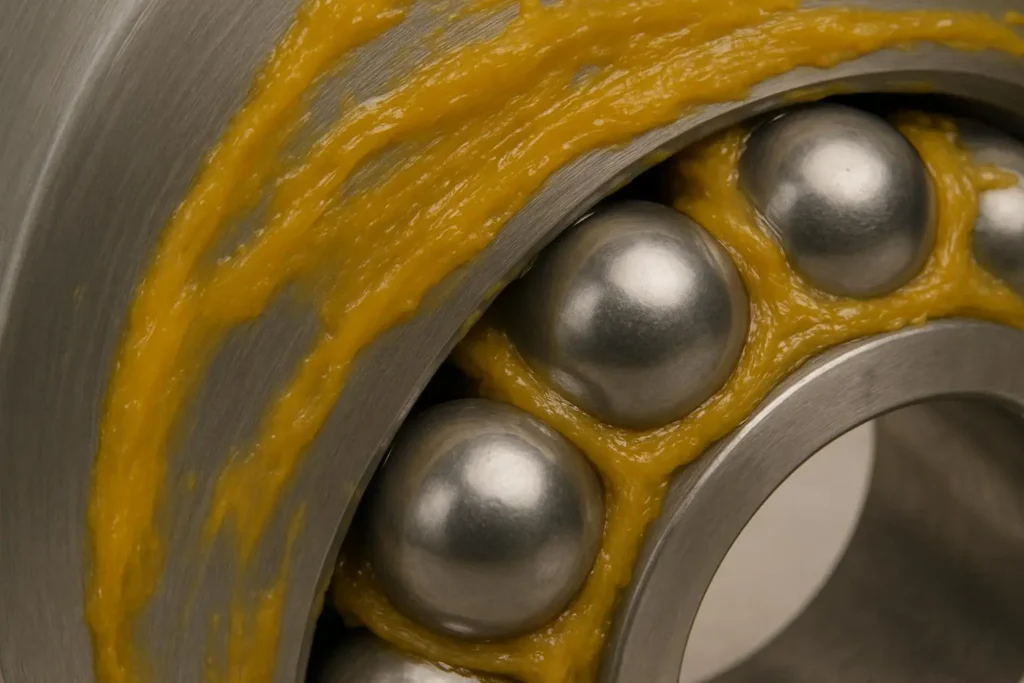
Different applications require different types of lubricants.
Grease is one of the most widely used lubricants for bearings.
It generally consists of base oil, thickener, and additives.
Grease is commonly used in electric motors, pumps, conveyors, fans, automotive components, and general industrial machinery.
However, grease selection must consider temperature, speed, load, compatibility, and environmental conditions.
Oil lubrication is often selected for applications involving high speeds, elevated temperatures, or a need for continuous heat removal.
Oil can be supplied through:
Oil lubrication is frequently used in gearboxes, turbines, compressors, machine tools, and other demanding machinery.
| Feature | Grease | Oil |
|---|---|---|
| Application | Simple and convenient | Requires more controlled systems |
| High-speed suitability | Depends on grease type | Often excellent |
| Heat removal | Moderate | Excellent |
| Maintenance | Generally simpler | Can require monitoring |
| Leakage | Lower | Potentially higher |
| Common use | Motors, conveyors, pumps | Gearboxes, turbines, high-speed systems |
The best choice depends on the bearing design and operating conditions.
A common mistake is assuming that more lubricant always provides better protection.
This is not true.
Over-Oiling can be just as problematic as under-Oiling.
Too much grease can increase resistance to movement and cause churning. This can generate additional heat, particularly in high-speed bearings.
Too little lubricant can result in inadequate surface protection and increased friction.
The correct quantity should therefore be based on the bearing manufacturer’s recommendations and the machine’s operating conditions.
Under-Greasing occurs when the lubricant quantity is insufficient or the lubricant has degraded.
Possible symptoms include:
Inadequate Greasing is especially dangerous in heavily loaded or high-speed applications.
Regular inspection and condition monitoring can help identify Greasing problems before serious damage occurs.
Over-Oiling occurs when too much grease or oil is introduced into the bearing.
Possible consequences include:
High-speed bearings are particularly sensitive to excessive grease because the rolling elements can create significant resistance within the lubricant.
Following the manufacturer’s recommended fill quantity is therefore essential.
High-speed bearings may require specialized low-viscosity oils or greases designed for high-speed operation.
Heavy loads can require lubricants with appropriate viscosity and additives to maintain a protective film.
High-temperature applications require lubricants that can remain stable under elevated operating temperatures.
Dust, water, chemicals, and moisture can influence lubricant selection.
Ball bearings, cylindrical roller bearings, tapered roller bearings, spherical roller bearings, and needle bearings may have different lubrication requirements.
Continuous operation, frequent starting and stopping, shock loads, vibration, and changing temperatures can all affect Oiling requirements.
Not every grease or oil is suitable for every bearing.
Lubricant properties such as viscosity, temperature rating, consistency, and additive package should match the application.
Different greases may use different thickener systems and additives. Mixing incompatible products can affect consistency and Greasing performance.
Over-greasing can create heat and increase friction.
Insufficient Greasing can lead to direct surface contact and accelerated wear.
Lubricant can deteriorate over time due to heat, contamination, oxidation, and mechanical action.
Dirty tools, open containers, moisture, and dust can introduce contaminants into the Greasing system.
A good Greasing program should include the following practices:
Always check the bearing and equipment manufacturer’s specifications for lubricant type and quantity.
Store grease and oil in clean, sealed containers.
Grease guns, pumps, and other Greasing equipment should be kept clean.
Check temperature, vibration, noise, and operating performance.
Apply only the recommended amount.
Lubrication intervals should be based on operating conditions rather than guesswork.
Use appropriate seals and keep the surrounding environment clean.
Industrial equipment often operates for long hours under demanding conditions.
A single bearing failure can stop an entire production line.
This makes lubrication a critical component of preventive maintenance.
Industries where bearing Greasing is particularly important include:
In these industries, effective Greasing can contribute to greater equipment reliability and reduced unplanned downtime.
Greasing should not be treated as an isolated activity. It should form part of a complete preventive maintenance strategy.
A maintenance program can include:
Condition-based maintenance can also help determine when lubrication or bearing replacement is actually required.
This approach can prevent unnecessary maintenance while reducing the risk of unexpected failure.
Some common warning signs include:
These symptoms do not always mean lubrication is the only problem. Misalignment, overload, contamination, or bearing damage can produce similar symptoms.
Therefore, the underlying cause should be investigated before simply adding more lubricant.
Proper Greasing provides several interconnected benefits:
Less friction → Less heat → Less wear → Longer bearing life → Better machine reliability
It can also contribute to:
For businesses operating machinery continuously, these benefits can have a direct impact on operating costs.
The importance of Greasing in bearing function cannot be overstated. Greasing is essential for reducing friction, minimizing wear, controlling temperature, preventing corrosion, reducing noise, and extending bearing service life.
Both grease and oil can provide effective Greasing, but the correct choice depends on the bearing type, load, speed, temperature, environment, and operating conditions. Equally important is applying the correct amount. Under-Greasing can cause excessive friction and wear, while over-Greasing can increase heat and resistance.
For reliable machinery performance, Greasing should be combined with proper bearing selection, installation, alignment, contamination control, and regular condition monitoring.
In short, the right lubricant, in the right quantity, at the right time, can make a major difference to bearing life and overall machine efficiency.
Lubrication reduces friction and wear, controls heat, prevents corrosion, and helps bearings operate smoothly for longer periods.
Without sufficient lubrication, friction and temperature can increase rapidly, resulting in wear, noise, vibration, overheating, and potentially bearing failure.
Neither is universally better. Grease is convenient and widely used, while oil can be advantageous for high-speed or high-temperature applications where heat removal is important.
Yes. Over-greasing can increase friction, cause churning, raise operating temperature, and potentially shorten bearing life.
Lubrication intervals depend on bearing type, speed, load, temperature, environment, lubricant, and operating conditions. Manufacturer recommendations should be followed.
The best grease depends on the specific application. Important factors include base oil viscosity, thickener type, temperature range, load, speed, and compatibility.
Not always. Some grease formulations are incompatible. Mixing should only be done when compatibility has been confirmed by the lubricant or bearing manufacturer.
Lubrication maintains a protective film between contacting surfaces, reducing friction, wear, heat, and surface damage.
Common signs include excessive noise, vibration, rising temperature, rough operation, lubricant discoloration, and premature wear.
Yes. Proper lubrication reduces friction and mechanical losses, which can help improve equipment efficiency and reduce energy consumption.

Welcome! I am a dedicated entrepreneur running an industrial affiliate product website, helping businesses and professionals find the best tools, equipment, and resources for their needs. With a passion for industrial products and a keen eye for quality, I curate and recommend top-performing items that enhance efficiency and reliability.
Through my platform, I aim to simplify the buying process by providing valuable insights, expert reviews, and trusted affiliate links to high-quality industrial products. Whether you’re looking for the latest machinery, tools, or safety gear, I strive to connect you with the best solutions available.
Thank you for visiting, and I look forward to helping you make informed purchasing decisions!
