Our Location
Killa-Pardi, Dist. Valsad, 396125

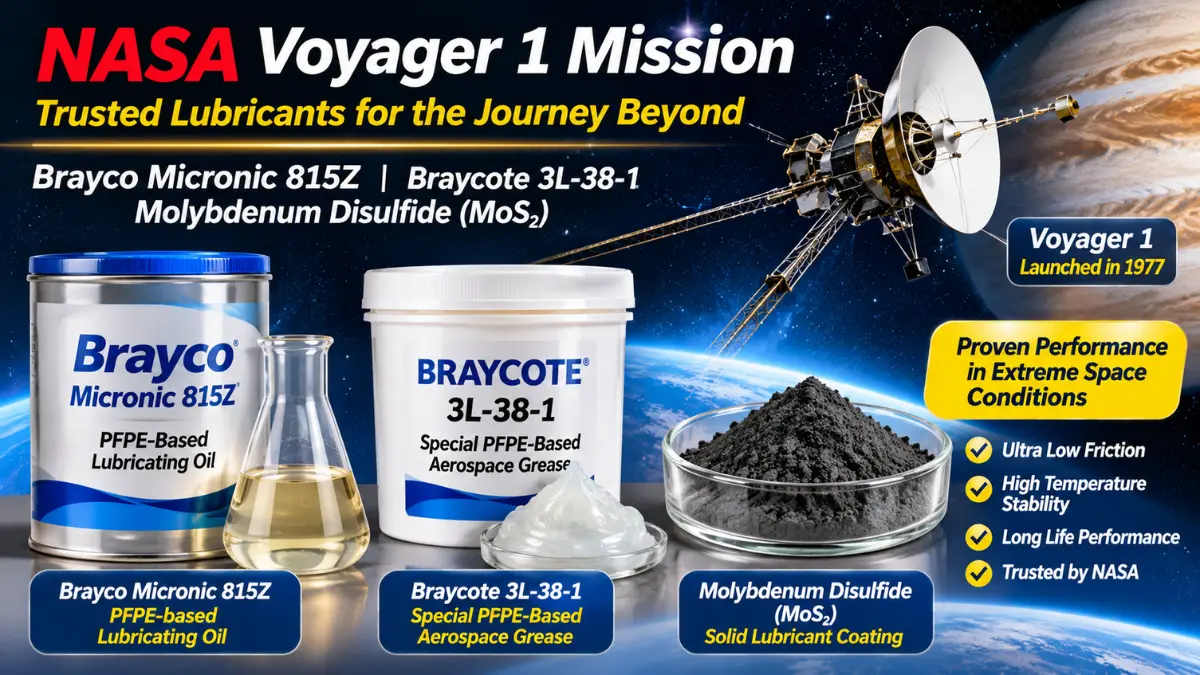
Imagine designing a machine (Voyager 1) that must operate for decades without a mechanic, maintenance engineer or lubricant replacement service.
Now imagine that the machine must travel through an environment where conventional atmospheric pressure does not exist, temperatures can vary dramatically, radiation is present and mechanical components cannot be accessed after launch. This is the engineering challenge behind spacecraft lubrication.
NASA’s Voyager programme is one of the most impressive examples of long-duration space exploration. Voyager 1 was launched on September 5, 1977, to explore Jupiter, Saturn and the outer regions of the Solar System. It subsequently crossed into interstellar space in August 2012. Although Voyager 1 is primarily known for its scientific discoveries, its mechanical engineering is equally interesting.
Spacecraft contain bearings, gears, actuators, shafts, screws, motors and other moving components. These parts require carefully engineered lubrication systems to reduce friction, prevent excessive wear and maintain reliable movement. NASA’s technical documentation on a Voyager-related linear boom actuator describes three important lubrication technologies:
These materials performed different functions within the actuator design. Brayco oil was used to impregnate porous bearings. Braycote grease was applied to the ball screw and gear mechanism. MoS₂ was deposited on selected metal surfaces to provide solid-film lubrication.
This article explores their chemistry, technical characteristics, lubrication mechanisms, engineering applications, advantages, limitations and lessons for modern industrial machinery.
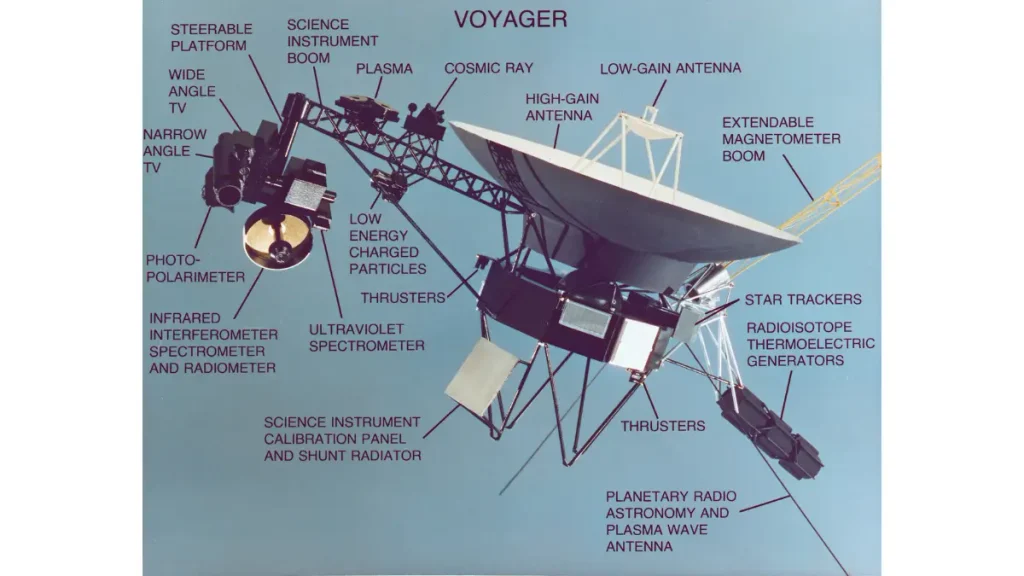
1. Mission background
Voyager 1 is a robotic spacecraft developed by NASA’s Jet Propulsion Laboratory. Its original mission was to investigate the outer planets, particularly Jupiter and Saturn. The spacecraft carried scientific instruments, communication equipment, an antenna, power-generation equipment and several mechanical assemblies.
The spacecraft’s original five-year design mission was extended because its systems continued to operate. Its mission history demonstrates the importance of reliability engineering, component selection and careful management of limited electrical and mechanical resources.
2. Why does a spacecraft need lubrication?
A spacecraft contains many mechanical interfaces. Examples include:
Whenever two surfaces move relative to one another, friction and wear can occur. Without suitable lubrication, several problems may develop:
On Earth, technicians can inspect and repair these problems. A deep-space spacecraft cannot receive conventional maintenance. Therefore, spacecraft lubrication must be designed around the expected operating life and environment.
The three materials are not identical products and should not be considered interchangeable.
| Property | Brayco 815Z | Braycote 3L-38-1 | MoS₂ |
|---|---|---|---|
| Lubricant category | Oil | Grease | Solid lubricant |
| Main chemistry | PFPE | PFPE-based system | Molybdenum disulfide |
| Physical form | Liquid | Semi-solid | Solid film |
| Main function | Bearing lubrication | Gear and screw lubrication | Surface friction reduction |
| Documented application | Porous bearings | Gears, ball screw and O-rings | Selected metal surfaces |
The engineering advantage comes from selecting different lubrication methods for different mechanical contacts.
PART A: BRAYCO MICRONIC 815Z
Brayco Micronic 815Z is a specialized perfluorinated polyether (PFPE)-based lubricating oil.
It is manufactured by Castrol and is designed for demanding applications where conventional mineral oils may not offer the required chemical stability, volatility or temperature performance. It is a liquid lubricant, not a grease. Its main characteristics include:
PFPE oils are important in aerospace engineering because their molecular structures contain fluorinated ether chains. This chemistry gives them properties that differ from conventional mineral and synthetic hydrocarbon oils.
PFPE stands for Perfluoropolyether. It is a family of synthetic fluorinated fluids. The molecular structure contains repeating ether linkages and fluorinated carbon groups.
A simplified representation is: CF₃–(O–CF₂–CF₂)n–O–CF₃
This is an illustrative simplified structure, not a complete molecular specification of Brayco 815Z. The fluorinated molecular backbone contributes to chemical stability and low volatility. However, different PFPE formulations have different molecular weights, viscosity grades and tribological characteristics. Therefore, technical values from Brayco 815Z should not automatically be applied to every PFPE oil.
Conventional mineral oils may evaporate, oxidize or change properties under demanding conditions. Specialized PFPE fluids can offer:
These characteristics make PFPE oils attractive for selected aerospace and precision engineering applications. However, PFPE lubricants are not completely immune to tribochemical degradation. Their performance depends on the metal surface, load, contact stress, temperature and operating environment.
The following values are taken from the Castrol product data sheet published in March 2019.
| Technical parameter | Published value |
|---|---|
| Product | Brayco Micronic 815Z |
| Lubricant type | PFPE oil |
| Specific gravity at 16°C | 1.8531 |
| Viscosity at 99°C | 45 cSt |
| Viscosity at 38°C | 148 cSt |
| Viscosity at -40°C | 6,500 cSt |
| Viscosity at -54°C | 10,855 cSt |
| Viscosity index | 350 |
| Pour point | -72°C |
| Vapour pressure at 20°C | 4 × 10⁻¹³ torr |
| Vapour pressure at 100°C | 2 × 10⁻⁹ torr |
| Temperature range | -72°C to above 204°C under stated normal conditions |
| Brief temperature exposure | Up to 260°C, according to the product sheet |
These are published product data, not measurements taken from Voyager 1 during flight.
Viscosity describes a fluid’s resistance to flow. In machinery, viscosity influences:
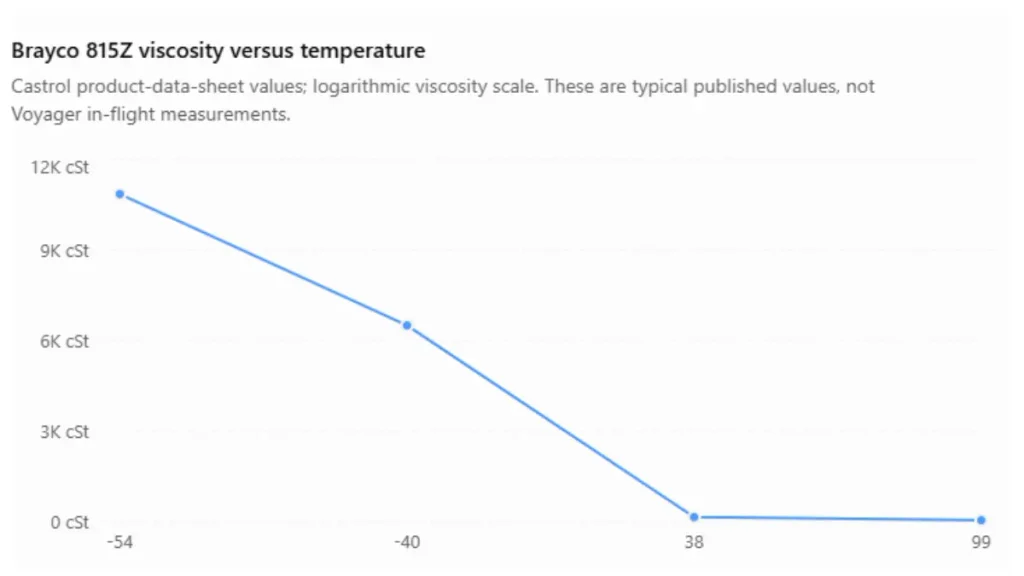
The Brayco 815Z data show that viscosity increases considerably as temperature decreases.
For example: At 99°C, viscosity is 45 cSt. and At -54°C, viscosity is 10,855 cSt.
The ratio is: 10,855 ÷ 45 = 241.2
Therefore, the published viscosity at -54°C is approximately 241 times the value at 99°C. This demonstrates why temperature-dependent viscosity must be considered in precision mechanism design.
The chart below uses the four published Castrol data points.
Vapour pressure indicates the tendency of a liquid to enter the vapour phase at a particular temperature. In a high-vacuum environment, lubricant evaporation and migration can become important design concerns. Low vapour pressure can help reduce lubricant loss and contamination, but it does not guarantee zero evaporation.
Engineers must also consider:

NASA’s actuator report identifies Brayco 815Z oil for impregnating porous bearings. A porous bearing contains microscopic spaces within its material structure. These pores can retain oil and act as a lubricant reservoir.
When the bearing operates, oil can become available at the contact interface. This is called oil impregnation.
Porous bearings can be useful where a continuous external oil supply is not practical. Potential advantages include:
However, bearing performance depends on pore size, porosity, oil viscosity, temperature, load, speed and the bearing material. A porous bearing should not be assumed to provide unlimited lubrication.
The oil must remain available at the contact. If the oil moves away from the working surface, lubricant starvation can occur. If the oil is too viscous at the operating temperature, delivery may become difficult. If the oil is too mobile, unwanted migration may occur.
Therefore, the bearing and lubricant must be designed and tested as a complete system.
PART B: BRAYCOTE 3L-38-1
Braycote 3L-38-1 is the special aerospace grease identified in NASA’s Voyager actuator documentation.
The report describes it as part of a fluorinated polyether oil-and-grease lubrication system. Unlike Brayco 815Z, which is a liquid oil, Braycote 3L-38-1 is a grease. Grease is generally composed of:
The base oil provides much of the lubricating action. The thickener forms a structure that helps retain the oil in the required location. This makes grease useful for gear trains, ball screws and other mechanical assemblies where a local lubricant reservoir is required.
Oil can flow away from certain contact locations. Grease has a semi-solid consistency and can remain near the working surfaces. Potential advantages include:
However, grease must have suitable consistency, base-oil viscosity and compatibility for the application.
NASA’s historical actuator report identifies the grease as 3L-38-1. A later ECSS handbook includes the related designation 3L-38RP in a space-lubricant listing.
These designations should not automatically be treated as identical formulations. Verify the exact product grade and manufacturer’s technical documentation before making a direct equivalence claim.
The NASA actuator paper identifies several applications.
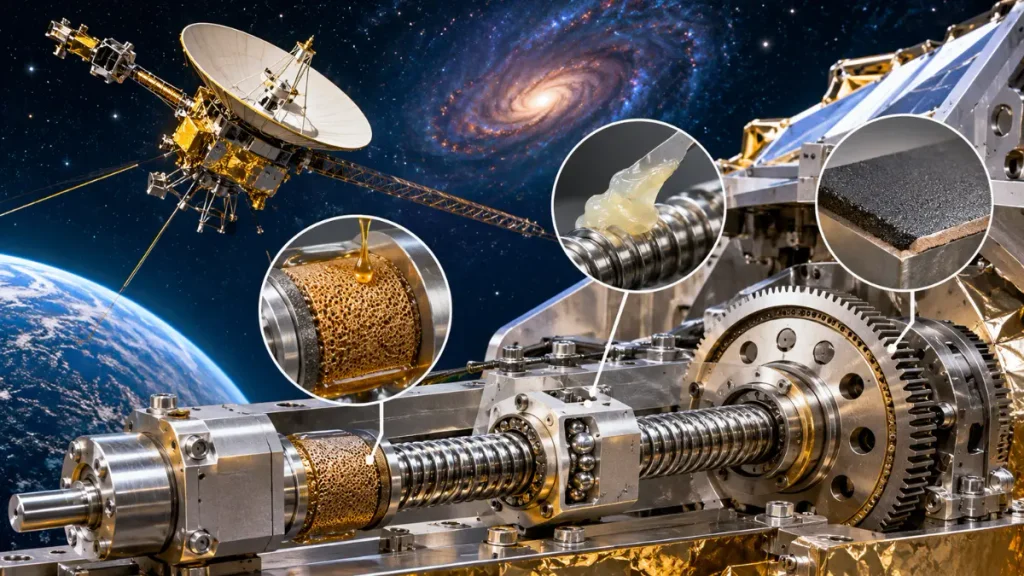
A ball screw converts rotational motion into linear movement. Its main components include:
As the screw rotates, the balls move along the raceways and transfer force between the screw and nut. Lubrication is required to reduce friction and wear. Grease can help maintain a lubricant supply near the rolling contacts.
A ring gear is a toothed mechanical component used in a gear transmission system. Its teeth engage with other gears and transfer rotational force. Repeated gear contact creates rolling and sliding motion. Lubrication helps reduce friction and surface damage.
Planetary gear mechanisms use a combination of sun gears, planet gears and ring gears. Planet gears rotate around a central gear while also engaging with the surrounding ring gear. The gear shafts support the rotating planet gears. Lubrication is important at the relevant shaft and gear contact surfaces.
Gear meshes are the areas where gear teeth engage. These contacts experience repeated mechanical loading. Without sufficient lubrication, the following problems may develop:
Grease can provide a local lubricant supply to the tooth contact area.
O-rings are sealing components used to prevent leakage between connected parts. Lubrication can reduce installation friction and help protect a compatible seal during assembly or movement. However, lubricant compatibility depends on the elastomer composition. Not every grease is compatible with every O-ring material.
The historical NASA paper identifies the grease and its applications but does not provide a complete modern product specification for 3L-38-1.
For this reason, the following parameters should be treated as required engineering checks, not invented numerical specifications.
| Parameter | Why it matters |
|---|---|
| Base-oil chemistry | Determines fluid lubrication behaviour |
| Base-oil viscosity | Influences film formation and flow |
| Thickener chemistry | Controls grease structure |
| Consistency grade | Influences retention and movement |
| Oil separation | Indicates oil release characteristics |
| Temperature range | Determines operating suitability |
| Material compatibility | Prevents damage to seals and components |
| Vacuum performance | Helps assess evaporation and contamination |
| Wear performance | Evaluates protection under mechanical loading |
This distinction is important for technical accuracy and product-review credibility.
PART C: MOLYBDENUM DISULFIDE
Molybdenum Disulfide is an inorganic solid lubricant. Its chemical formula is MoS₂.
It is widely used in industrial and aerospace engineering because it can reduce friction between suitable sliding surfaces. Unlike oil and grease, MoS₂ can be applied as a solid coating. Its layered crystal structure is responsible for much of its lubricating behaviour. Strong chemical bonds exist within the layers, while weaker interactions exist between adjacent layers. These layers can slide over one another during relative motion. This helps reduce friction.
Spacecraft mechanisms can operate under vacuum. Liquid lubricants can create problems associated with evaporation, migration and contamination. Solid lubricants provide an alternative for selected mechanical interfaces. MoS₂ is particularly important because it can provide useful friction reduction under suitable vacuum conditions. However, coating composition, deposition process, humidity exposure, adhesion and wear life must be evaluated.
NASA’s actuator report describes ion-plated molybdenum disulfide on selected components. The identified surfaces included:
The report gives the coating thickness as 1,500–2,500 angstroms.
1 angstrom = 0.1 nanometre.
Therefore:
1,500 Å = 150 nm.
2,500 Å = 250 nm.
The coating thickness was therefore approximately: 150–250 nm.
In micrometres: 0.15–0.25 μm.
This is a very thin engineered surface layer.
Ion plating is a physical vapour deposition process. In simplified terms:
The actual deposition process requires control over pressure, energy, substrate preparation, deposition rate and film composition. The Voyager report identifies ion plating, but it should not be used to invent unreported process settings.
MoS₂ coatings are not permanent. They can wear through or lose adhesion. Humidity and oxygen can also influence performance. The coating must be selected for its actual environment and contact conditions.
A bonded MoS₂ coating, sputtered MoS₂ film and burnished MoS₂ layer are different technologies and should not be treated as identical.
| Feature | PFPE oil | PFPE grease | MoS₂ coating |
|---|---|---|---|
| Physical state | Liquid | Semi-solid | Solid |
| Lubrication method | Fluid film | Grease reservoir and released base oil | Low-shear solid film |
| Main application in report | Porous bearings | Gear train and ball screw | Selected surfaces |
| Migration concern | Yes | Possible | No liquid migration |
| Evaporation concern | Must be evaluated | Base-oil loss must be evaluated | Not a liquid evaporation issue |
| Wear limitation | Starvation and tribochemical degradation | Grease depletion and degradation | Finite coating wear |
| Application method | Oil impregnation | Grease application | Ion plating |
No single technology is universally superior. The correct choice depends on the mechanical contact and environment.
One of the most important findings in the NASA report is the description of an actuator anomaly. During Voyager’s Saturn encounter in 1981, the instrument platform experienced sticking.
The report states that the anomaly was analysed as lubricant depletion between an idler shaft and gear, followed by galling and seizure of the gear to the shaft. This is a significant engineering lesson. A lubricant can have excellent chemical and physical properties but still fail to protect a contact if it is no longer present where needed.
Lubricant depletion occurs when the amount of usable lubricant at the working contact becomes insufficient. Possible mechanisms in general engineering include:
The specific Voyager report identifies depletion at the idler-shaft and gear interface; it does not establish all the possible mechanisms listed above as causes of that historical event.
Galling is a severe form of adhesive wear. It can occur when two loaded surfaces slide against each other without adequate protection. Material can transfer between surfaces. The resulting damage can increase friction and eventually cause seizure.
The actuator design incorporated a fluorinated oil-and-grease system, selected MoS₂ coatings and specific surface and geometric features.
The report also describes a small flat on certain shafts to help lubricant flow or provide debris relief. This demonstrates that lubrication design involves more than choosing an oil or grease. It also involves surface engineering, component geometry and lubricant delivery.
PART 2: ADVANCED TECHNICAL ANALYSIS AND INDUSTRIAL APPLICATIONS
A major difference between aerospace lubrication and conventional industrial lubrication is the operating environment. Industrial machines generally operate under atmospheric pressure. Spacecraft mechanisms may operate under high vacuum, experience wide temperature variations and remain inaccessible for maintenance. A lubricant suitable for a factory gearbox may not be suitable for a spacecraft actuator.
| Engineering factor | Industrial machinery | Spacecraft mechanisms |
|---|---|---|
| Atmospheric pressure | Normally present | High vacuum or near vacuum |
| Oxygen | Available | Extremely limited or absent |
| Moisture | May be present | Environment-dependent |
| Maintenance | Possible | Generally impossible after launch |
| Lubricant replenishment | Often possible | Must be designed before launch |
| Contamination | Usually manageable | Can damage sensitive instruments |
| Temperature | Application-dependent | Can experience extreme thermal cycling |
| Radiation | Normally limited | Important for many missions |
| Operating life | Maintenance-supported | Mission-lifetime reliability required |
Mineral oils are widely used in industrial applications because they provide good lubrication at reasonable cost. However, many conventional mineral oils have higher volatility than specially formulated PFPE fluids.
In a vacuum environment, evaporation and migration can reduce lubricant availability. Additionally, vapour or condensed material may contaminate optical and electronic components. This does not mean every mineral oil is unsuitable for every aerospace application. Sealed systems and carefully qualified materials may use other lubricant chemistries.
The actual selection must follow mission requirements.
PFPE is important in aerospace lubrication because of its chemical structure and low-volatility characteristics.
1. Low volatility
Many PFPE formulations have low vapour pressure, making them attractive for selected vacuum applications.
2. Chemical stability
PFPE fluids generally offer strong resistance to oxidation and many chemical environments.
3. Temperature performance
Certain grades retain useful lubrication properties over a wide temperature range.
4. Material compatibility
PFPE fluids can be compatible with many commonly used materials, although individual metals and elastomers must be evaluated.
5. Aerospace heritage
PFPE-based oils and greases have been used in a variety of spacecraft and aerospace mechanisms.
PFPE lubricants also have limitations. Some Z-type PFPE oils can experience tribochemical degradation when used under severe boundary-lubrication conditions against reactive metal surfaces.
Research has identified catalytic degradation pathways involving metal surfaces and metal fluoride formation. This may result in increased friction, wear and lubricant degradation. The risk depends on the PFPE chemistry, metal alloy, contact stress, temperature and surface condition. Consequently, PFPE should not be described as completely chemically inert under every mechanical condition.
Engineers must test the actual lubricant and material combination.
MoS₂ is not the only solid lubricant used in aerospace engineering. Other materials include:
| Solid lubricant | Main characteristic | Important limitation |
|---|---|---|
| MoS₂ | Low friction in suitable vacuum conditions | Humidity and oxidation sensitivity |
| WS₂ | Lamellar solid lubricant | Performance depends on coating and environment |
| PTFE | Low friction polymer | Load and temperature limitations |
| DLC | Hard protective carbon coating | Friction depends strongly on film chemistry and environment |
| Graphite | Layered solid lubricant | Often requires moisture for effective lubrication |
| h-BN | Lamellar solid lubricant with useful thermal properties | Application-specific qualification required |
MoS₂ remains an important reference material for spacecraft solid lubrication. However, the best coating depends on the operating environment and required service life.
Space lubricants cannot be selected solely from a product brochure. They require suitable testing and engineering qualification.
ASTM E595 is a standard test method for measuring total mass loss and collected volatile condensable material from materials exposed to a vacuum environment. Two important measurements are:
Total Mass Loss (TML)
Collected Volatile Condensable Material (CVCM)
Additional application-specific testing may be required.
| Test | Purpose |
|---|---|
| Viscosity test | Measures resistance to flow |
| Vapour pressure test | Evaluates evaporation tendency |
| ASTM E595 | Screens vacuum mass loss and condensable material |
| Vacuum tribology test | Evaluates friction and wear in vacuum |
| Thermal cycling | Evaluates performance during temperature changes |
| Material compatibility | Checks interaction with metals, polymers and seals |
| Coating adhesion | Evaluates solid-film bonding |
| Wear-life test | Measures coating or lubricant durability |
| Chemical analysis | Identifies lubricant degradation |
| Bearing life test | Evaluates mechanical performance |
Testing a lubricant only in normal atmospheric conditions is insufficient when the intended application is space. Engineers must reproduce relevant conditions as closely as practical. These may include:
The published Voyager actuator and Brayco data provide several useful educational calculations.
NASA reports a coating thickness of 1,500–2,500 angstroms.
In micrometres:
Published viscosity:
Formula: Viscosity ratio = Higher viscosity ÷ Lower viscosity = 10,855 ÷ 45 = 241.22
Therefore, the viscosity at -54°C is approximately 241 times the viscosity at 99°C. This highlights the importance of temperature when designing precision lubrication systems.
The NASA report specifies an eight micro-inch finish for certain steel and bronze relative-motion surfaces.
One micro-inch: 1 μin = 0.0254 μm.
Therefore: 8 × 0.0254 = 0.2032 μm.
This is approximately 0.203 μm.
The exact surface roughness parameter should be confirmed from the original engineering specification before interpreting this as Ra or another roughness measurement.
The published vapour pressure at 100°C is 5,000 times the value at 20°C.This illustrates why operating temperature must be considered when evaluating lubricant loss. It does not mean the lubricant will lose 5,000 times as much mass in an actual mechanism.
The engineering principles demonstrated by the Voyager actuator are relevant to many modern industries.
Applications include:
Related lubrication principles are useful in:
However, aerospace PFPE products should not automatically replace automotive lubricants.
Industrial applications include:
Specialized low-volatility lubricants may be considered for:
The lubricant must be selected for the specific application.
For industrial buyers in India and the United States, the Voyager case offers several practical lessons.
Lesson 1: Select lubricant according to the application.
Lesson 2: Check operating temperature.
Lesson 3: Understand lubricant retention.
Lesson 4: Consider material compatibility.
Lesson 5: Understand the difference between oil, grease and solid coatings.
Lesson 6: Follow manufacturer specifications.
For Indian workshops, industrial dust, ambient heat and seasonal humidity may influence lubricant selection. For US industrial applications, cold-start requirements, aerospace specifications, precision equipment and environmental conditions may be particularly important. Neither market should use a space lubricant without confirming suitability for the actual machine.
Voyager’s actuator engineering provides an excellent example of how different lubrication technologies can work together in a demanding mechanical environment. The three technologies documented in NASA’s report had different responsibilities.
The historical actuator anomaly also demonstrates that lubricant retention is critical. A lubricant can have excellent properties but still fail to protect a mechanical interface if it becomes depleted.
For modern engineers, the lesson is clear: Reliable machinery requires a complete lubrication engineering system, not simply a high-quality oil or grease. The same principles are important in aerospace equipment, precision manufacturing, robotics, industrial bearings, gearboxes and automated machinery. Understanding these technologies helps engineers and industrial buyers make better technical decisions.
Lubrication Related Blog By www.retailglobe.in
Technical References:
The following references are divided into primary historical evidence, manufacturer data, standards, NASA research, aerospace engineering and supporting tribology literature.
Reference quality note: References 1–18 include direct technical reports, manufacturer documentation and standards. Some later entries are research discovery portals or broader engineering resources, rather than individual studies of the Voyager products. They should not all be represented as direct evidence for Voyager 1.
Editorial Disclaimer
This article is prepared for educational and informational purposes. The discussion of Voyager lubrication is based on publicly available NASA technical documentation, manufacturer product information and aerospace engineering literature. The article does not claim that all Voyager 1 components used the three lubrication technologies discussed.
Brayco 815Z technical values are based on published manufacturer data and may change with product documentation revisions. The historical Braycote 3L-38-1 designation should not be assumed equivalent to other Braycote grades without manufacturer confirmation.
RetailGlobe.in has not independently tested these products or verified their performance in an actual spacecraft mechanism. Readers should consult the manufacturer, applicable standards and qualified engineering professionals before selecting lubricants for industrial or aerospace applications.
The NASA technical report identifies Brayco 815Z oil, Braycote 3L-38-1 grease and molybdenum disulfide solid-lubricant coating.
It is a PFPE-based liquid lubricating oil.
It is a specialized PFPE-based aerospace grease identified in the Voyager actuator report.
Molybdenum disulfide is an inorganic solid lubricant with a layered crystal structure.
It was used to impregnate porous bearings, allowing the bearing material to retain and supply oil.
The NASA report identifies the ball screw, ring gear, planet gear shafts, gear meshes and O-rings.
Approximately 150–250 nanometres, based on the reported 1,500–2,500 angstrom thickness.
Its low volatility, chemical stability and useful lubrication properties make selected PFPE formulations suitable for demanding applications.
Yes. MoS₂ can provide solid-film lubrication without a conventional liquid oil film.
No. Humidity, oxygen, coating structure, adhesion and operating conditions influence its performance.
Not automatically. Compatibility, viscosity, operating conditions and manufacturer recommendations must be evaluated.
Not without qualification. Their chemistry and performance characteristics can be different.
The report attributes it to lubricant depletion between an idler shaft and gear, followed by galling and seizure.
Lubricant starvation occurs when the working contact does not receive sufficient lubricant to maintain the required protective lubrication condition.
Galling is severe adhesive wear involving material transfer between contacting surfaces.
No. Vapour pressure and evaporation depend on temperature, chemistry and the surrounding environment.
Specialized formulations, material compatibility, quality controls, testing and qualification requirements can increase their cost.
No. Oils and greases have different physical properties and application methods.
PFPE grease is a semi-solid lubricant containing a liquid base oil, while MoS₂ is a solid lubricant that can be applied as a coating.
Reliable lubrication requires the correct lubricant, contact geometry, material selection, surface finish and lubricant retention system.

Welcome!
I am the Founder of RetailGlobe.in and a digital content creator focused on industrial tools, machinery, equipment, and technical product information. I develops product guides, reviews, comparisons, and practical buying insights to help engineers, technicians, workshop owners, and industrial buyers make informed purchasing decisions in India and the USA.
Thank you for visiting, and I look forward to helping you make informed purchasing decisions!
