Our Location
Killa-Pardi, Dist. Valsad, 396125

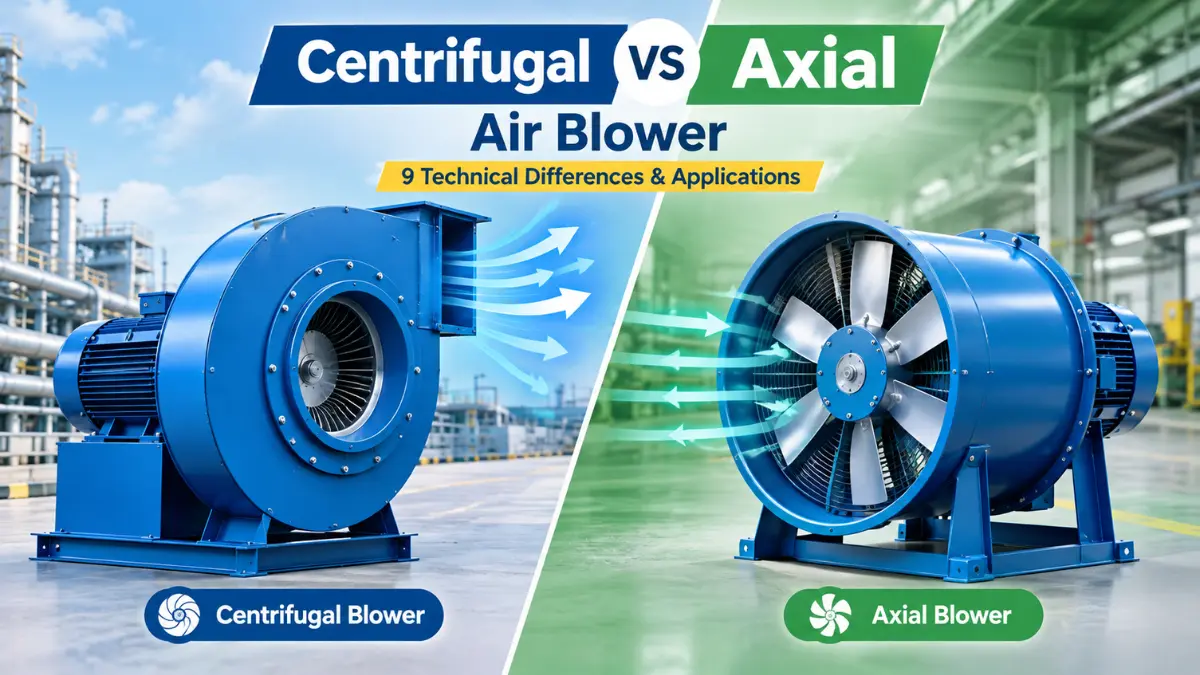
When choosing an industrial air blower, one of the most important questions is: Should you use a centrifugal blower or an axial blower? This guide explains Centrifugal vs Axial Air Blower :9 technical differences between centrifugal and axial air blowers, their applications, CFM, static pressure, power requirements, practical selection methods, and common questions.
Both blower types move air, but they are designed for different operating conditions. The biggest difference is the way they move air and how they handle airflow, static pressure, duct resistance, and industrial applications.
A centrifugal blower moves air outward from the center of an impeller and turns the airflow by approximately 90 degrees before it leaves the blower. An axial blower moves air in a direction parallel to the rotating shaft, similar to a large industrial propeller.
For example, an axial blower can be useful when a facility needs a large volume of air for general ventilation or cooling. A centrifugal blower may be more appropriate when air must travel through long ductwork, filters, dampers, or other components that create higher resistance.
A centrifugal air blower uses a rotating impeller to draw air into the center of the blower and accelerate it outward. The basic airflow path is:
Air inlet → Impeller → Volute/casing → Air outlet
The impeller rotates at high speed. As air enters near the center, centrifugal force and the aerodynamic design of the blades move the air toward the outside of the impeller. The blower casing then collects and directs the air toward the discharge outlet.
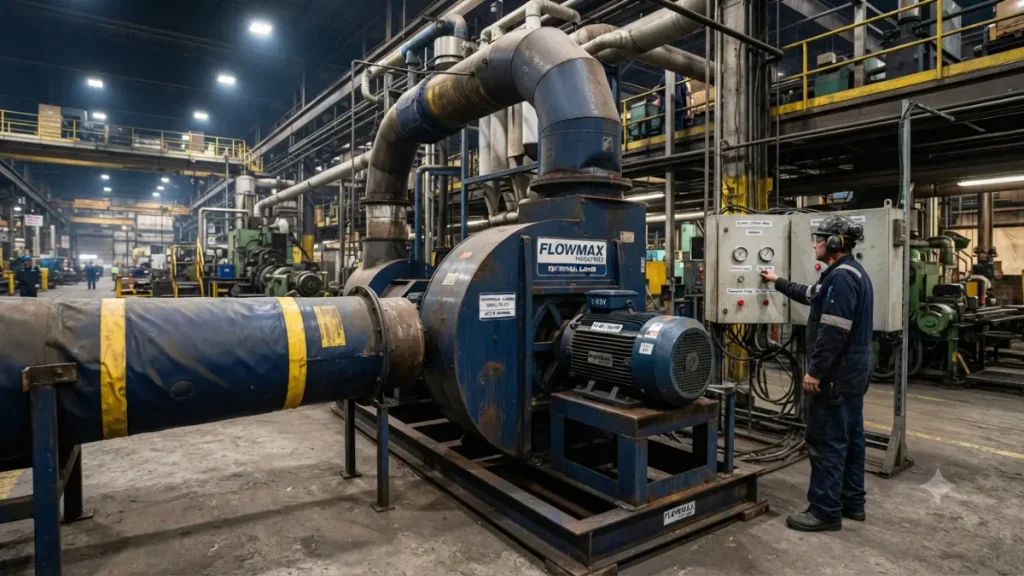
A typical centrifugal fan contains:
Centrifugal blowers are commonly used where the system requires higher pressure against resistance.
Typical applications include:
An axial air blower moves air approximately parallel to the shaft of the rotating fan or impeller. The basic airflow path is:
Air inlet → Axial blades → Air outlet
The blades rotate like a propeller and push air forward. Axial fans are commonly selected when the application requires high airflow volume with relatively low or moderate system resistance.
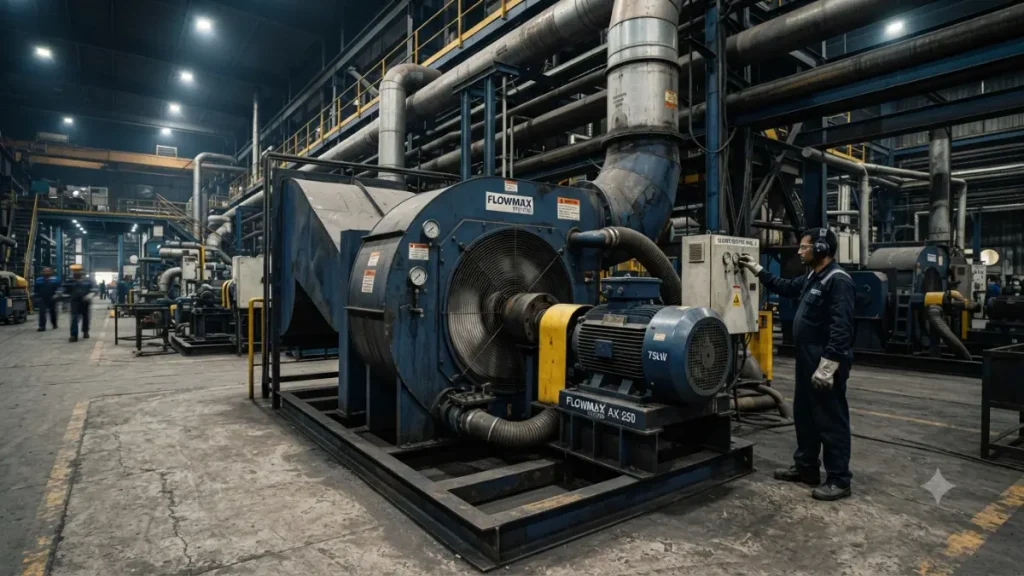
Typical applications include:
An axial blower can move a large amount of air, but its ability to overcome high system resistance depends on the specific design and fan curve.
A centrifugal blower first pulls air into the center of its impeller. As the impeller rotates, its blades accelerate the air outward. The casing collects the moving air and converts part of its velocity into pressure. The air then exits through the discharge outlet. The direction of airflow changes inside the blower.
Centrifugal blower:
Air ↓
Impeller ↻ → Air exits
The exact airflow path depends on the fan design, but the key difference is that centrifugal machines redirect the air radially rather than keeping it primarily along the shaft.
An axial blower works more like a powered propeller. The motor rotates the blades. The blades create a pressure difference and push air through the blower. The airflow remains generally parallel to the shaft.
Air → [Rotating Axial Blades] → → →
Because of this direct airflow path, axial blowers are often useful when the application requires large air volume with relatively low resistance.
The first major difference is airflow direction.
Airflow direction affects installation, duct layout, pressure generation, and application suitability. If your system requires air to travel through a complex duct system, the blower must be capable of overcoming the pressure losses created by that system.
CFM means Cubic Feet per Minute. It describes how much air a fan moves.
For example: 5,000 CFM
means the blower is rated to move approximately 5,000 cubic feet of air per minute under a specified operating condition.
A common mistake is to compare blowers only by CFM. That is not enough. A blower rated at 10,000 CFM may not perform properly in a system requiring high static pressure if its fan curve does not provide that airflow at the required pressure.
Therefore, selection should consider: Required CFM + Required Static Pressure rather than CFM alone.
Static pressure is one of the most important factors when selecting an industrial blower. Static pressure represents the resistance the fan must overcome in the air system. Resistance can come from:
Imagine two systems that both require 10,000 CFM.
System A: The blower discharges directly into a large open area. The resistance may be relatively low.
System B: The blower must push air through:
The second system may require significantly more static pressure. This is where blower selection becomes more technical.
High airflow + low resistance → axial fan may be suitable
Airflow + higher system resistance → centrifugal blower may be considered
However, always verify the manufacturer’s performance curve.
The impeller design is another major difference.
A centrifugal impeller has blades arranged around a rotating wheel. Common blade configurations include:
Each design has different performance characteristics. For example, backward-curved impellers are commonly used in applications where efficiency and pressure performance are important.
Axial fans use blades positioned around a central hub. They resemble a propeller. Blade angle, diameter, number of blades, RPM, and motor power all influence airflow and pressure.
Therefore, two axial blowers with the same diameter can have very different performance.
A blower does not operate at one fixed CFM under every condition. Its actual airflow changes according to the resistance of the system. This is why manufacturers provide a fan performance curve or blower curve. The curve can show relationships between:
For example, a blower may produce: 10,000 CFM at low static pressure but considerably less airflow when the system resistance increases.
This is why saying:
“I need a 10,000 CFM blower”
is incomplete.
A better specification is:
“I need 10,000 CFM at 4 inches of water gauge static pressure.”
The exact pressure unit may vary by industry and manufacturer. Common units include:
Motor power depends on several factors, including:
A simplified relationship between airflow, pressure, and air power is: Air Power = Q × ΔP
where:
In practical blower selection, efficiency must also be considered.
A simplified fan power relationship can be expressed as: Power ≈ (Q × ΔP) / η
where:
The exact equation depends on the units being used.
For example, when using CFM and inches of water gauge, a commonly used approximate relationship is: BHP = (CFM × Static Pressure) / (6356 × Fan Efficiency)
This is a useful engineering estimate, but the actual motor selection should be based on the manufacturer’s performance data.
Do not select a motor only because the horsepower number looks large. An oversized motor can increase purchase and operating costs, while an undersized motor may overload.
Both centrifugal fans and axial blowers can produce noise and vibration. Noise depends on:
High-speed operation can increase aerodynamic noise. Poor alignment or worn bearings can increase mechanical vibration.
Depending on the application, engineers may use:
Noise should be considered when installing blowers near workers or occupied areas.
Installation requirements can differ significantly.
A centrifugal blower may be connected to:
Proper duct sizing is important. Sharp bends, unnecessary restrictions, and poorly designed transitions can increase pressure losses.
Axial fans are often easier to integrate into:
However, an axial blower is not automatically the correct choice simply because installation appears easier. The complete system resistance must still be evaluated.
The final major difference is application.
| Dust collection | Dust collection systems often include ductwork, filters, hoods, and collection equipment. These components create resistance. |
| Furnace combustion | Industrial furnaces may require controlled combustion air. The blower must provide the required airflow at the pressure needed by the combustion system. |
| Welding fume extraction | Fume extraction systems can contain long ducts, filters, and extraction hoods. |
| Process drying | Centrifugal fans can be used to move process air through drying systems. |
| Industrial exhaust | They can be used when exhaust air must travel through ductwork or treatment equipment. |
| Factory ventilation | Axial blowers can move large volumes of air through large openings. |
| Warehouse cooling | Large-volume airflow can help remove accumulated heat when the application allows suitable air exchange. |
| Equipment cooling | Axial fans can provide direct airflow over equipment and components. |
| Tunnel ventilation | Large axial ventilation systems can move substantial volumes of air through large spaces. |
| General exhaust | They can be useful for exhausting hot or contaminated air where system resistance is relatively low. |
| Feature | Centrifugal exhaust fan | Axial Blower exhaust fan |
|---|---|---|
| Air direction | Radial/outward | Parallel to shaft |
| Typical airflow | Low to very high depending on design | Moderate to very high |
| Pressure capability | Often higher | Often lower to moderate |
| High-resistance duct system | Often suitable | Depends strongly on design |
| Impeller | Centrifugal wheel | Propeller-type blades |
| Duct applications | Very common | More limited depending on resistance |
| General ventilation | Suitable | Very common |
| Dust collection | Common | Application-dependent |
| Furnace air | Common | Application-dependent |
| Large open-space ventilation | Possible | Very common |
| Noise | Depends on design and speed | Depends on design and speed |
| Selection factors | CFM + pressure + efficiency | CFM + pressure + efficiency |
| Best selection method | Fan curve | Fan curve |
Consider a manufacturing facility that needs approximately: 10,000 CFM
The owner wants to remove heat from the production area. There are two possible situations.
Suppose the exhaust fan is installed in a wall and discharges air directly outside. There is:
An axial exhaust fan may be considered because the application primarily needs a large volume of air with relatively low resistance.
Now consider another facility. The same 10,000 CFM requirement exists, but the system contains:
The system resistance is much higher. A centrifugal blower may be considered because this type of blower is commonly used in systems where pressure development is important.
The answer is not: “Axial exhaust fan is always better for high CFM.”
Nor is it: “Centrifugal exhaust fan is always better.”
The correct selection of Air Blower depends on the required airflow, total system resistance, operating point, efficiency, environment, and manufacturer performance curve.
For simple room ventilation, one starting point is the air-change method.
Formula : Required CFM = Room Volume × ACH / 60
Where:
Example:
Suppose a room measures: 50 ft × 45 ft × 30 ft
Room volume: 50 × 45 × 30 = 67,500 cubic feet
Suppose the design requirement is: 6 air changes per hour
Then:
CFM = 67,500 × 6 / 60
CFM = 6,750
So the theoretical ventilation airflow requirement is approximately: 6,750 CFM
But this is only the starting point. If the system has significant duct resistance, filters, process equipment, or other restrictions, you must calculate or estimate the required static pressure too.
For industrial process ventilation, the required airflow may instead be determined by hood capture requirements, heat load, contaminant control, combustion requirements, or process specifications.
This is one of the most important concepts for anyone buying a blower.
Think about a water pump. A pump specification does not only say how many gallons it can move. You also need to know the pressure or head at which it can deliver that flow.
A blower works in a similar way. Therefore:
CFM + Static Pressure = Much better blower specification
Before purchasing an industrial fan, collect the following information.
| 1. Determine required airflow | Calculate or obtain the required CFM. |
| 2. Determine static pressure | Estimate the pressure loss through: Ducts Elbows Filters Dampers Equipment Exhaust outlets |
| 3. Check operating temperature | Hot air can affect material selection, motor cooling, and blower performance. |
| 4. Check the air being moved | Is the air: Clean? Dusty? Hot? Moist? Corrosive? Contaminated? Dusty air may require a suitable impeller and system design. |
| 5. Check electrical supply | Confirm: Voltage Phase Frequency Motor HP/kW For example, industrial facilities may use different electrical configurations depending on the location and equipment. |
| 6. Check noise requirements | If workers are nearby, consider the sound level and whether additional noise control is needed. |
| 7. Check fan curve | This is critical. Make sure the blower can provide the required CFM at the required static pressure. |
| 8. Consider efficiency | A blower that operates efficiently at the required operating point can reduce long-term energy costs. |
| 9. Consider maintenance | Check access to: Bearings Motor Impeller Filters Belts Electrical components |
The correct choice depends on your application.
Consider a centrifugal blower exhaust when:
Consider an axial blower exhaust when:
These are general selection guidelines. Always verify actual performance using the manufacturer’s published fan curve.
Regular maintenance can help maintain airflow and reduce unexpected downtime.
1. Check the impeller: Look for:
An unbalanced impeller can cause vibration.
2. Check bearings: Monitor:
Follow the manufacturer’s lubrication interval.
3. Inspect belts: For belt-driven blowers, check:
4. Clean filters: Blocked filters increase system resistance and can reduce airflow.
5. Check motor: Inspect:
6. Monitor performance: A change in normal CFM, pressure, temperature, noise, or vibration can indicate a developing problem.
The choice between a centrifugal and axial air blower should not be based on CFM alone.
An axial blower is commonly associated with high-volume, lower-resistance air movement, making it useful for ventilation, cooling, exhaust, and large open areas.
A centrifugal blower exhaust is commonly selected when the system requires greater pressure capability, especially when air must move through ductwork, filters, dust collectors, process equipment, or other restrictions.
The most important selection parameters are:
Required CFM + Static Pressure + Operating Temperature + Air Quality + Efficiency + Electrical Requirements
Before purchasing an industrial exhaust, determine the actual system operating point and check the manufacturer’s performance curve.
For a simple ventilation application, CFM may be estimated using:
CFM = Room Volume × ACH / 60
For more complex industrial systems, the airflow requirement and pressure losses should be calculated based on the actual process and system design.
The key takeaway is simple:
Do not choose an industrial blower exhaust by CFM alone. Choose it based on the airflow you need at the pressure your system requires.
That approach can help you select the appropriate blower, avoid undersized equipment, reduce unnecessary energy use, and achieve more reliable industrial ventilation or process-air performance.
The main difference is airflow direction and pressure capability. An axial blower moves air mainly parallel to its shaft and is commonly used for high-volume, lower-resistance ventilation. A centrifugal blower moves air outward through an impeller and is commonly used where higher pressure is needed to overcome duct, filter, or process resistance.
Centrifugal blowers are generally used for higher-pressure applications than many axial designs, but actual performance depends on the specific blower and operating point.
Axial blowers are commonly used for high-volume airflow applications, but there is no universal CFM winner. Specific models must be compared at the required pressure.
Yes. Axial blowers are widely used for industrial ventilation, cooling, exhaust, and large-area air movement, particularly where system resistance is relatively low.
Yes. Centrifugal blowers are commonly used in ducted systems because many designs can provide the pressure required to overcome duct and equipment resistance.
CFM means Cubic Feet per Minute. It describes volumetric airflow.
Static pressure represents the resistance that the blower must overcome in an air-moving system.
No. The required airflow depends on the application. Excessive airflow can increase energy use, noise, and system operating problems.
Start with the required CFM and static pressure. Then consider temperature, air quality, electrical supply, efficiency, noise, installation, maintenance, and the manufacturer’s performance curve.
No. Industrial blowers are designed for different airflow, pressure, temperature, and environmental conditions. Selecting the correct design is important for reliable operation.
A fan or blower curve shows how airflow changes as system pressure changes. It helps engineers determine the operating point of the blower.
Because a blower may have a high free-air CFM rating but deliver much less airflow when connected to a restrictive duct or process system.

Welcome! I am a dedicated entrepreneur running an industrial affiliate product website, helping businesses and professionals find the best tools, equipment, and resources for their needs. With a passion for industrial products and a keen eye for quality, I curate and recommend top-performing items that enhance efficiency and reliability.
Through my platform, I aim to simplify the buying process by providing valuable insights, expert reviews, and trusted affiliate links to high-quality industrial products. Whether you’re looking for the latest machinery, tools, or safety gear, I strive to connect you with the best solutions available.
Thank you for visiting, and I look forward to helping you make informed purchasing decisions!
