Our Location
Killa-Pardi, Dist. Valsad, 396125

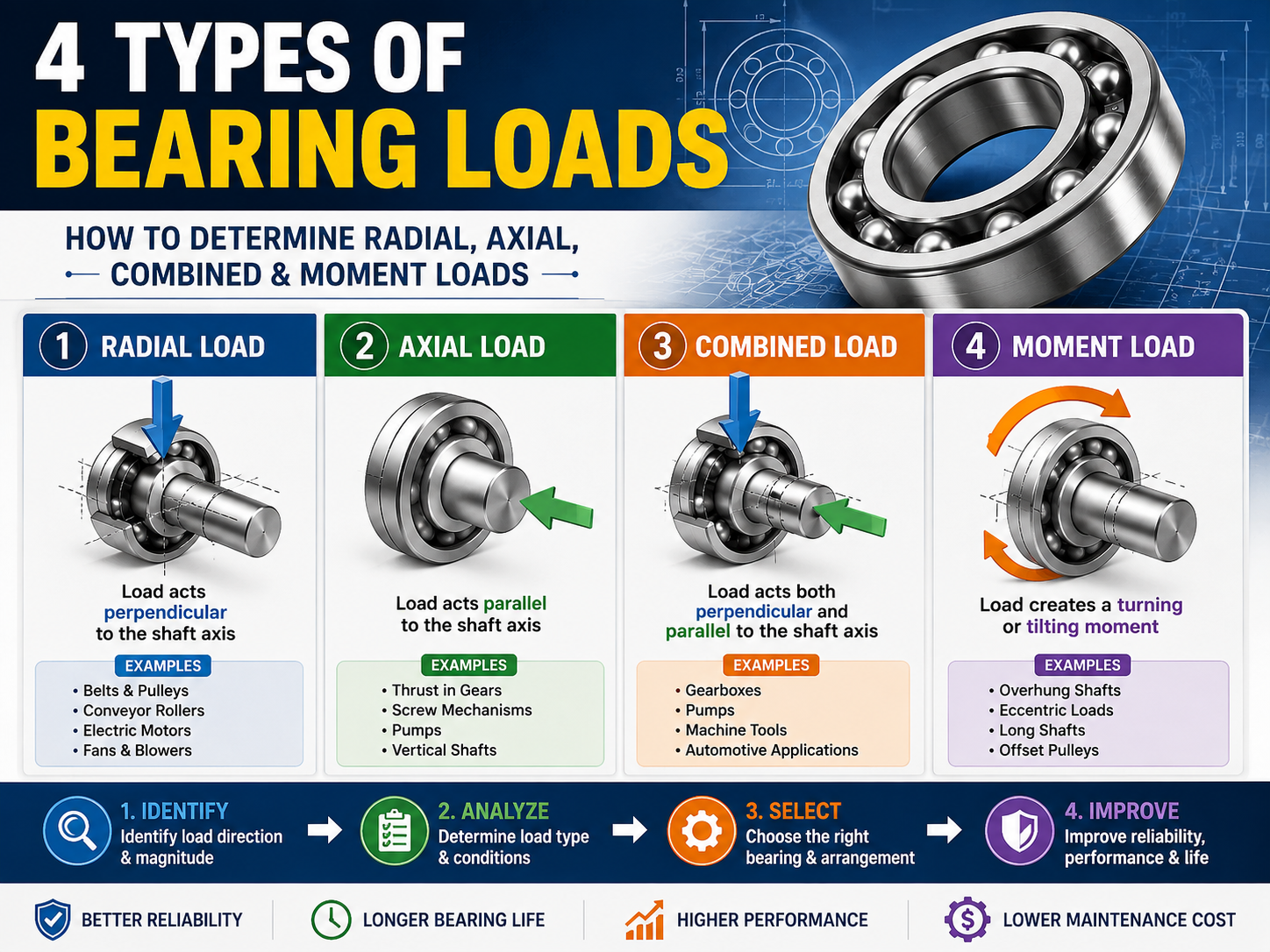
Selecting the correct bearing is not simply a matter of matching the shaft diameter with the bearing bore. One of the most important steps in bearing selection is to determine the type, direction, magnitude and operating condition of the load acting on the bearing.
A bearing can experience a radial load, axial load, combined radial-and-axial load, or a moment load. The wrong interpretation of the load can lead to excessive heat, vibration, premature wear, raceway damage, lubrication problems and ultimately bearing failure.
For example, a cylindrical roller bearing designed primarily for radial loading is not automatically the best choice for a large axial load. Similarly, a thrust bearing designed for axial loading may not be suitable when substantial radial loading is present. SKF Company notes that roller bearings generally accommodate heavier bearing loads than similarly sized ball bearings, while bearing type selection also depends strongly on load direction and magnitude.
This guide explains how to determine the bearing load type step by step and how to use that information when selecting a bearing.
Bearing load is the force transmitted between the shaft, bearing rolling elements and housing during machine operation.
The load may come from:
The first task is to determine where the force is acting and in which direction.
A useful approach is to draw a free-body diagram of the shaft and identify all external forces before selecting the bearing.
There are four important load categories:
SKF identifies radial, axial, combined and moment loading as important load-direction categories for bearing selection.
A radial load acts approximately perpendicular to the shaft axis.
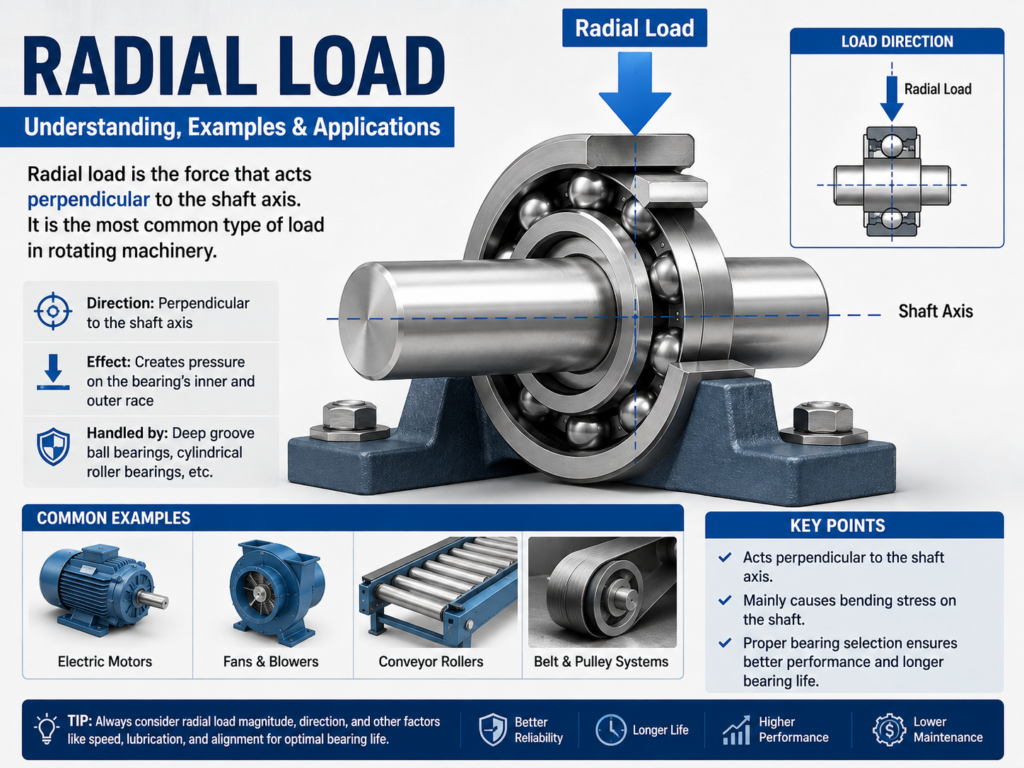
For example, if a pulley mounted on a rotating shaft is pulling downward because of belt tension, the resulting force can create a radial load on the bearing.
Typical applications include:
Cylindrical roller bearings, needle roller bearings and many deep-groove ball bearings are commonly associated with radial loading. SKF notes that some cylindrical and needle roller bearing designs are intended for pure radial loads, while other bearing designs can also accommodate axial components.
An axial load acts parallel to the shaft axis.
It is also commonly called a thrust load.
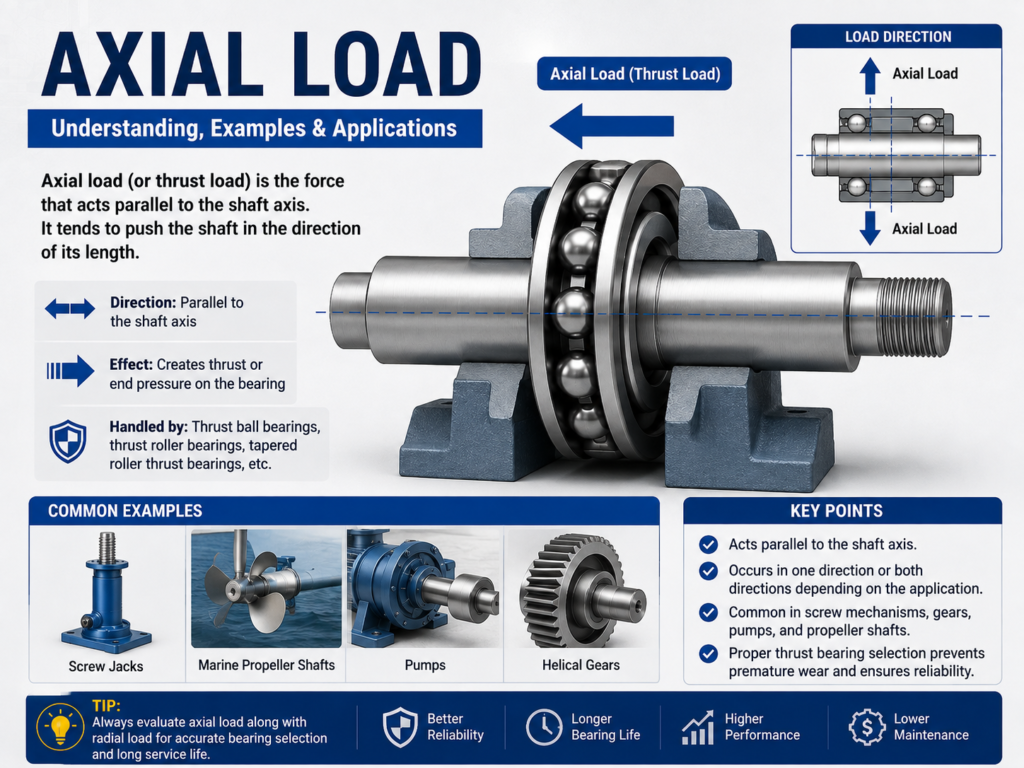
Examples include:
Thrust ball bearings are designed for axial loading. Depending on the bearing design, axial load may be supported in one direction or both directions.
A combined load occurs when radial and axial forces act simultaneously.
This is extremely common in industrial machinery.
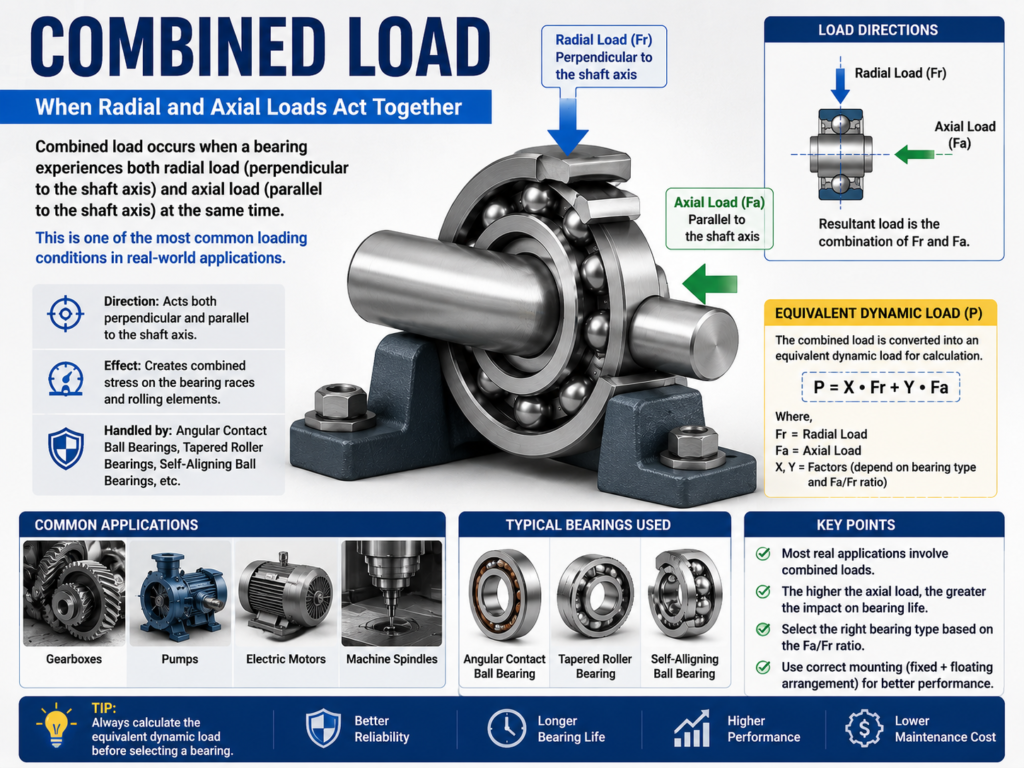
For example, a shaft carrying a helical gear can experience:
The bearing therefore needs to accommodate both components.
SKF explains that combined loads can be handled by bearing types such as angular-contact ball bearings and tapered roller bearings, while deep-groove ball bearings and spherical roller bearings may also be suitable depending on the axial component.
A moment load occurs when the load acts at a distance from the bearing or bearing centerline, creating a tilting effect.
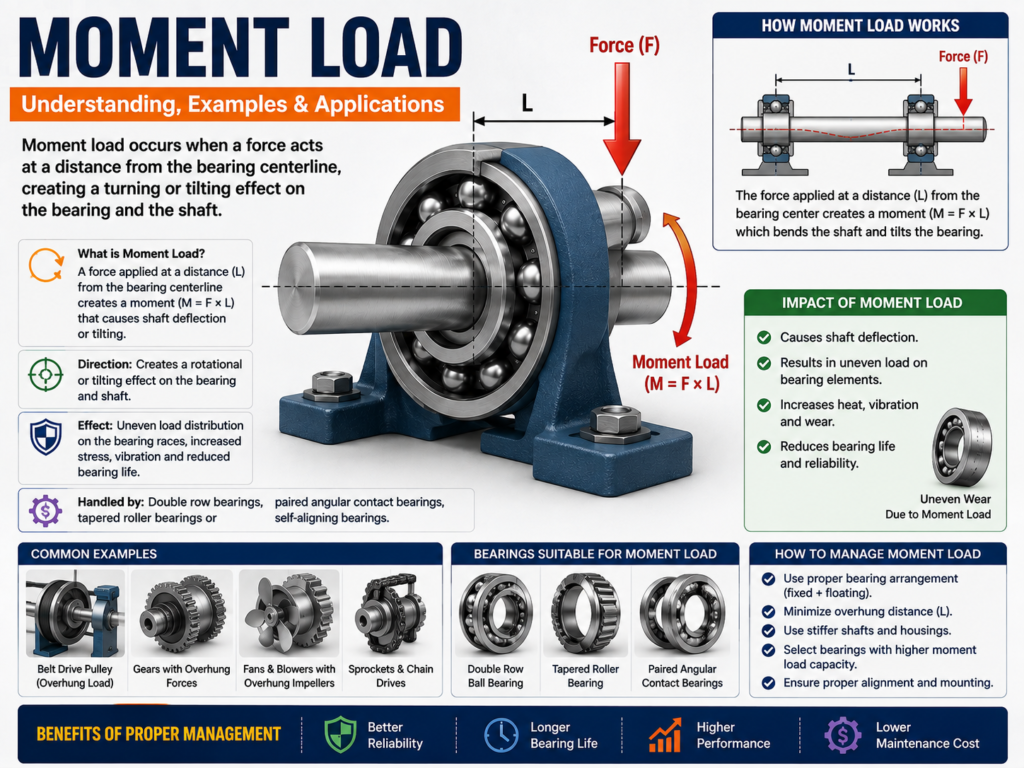
This can happen when:
Moment loading can cause uneven bearing loading and must be considered during bearing arrangement design.
SKF notes that double-row bearings can accommodate tilting moments, while paired angular-contact or tapered roller bearing arrangements can be more suitable for certain moment-load applications.
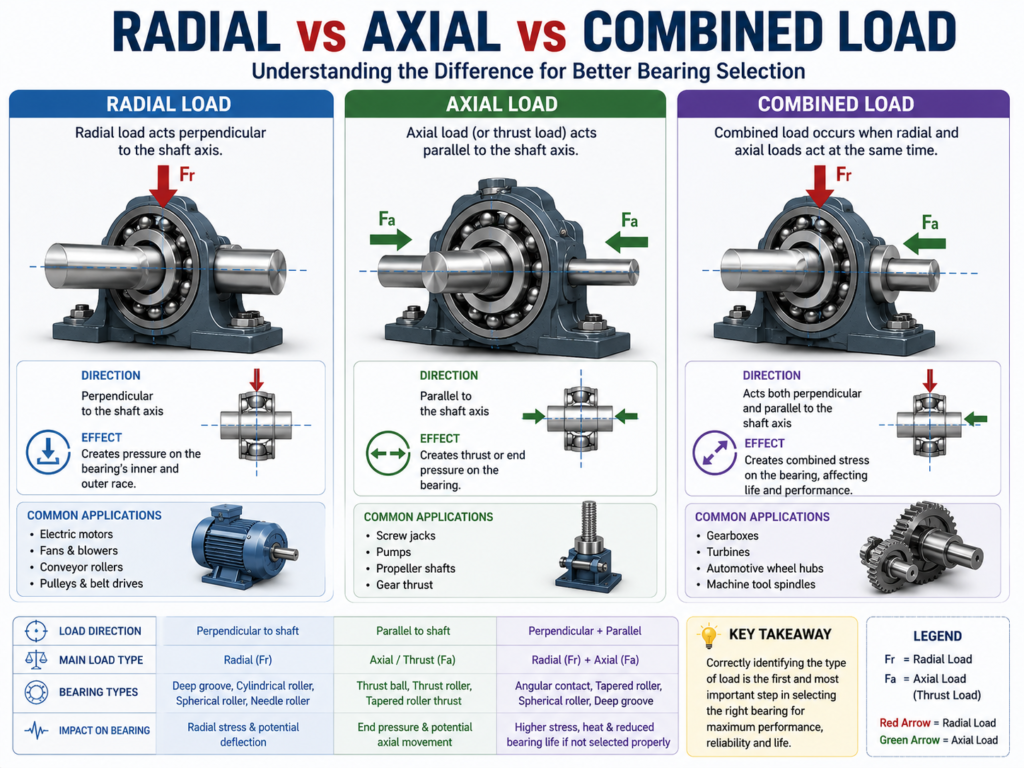
| Load Type | Force Direction | Typical Application | Common Bearing Choices |
|---|---|---|---|
| Radial | Perpendicular to shaft | Motors, rollers, fans | Deep-groove, cylindrical roller, spherical roller |
| Axial | Parallel to shaft | Thrust, screws, pumps | Thrust ball, thrust roller |
| Combined | Radial + axial | Gears, pumps, transmissions | Angular contact, tapered roller, deep groove |
| Moment | Creates tilting effect | Overhung shafts, eccentric loads | Double-row or paired bearings |
This table is a general guide. Actual bearing selection should always be checked against the manufacturer’s load ratings, speed, mounting arrangement and application conditions.
First identify the shaft centerline.
Imagine a horizontal shaft.
A force pushing downward on that shaft is generally radial.
A force pushing along the shaft toward its end is axial.
This simple visualization makes the first classification easier.
Do not consider only the machine’s weight.
Look for:
A shaft can have multiple forces acting at the same time.
If the force is angled, separate it into components.
For example:
Radial component = Fr
Axial component = Fa
The combined load is determined from these components.
The exact calculation method depends on bearing type and manufacturer factors.
For many radial bearings, NTN gives the dynamic equivalent radial load in the form:
P = XFr + YFa
where Fr is the radial load, Fa is the axial load, and X and Y are bearing-specific factors.
Do not use generic X and Y values without checking the particular bearing manufacturer’s catalog.
Load direction alone is not enough.
You should also determine whether the load is:
SKF distinguishes between constant-direction and alternating-direction loads, as well as static and dynamic loading conditions.
The load magnitude and direction remain approximately constant.
Example:
A conveyor roller operating with a relatively stable product load.
The load changes during operation.
Example:
A machine that starts with a light load and later operates under heavy load.
The direction changes repeatedly.
Example:
A mechanism where forces reverse during each operating cycle.
A sudden force is applied to the bearing.
Examples include:
Shock loads require special attention because the peak force may be much greater than the normal operating force.
After identifying the load direction, determine its magnitude.
Use appropriate units such as:
For example:
Suppose a shaft bearing experiences:
Radial load = 5 kN
Axial load = 2 kN
This is not a pure radial application. It is a combined-load application.
The bearing’s actual equivalent load must then be calculated using the manufacturer’s prescribed method.
For variable loading, the operating cycle may also need to be converted into an equivalent or mean load. NTN provides load-calculation methods for fluctuating and stepped loads and uses different exponents for ball and roller bearings in its calculation methods.
Common options include:
Roller bearings are generally advantageous when heavier radial loads must be supported because roller bearings can accommodate higher loads than similarly sized ball bearings.
Possible choices include:
The exact selection depends on load magnitude, direction, speed and whether radial load is also present.
Possible choices include:
As the axial component becomes more significant, bearing types with greater axial load capability may become more appropriate. SKF specifically notes angular-contact ball bearings and tapered roller bearings for higher axial components in combined loading.
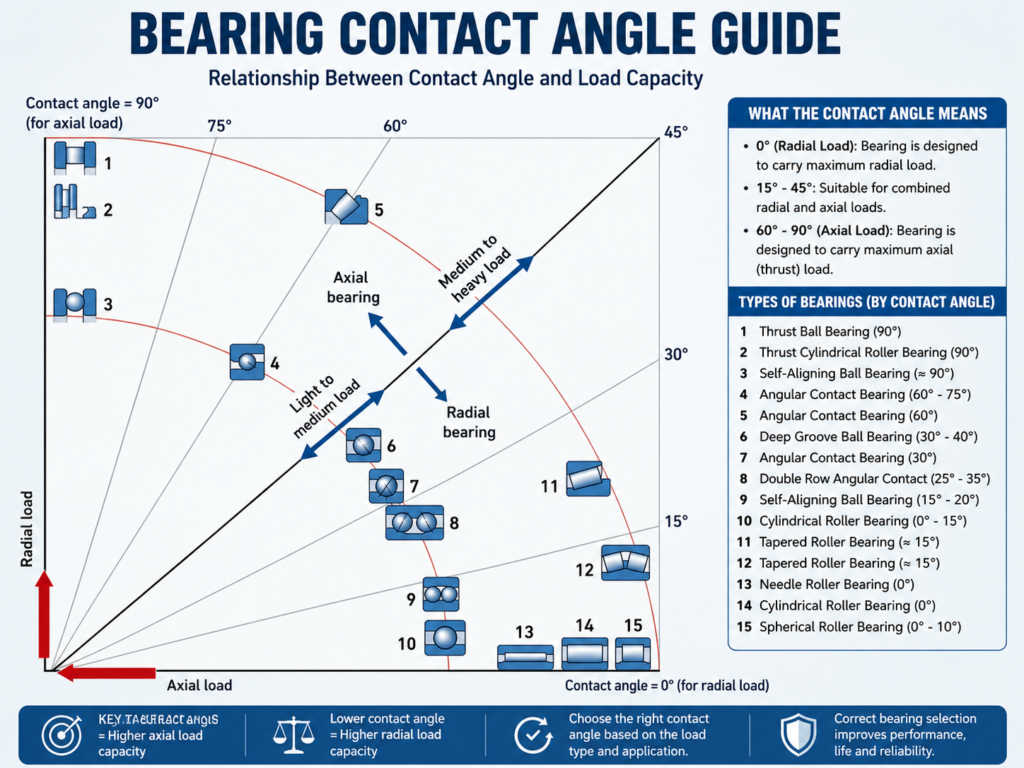
Contact angle is an important concept when select bearings for combined loading.
A bearing with a larger contact angle generally has greater axial load-carrying capability.
SKF explains that increasing contact angle increases axial load capability, while the direction of the combined load is determined by the ratio between radial and axial components.
This creates a practical trade-off.
Advantages:
Disadvantages:
Advantages:
Disadvantages:
Therefore, do not select a contact angle simply because “larger is stronger.” The complete application must be considered.
| Feature | Ball Bearing | Roller Bearing |
| Radial load | Light to moderate applications | Moderate to heavy applications |
| Axial capability | Depends on design | Depends strongly on design |
| Speed | Often excellent | Depends on type |
| Friction | Generally low | Depends on roller design |
| Heavy-load capability | Moderate | Generally higher |
| Typical use | Motors, fans, general machinery | Gearboxes, heavy machinery, industrial equipment |
SKF states that roller bearings generally accommodate heavier loads than similarly sized ball bearings.
Correct load identification provides several benefits.
Selecting a bearing according to actual loading reduces the risk of overloading.
The bearing is less likely to experience premature fatigue, excessive vibration or overheating.
Correct bearing selection helps maintain shaft positioning and machine accuracy.
Load, speed and temperature influence lubricant selection and relubrication requirements.
A properly selected bearing can reduce unplanned downtime and replacement frequency.
An undersized bearing may experience:
A bearing selected for radial loading may be unsuitable for a large axial component.
An eccentric load can produce additional stress that is not obvious if only the vertical or horizontal force is considered.
Using only the average load can underestimate the actual operating severity.
A machine with changing loads requires more detailed analysis than a machine operating at one constant load.
Follow this practical process:
Draw the shaft, bearings and all external forces.
Mark:
Fr = radial force
Fa = axial force
M = moment
Where possible, use:
Do not select the bearing only according to normal average load.
Consider:
Use the exact manufacturer’s bearing data.
Important parameters include:
NTN’s technical handbook specifically provides equivalent-load equations and manufacturer-specific factors for combined radial and axial loading.
Bearing selection should also consider:
Load is critical, but it is not the only selection criterion.
Consider a gearbox shaft.
Suppose the shaft experiences:
Because both radial and axial forces are present, this is a combined-load application.
The next step is not simply to select a bearing with an 8 kN radial rating.
Instead:
This method is much more reliable than selecting a bearing only from its bore diameter.
Before purchasing a bearing, answer these questions:
If these questions are answered correctly, bearing selection becomes considerably more systematic.
Determining the type of load is one of the most important steps in bearing selection. A bearing does not simply carry “weight”; it experiences forces with specific directions, magnitudes and operating patterns.
The four major load categories are radial, axial, combined and moment loads. Radial loads act perpendicular to the shaft, axial loads act parallel to the shaft, combined loads contain both radial and axial components, while moment loads create a tilting effect.
For light or moderate combined loads, a deep-groove ball bearing may be suitable in many applications. When the axial component becomes larger, angular-contact or tapered roller bearings may be more appropriate. Heavy radial applications may favor roller bearings because of their generally higher load-carrying capability.
The most important principle is simple:
Do not choose a bearing only by shaft size. Determine the actual load type, direction, magnitude, speed and operating conditions first.A proper load analysis can improve bearing life, machine reliability, maintenance planning and overall equipment performance.
The main types are radial, axial, combined radial-and-axial, and moment loads.
A radial load acts perpendicular to the shaft axis. Motors, fans and conveyor rollers commonly experience radial loads.
An axial load acts parallel to the shaft axis. It is also called a thrust load.
A combined load occurs when radial and axial forces act on the bearing simultaneously.
The answer depends on load magnitude, speed and other conditions. Deep-groove ball bearings are common for many radial applications, while cylindrical or spherical roller bearings can be appropriate for heavier loads.
Thrust bearings are designed specifically for axial loading, although some radial bearing designs can also support axial forces.
Contact angle affects the bearing’s ability to accommodate axial loading. Generally, a larger contact angle provides greater axial load-carrying capability.
Yes. Several bearing types can accommodate combined loads, including deep-groove ball, angular-contact ball and tapered roller bearings, depending on the application.
Overloading can increase stress, heat, vibration and fatigue damage, potentially causing premature bearing failure.
No. Bearing type, internal design, dynamic load rating, static load rating, speed, lubrication and operating conditions must also be considered.

Welcome! I am a dedicated entrepreneur running an industrial affiliate product website, helping businesses and professionals find the best tools, equipment, and resources for their needs. With a passion for industrial products and a keen eye for quality, I curate and recommend top-performing items that enhance efficiency and reliability.
Through my platform, I aim to simplify the buying process by providing valuable insights, expert reviews, and trusted affiliate links to high-quality industrial products. Whether you’re looking for the latest machinery, tools, or safety gear, I strive to connect you with the best solutions available.
Thank you for visiting, and I look forward to helping you make informed purchasing decisions!
