Our Location
Killa-Pardi, Dist. Valsad, 396125

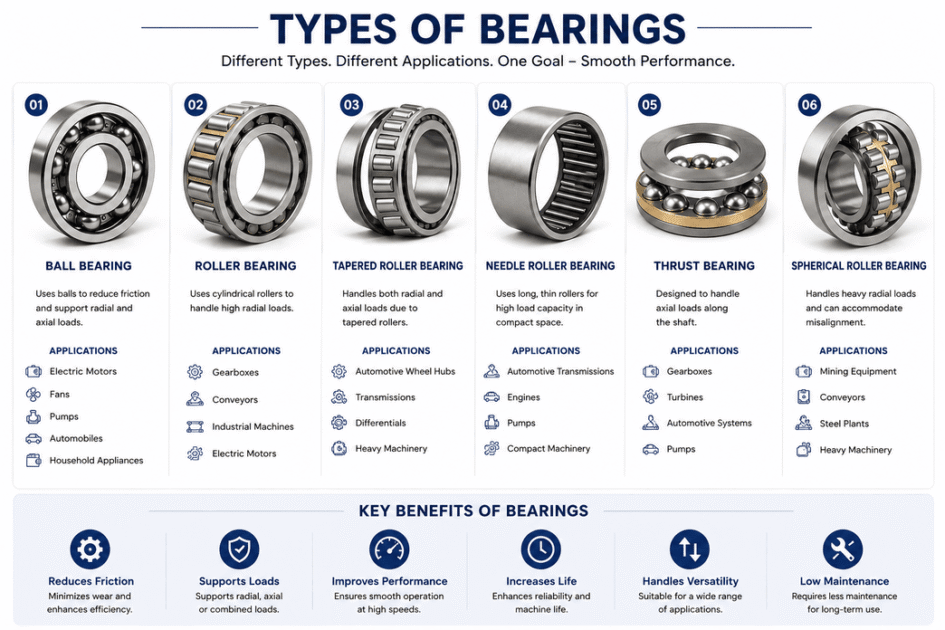
A bearing is a mechanical component designed to support rotating or moving parts while reducing friction between surfaces. Bearings are used in almost every industry where controlled mechanical movement is required, including automobiles, electric motors, pumps, fans, gearboxes, conveyors, agricultural machinery, industrial equipment, and household appliances.
Without a suitable bearing, direct contact between moving components can create excessive friction, heat, vibration, noise, and wear. The correct bearing helps a machine operate smoothly, efficiently, and reliably.
There are many types of bearings, and each type is designed for specific load, speed, alignment, temperature, and operating conditions. Understanding these differences is important when selecting a bearing for a particular application.
The basic working principle of a bearing is to reduce sliding friction by allowing controlled rolling or sliding motion between components.
In a typical rolling-element bearing, balls or rollers are positioned between an inner ring and outer ring. When the shaft rotates, the inner ring rotates with it while the rolling elements move between the races.
The basic working process is:
Shaft → Inner Ring → Rolling Elements → Outer Ring → Housing
The rolling elements reduce the direct sliding contact between the rotating shaft and stationary housing. Lubrication further reduces friction, heat, and wear.
Bearings can also be designed to handle:
The correct bearing type depends largely on which of these loads the machine experiences.
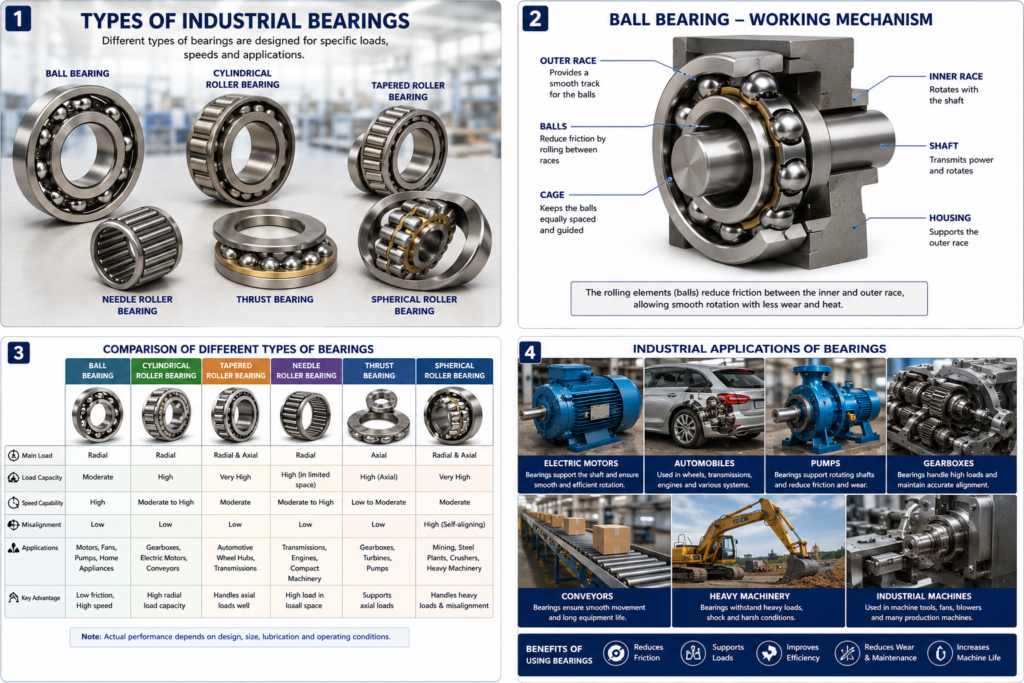
Ball bearings are among the most widely used bearing types. They use spherical balls between the inner and outer races.
They are particularly suitable for applications requiring relatively high rotational speed and moderate loads.
Ball bearings are commonly found in:
Best choice when: high speed and moderate load are more important than extremely high load capacity.
Cylindrical roller bearings use cylindrical rollers instead of balls. Because the rollers have a larger contact area, these bearings can generally support higher radial loads than similarly sized ball bearings.
They are commonly used in:
Best choice when: the primary requirement is high radial-load capacity.
Tapered roller bearings contain rollers arranged at an angle. Their geometry allows them to handle both radial and axial loads.
They are particularly important in automotive and heavy mechanical applications.
Best choice when: the machine experiences significant radial and axial loads simultaneously.
Needle roller bearings use long, thin rollers with a relatively small diameter. Their compact cross-section makes them useful where installation space is limited.
Best choice when: there is limited radial space but a relatively high radial load must be supported.
Thrust bearings are primarily designed to support axial loads. Instead of mainly supporting loads perpendicular to the shaft, they are designed for forces acting along the shaft.
Best choice when: axial load is the dominant operating requirement.
Spherical roller bearings use barrel-shaped rollers and are designed to accommodate heavy loads and certain levels of shaft or housing misalignment.
Best choice when: heavy loads and possible shaft misalignment are important considerations.
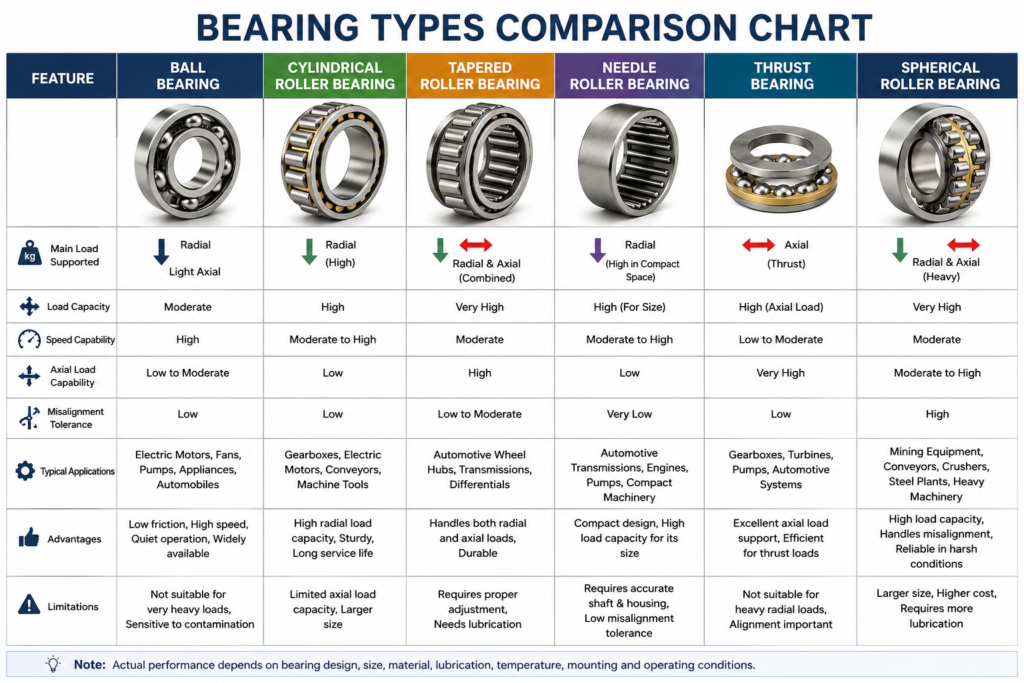
| Bearing Type | Main Load | Speed | Load Capacity | Typical Application |
|---|---|---|---|---|
| Ball Bearing | Radial + limited axial | High | Moderate | Motors, fans, pumps |
| Cylindrical Roller | Mainly radial | Moderate–High | High | Gearboxes, motors |
| Tapered Roller | Radial + axial | Moderate | Very High | Vehicle wheels |
| Needle Roller | Mainly radial | Moderate–High | High for size | Transmissions |
| Thrust Bearing | Mainly axial | Application dependent | High axial | Gearboxes, turbines |
| Spherical Roller | Radial + axial | Moderate | Very High | Mining, conveyors |
Note: Actual load and speed capabilities depend on the bearing design, dimensions, clearance, lubrication, mounting, temperature, and manufacturer specifications.
One of the most common bearing-selection questions is whether to use a ball bearing or roller bearing.
| Feature | Ball Bearing | Roller Bearing |
| Rolling element | Ball | Roller |
| Speed capability | Generally high | Varies by design |
| Heavy radial load | Moderate | Generally better |
| Friction | Generally low | Depends on design |
| Compactness | Often excellent | Varies |
| Typical use | Motors, fans, appliances | Gearboxes, heavy machinery |
| Cost | Often economical | Depends on type |
Neither is universally better.
A ball bearing is usually a good choice for high-speed applications with moderate loads. A roller bearing is generally preferred when high radial-load capacity is the priority.
Another important distinction is between radial and thrust bearings.
A radial bearing primarily supports loads perpendicular to the shaft.
Examples: Ball bearings, cylindrical roller bearings, spherical roller bearings.
A thrust bearing primarily supports loads acting along the shaft.
Examples: Ball thrust bearings and roller thrust bearings.
Selecting the wrong load direction can significantly reduce bearing performance and service life.
Different types of Bearings perform several critical functions in mechanical systems.
Bearings reduce resistance between moving components, helping the machine operate efficiently.
They support the weight and operating forces applied to rotating shafts.
Bearings help keep shafts accurately positioned relative to housings and other components.
By minimizing direct contact between moving surfaces, bearings can reduce mechanical wear.
Lower friction can help reduce unnecessary heat generation and energy consumption.
Correct bearing selection and maintenance can contribute significantly to reliable equipment operation.
Choosing a bearing should not be based only on its size or price. Consider the complete operating environment.
First identify whether the application has:
High-speed applications may require a bearing specifically designed for higher rotational speeds.
High or low operating temperatures can affect bearing materials, seals, grease, and service life.
If shaft or housing misalignment is possible, a self-aligning or spherical bearing design may be more appropriate.
Grease or oil must be compatible with the bearing and operating conditions.
Dust, water, chemicals, humidity, vibration, and contamination can influence bearing selection.
The available radial and axial space can determine whether a standard, needle, thrust, or another bearing design is suitable.
For difficult-to-access equipment, a bearing and lubrication arrangement that supports longer maintenance intervals may be advantageous.
Proper installation and maintenance are just as important as selecting the correct bearing.
Always use appropriate tools and installation procedures. Avoid hitting a bearing directly with a hammer or applying installation force through the wrong ring.
Use the lubricant recommended for the application. Both insufficient and excessive lubrication can create problems.
Keep dirt, dust, water, and other contaminants away from bearing surfaces.
Watch for:
Early detection can help prevent unexpected equipment downtime.
Bearings are used across almost every major engineering sector.
Used in wheels, transmissions, differentials, steering systems, engines, and other rotating components.
Bearings support motor shafts and allow smooth rotor rotation.
Bearings support rotating shafts and help maintain shaft alignment.
Gearboxes, conveyors, compressors, machine tools, and production equipment commonly use different bearing designs.
Tractors, harvesters, irrigation equipment, and agricultural machinery use bearings in many rotating assemblies.
Heavy-duty bearings are used in crushers, conveyors, excavators, and other equipment operating under demanding conditions.
| Requirement | Recommended Bearing Type |
| High speed + moderate load | Ball bearing |
| Heavy radial load | Cylindrical roller bearing |
| Combined radial + axial load | Tapered roller bearing |
| High load in limited radial space | Needle roller bearing |
| Mainly axial load | Thrust bearing |
| Heavy load + misalignment | Spherical roller bearing |
This table is a starting point only. Always verify the manufacturer’s load, speed, clearance, lubrication, temperature, and installation specifications before final selection.
Bearing failure does not always mean that the bearing itself was defective. Common causes include:
Correct installation, lubrication, sealing, alignment, and condition monitoring can significantly improve bearing performance.
Bearings are essential components for modern mechanical systems because they enable controlled movement while reducing friction, wear, and energy loss. However, there is no single bearing that is ideal for every application.
Ball bearings are commonly selected for high-speed, moderate-load applications, while roller bearings are generally better suited to heavier loads. Tapered roller bearings are useful for combined radial and axial loads, needle roller bearings are valuable where space is limited, thrust bearings are designed primarily for axial loads, and spherical roller bearings are useful for heavy loads and applications where misalignment may occur.
The best bearing should always be selected according to the machine’s load, speed, temperature, alignment, lubrication, environment, available space, and maintenance requirements.
Proper bearing selection combined with correct installation and regular maintenance can improve equipment reliability, reduce downtime, and extend machine service life as well as bearing life.
The main types include ball bearings, cylindrical roller bearings, tapered roller bearings, needle roller bearings, thrust bearings, and spherical roller bearings.
Ball bearings are commonly suitable for high-speed applications where loads are within their specified capacity.
Roller bearings are generally preferred for heavy radial loads, while tapered or spherical roller bearings can be suitable when combined loading or misalignment is involved.
Ball bearings use spherical rolling elements, while roller bearings use cylindrical, tapered, needle, or spherical rollers. Roller bearings generally provide higher load capacity for heavy radial loads.
A thrust bearing is primarily used to support axial loads acting along the shaft.
Lubrication helps reduce friction, heat, and wear and can protect bearing surfaces from premature damage.
Unusual noise, vibration, overheating, looseness, lubricant problems, and abnormal running conditions can indicate bearing problems.
Yes. Certain bearing designs, such as angular-contact ball bearings and tapered roller bearings, are specifically designed to handle combined radial and axial loads.
Use the correct bearing, maintain proper lubrication, prevent contamination, ensure accurate installation and alignment, and operate within the bearing’s rated conditions.
No. The best bearing is the one that matches the application’s load, speed, environment, temperature, alignment, and other operating requirements. A more expensive bearing is not automatically the right choice.

Welcome! I am a dedicated entrepreneur running an industrial affiliate product website, helping businesses and professionals find the best tools, equipment, and resources for their needs. With a passion for industrial products and a keen eye for quality, I curate and recommend top-performing items that enhance efficiency and reliability.
Through my platform, I aim to simplify the buying process by providing valuable insights, expert reviews, and trusted affiliate links to high-quality industrial products. Whether you’re looking for the latest machinery, tools, or safety gear, I strive to connect you with the best solutions available.
Thank you for visiting, and I look forward to helping you make informed purchasing decisions!
