Our Location
Killa-Pardi, Dist. Valsad, 396125


This document serves as an exhaustive engineering manual and sourcing blueprint exploring the ecosystem of various active and passive components. It details their physics-based definitions, critical functions, design nuances, and procurement strategies to secure real-time, in-stock status from trusted global manufacturers.
Abstract :
Modern electronics power nearly every aspect of our daily lives—from smartphones and laptops to medical equipment, industrial automation, and renewable energy systems. At the heart of every electronic device are two essential categories of components: active components and passive components. Understanding these building blocks is fundamental for students, engineers, hobbyists, and anyone interested in electronics.
Modern electronic systems rely on a strict operational symbiosis between active and passive components. Active devices direct signal processing, logical reasoning, and power manipulation, while passive components establish structural boundaries, reduce high-frequency electrical noise, and secure localized energy reservoirs. Selecting premium components from globally trusted, authorized distribution channels prevents circuit failures and protects supply chains against allocation delays.
Electronic components are the individual parts used to build electrical and electronic circuits. Each component performs a specific function, such as controlling current, storing energy, amplifying signals, or processing data.
These components are broadly classified into two categories:
Both are essential for designing efficient, reliable, and high-performance electronic systems.
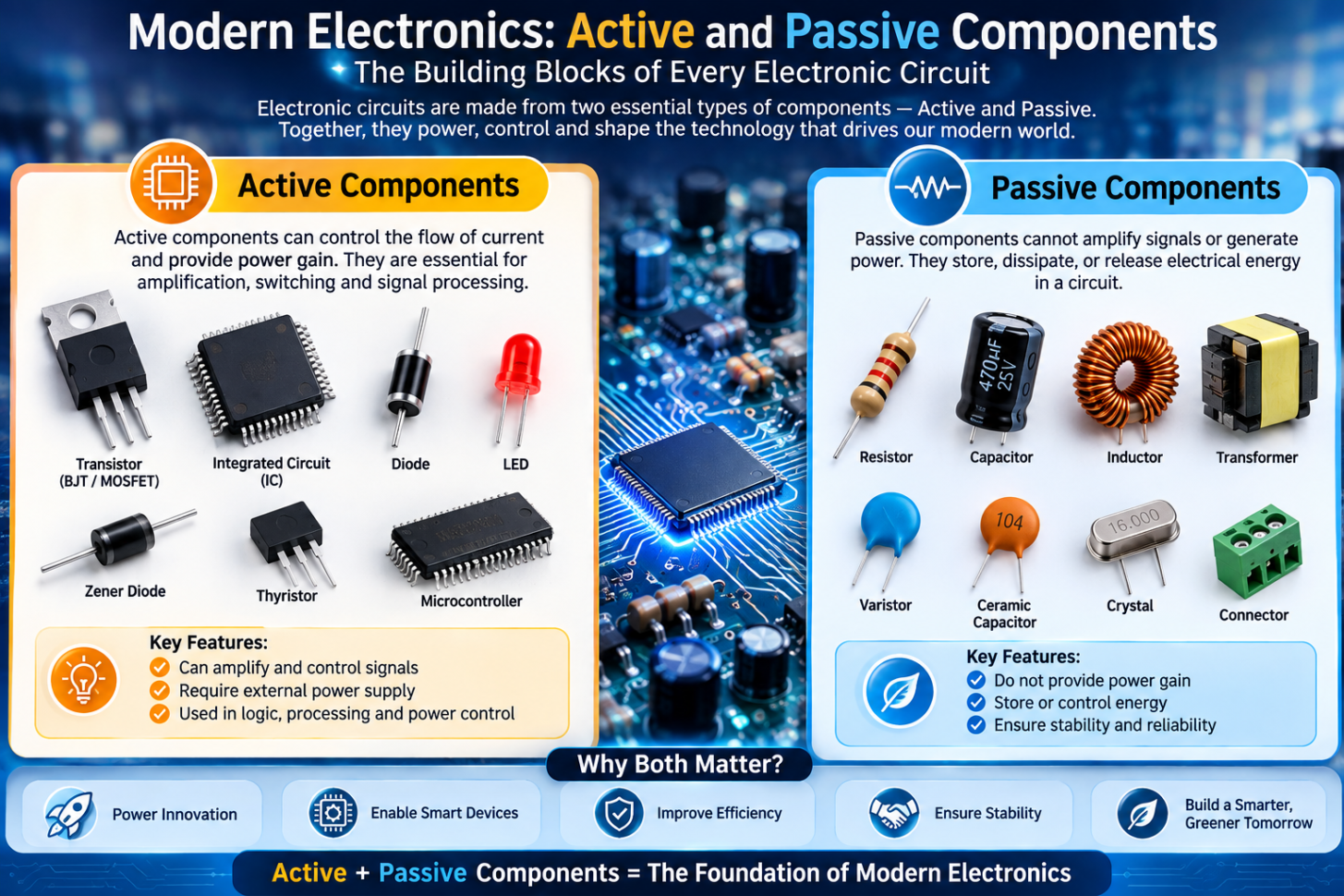
The primary difference between these component classes is the reliance on an external operational power supply and the capacity to generate a net power gain.
Active components control the flow of electrons electrically and can inject measurable power gain into an isolated network path.
Active components are devices that require an external power source to operate. They can amplify electrical signals, control current flow, generate power gain, or perform switching operations.
Unlike passive components, active devices introduce energy into a circuit, making them indispensable for modern electronic applications.
Transistors act as electronic switches and amplifiers. They are the backbone of modern computing, communication systems, and integrated circuits.
Applications:
Diodes allow current to flow in one direction while blocking it in the opposite direction.
Applications:
Integrated circuits combine thousands—or even billions—of transistors and other components onto a single semiconductor chip.
Applications:
Operational amplifiers are high-gain voltage amplifiers widely used in analog electronics.
Applications:
Passive components operate without an external power source, acting strictly on the electrical energy already moving through the signal loop.
Passive components do not require an external power source to function. Instead, they store, dissipate, or regulate electrical energy without amplifying signals.
These components are crucial for maintaining circuit stability, filtering noise, and controlling voltage and current.
Resistors limit current flow and divide voltages within electronic circuits.
Applications:
Capacitors store electrical energy in an electric field and release it when needed.
Applications:
Inductors store energy in a magnetic field and oppose rapid changes in current.
Applications:
Transformers transfer electrical energy between circuits using electromagnetic induction.
Applications:
Critical Active Components
Critical Passive Components
| Feature | Active Components | Passive Components |
|---|---|---|
| External Power Required | Yes | No |
| Signal Amplification | Yes | No |
| Power Gain | Yes | No |
| Energy Storage | Limited | Yes |
| Controls Current | Yes | Yes |
| Examples | Transistors, Diodes, ICs | Resistors, Capacitors, Inductors |
A functional electronic circuit depends on the seamless interaction between active and passive components.
For example, in an audio amplifier:
This collaboration forms the foundation of virtually every electronic device.
Active and passive components are found across numerous industries, including:
As technology continues to evolve, these components remain fundamental to innovation and product development.
Whether you’re learning electronics, designing printed circuit boards (PCBs), or troubleshooting electronic systems, understanding active and passive components provides several benefits:
A solid understanding of these concepts is essential for careers in electrical engineering, embedded systems, robotics, and electronics manufacturing.
| Technical Metric | Active Components | Passive Components |
|---|---|---|
| Operational Auxiliary Power | Required. Must have external bias rails to control input signals. | None. Operates entirely using energy from the input signal line. |
| Net Power Gain | Yes. Capable of amplifying voltage or current signals. | No. Acts exclusively as an energy attenuator or storage medium. |
| Circuit Topology Nature | Primarily non-linear (exhibits saturation, breakdown, and cutoff). | Fundamentally linear within stated data sheet electrical limits. |
| Primary Structural Roles | Logic computing, signal generation, regulation, and switching. | Filtering noise, current limiting, loop stabilization, and energy storage. |
| Parasitic Vulnerabilities | Internal Miller capacitances that limit tracking speed. | Intrinsic structural self-resonant frequencies (SRF) from ESR and ESL. |
To minimize field failures and eliminate counterfeit risks, engineering bills of materials (BOMs) should strictly specify components from Tier-1 manufacturers available via authorized franchised distributors like DigiKey, Mouser Electronics, Arrow Electronics, and TTI Inc.
Trusted Passive Component Brands
Trusted Active Component Brands
The seamless interaction between active and passive elements underpins all modern electrical engineering. While active components supply the computational logic and raw power modulation that define advanced devices, their performance relies entirely on the stability of the surrounding passive matrix. Specifying Tier-1 manufacturers and sourcing through authorized global distributors ensures bills of materials remain robust, structurally sound, and consistently in stock.
Active components require an external power source and can amplify or control electrical signals. Passive components do not require external power and mainly store, regulate, or dissipate electrical energy.
Common active components include transistors, diodes, integrated circuits (ICs), and operational amplifiers (Op-Amps).
Passive components include resistors, capacitors, inductors, and transformers.
Both types of components are essential for building reliable electronic circuits. Active components perform processing and amplification, while passive components support stability, filtering, and energy management.
Most practical electronic circuits require passive components for current limiting, filtering, voltage regulation, and overall stability, making them indispensable in modern electronics.
No. Passive components cannot add energy to an active circuit loop. While a tuned capacitor and inductor network configured in parallel (an LC tank circuit) can oscillate at a specific resonant frequency, it only does so by exchanging energy previously introduced by an active source. Internal parasitic resistances will naturally damp this oscillation over time.
In classical network synthesis, components are categorized as passive if they cannot deliver a net power gain (\(A_p < 1\)). Because standard signal, rectifier, and Zener diodes do not require separate power rails to perform their basic routing or clamping functions and cannot amplify input signals, they are classified mathematically as passive, non-linear elements.
Class II and III ceramic capacitors (such as X5R and X7R formulations) lose a significant portion of their effective capacitance when a continuous DC voltage is applied across their terminals. In compact surface-mount packages, a \(10\mu\text{F}\) capacitor operating near its maximum voltage rating can experience a capacitance drop of up to 60% to 80%, reducing its ability to filter power supply noise.
Wide-Bandgap materials, such as Gallium Nitride (GaN) and Silicon Carbide (SiC), feature a larger energy gap between their valence and conduction bands than traditional silicon. This structural trait allows active power switches to withstand higher operational voltages, run at elevated temperatures, and cycle at megahertz frequencies while cutting internal thermal losses in half.

Welcome! I am a dedicated entrepreneur running an industrial affiliate product website, helping businesses and professionals find the best tools, equipment, and resources for their needs. With a passion for industrial products and a keen eye for quality, I curate and recommend top-performing items that enhance efficiency and reliability.
Through my platform, I aim to simplify the buying process by providing valuable insights, expert reviews, and trusted affiliate links to high-quality industrial products. Whether you’re looking for the latest machinery, tools, or safety gear, I strive to connect you with the best solutions available.
Thank you for visiting, and I look forward to helping you make informed purchasing decisions!
