Our Location
Killa-Pardi, Dist. Valsad, 396125

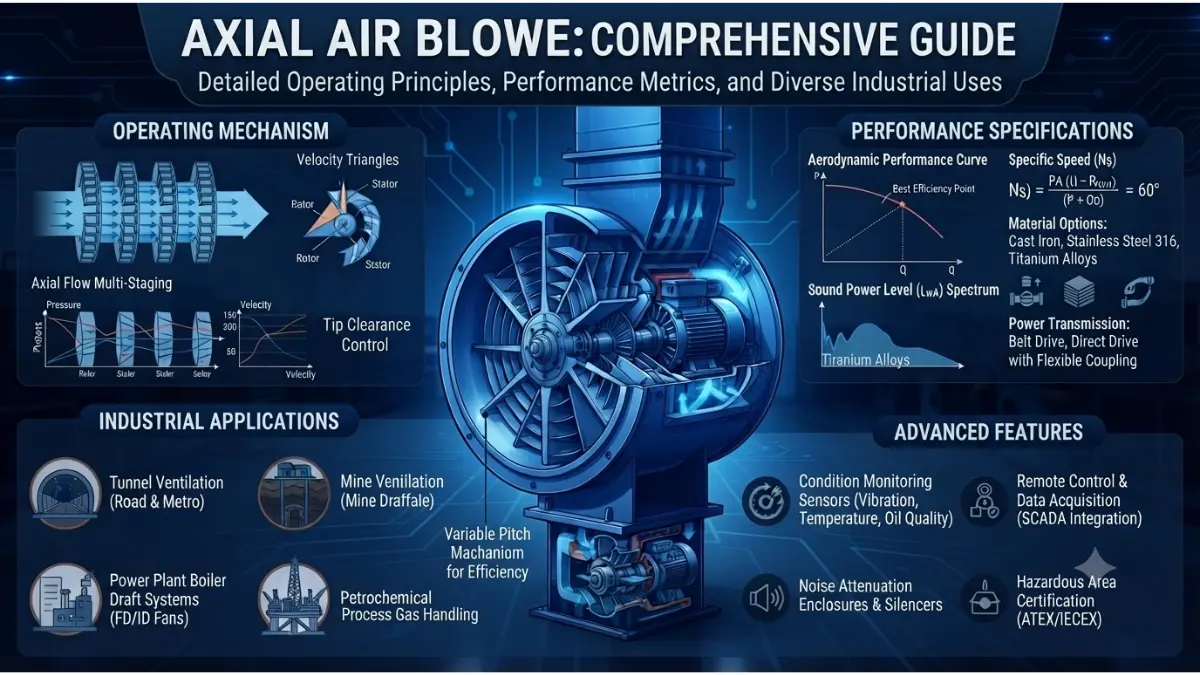
An axial air blower is an industrial airflow machine designed to move large volumes of air or gas in a straight direction parallel to its rotating shaft. Unlike centrifugal blowers, which discharge air at a 90-degree angle, axial blowers push air directly along the axis of rotation.
Axial air blowers are widely used in factories, warehouses, HVAC systems, cooling towers, tunnels, agricultural facilities, power plants, and industrial ventilation systems across the United States and worldwide. Their main advantage is high airflow capacity with relatively low static pressure, making them an excellent choice for general ventilation, equipment cooling, exhaust systems, and air circulation applications.
In this complete guide, we will explain the axial air blower working principle, major types, technical specifications, applications, advantages, disadvantages, maintenance requirements, and how to select the right blower for your industrial application.
An axial air blower is a mechanical device that moves air parallel to the axis of its motor shaft. It consists of rotating blades mounted on a central hub, which is powered by an electric motor.
As the blades rotate, they create a pressure difference that pulls air into the blower and pushes it forward in a straight-line airflow pattern.
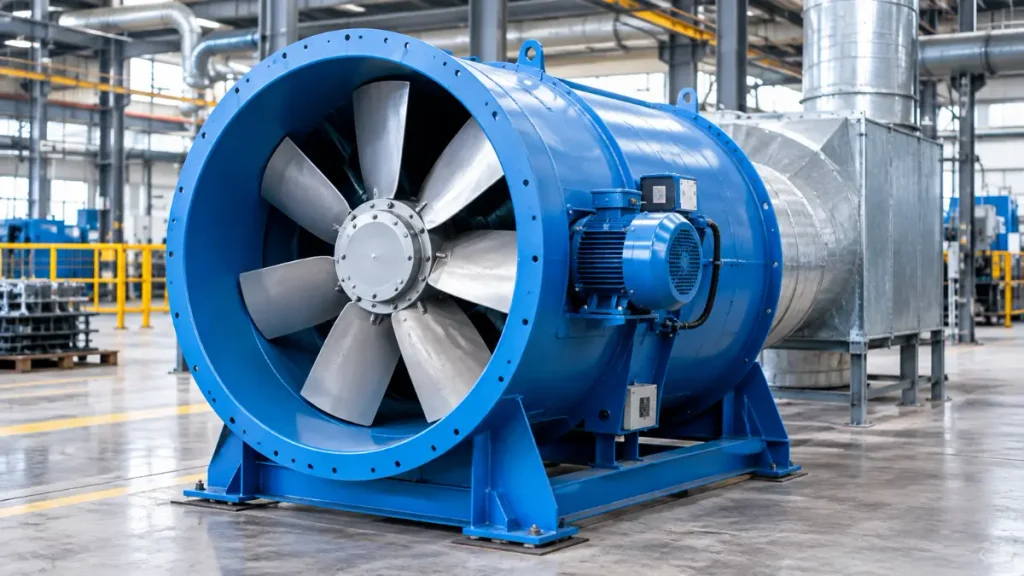
An axial air blower is a high-volume, low-pressure airflow device that moves air parallel to its rotating shaft.
Axial blowers are sometimes called:
The terms “axial fan” and “axial blower” are often used interchangeably in industrial applications, although technically, the pressure and design requirements may differ between manufacturers.
Axial fans are particularly suitable where large quantities of air must be moved through open spaces or low-resistance duct systems. Axial blowers are particularly suitable for applications requiring:
The working principle of an axial air blower is based on aerodynamic blade rotation and pressure generation.
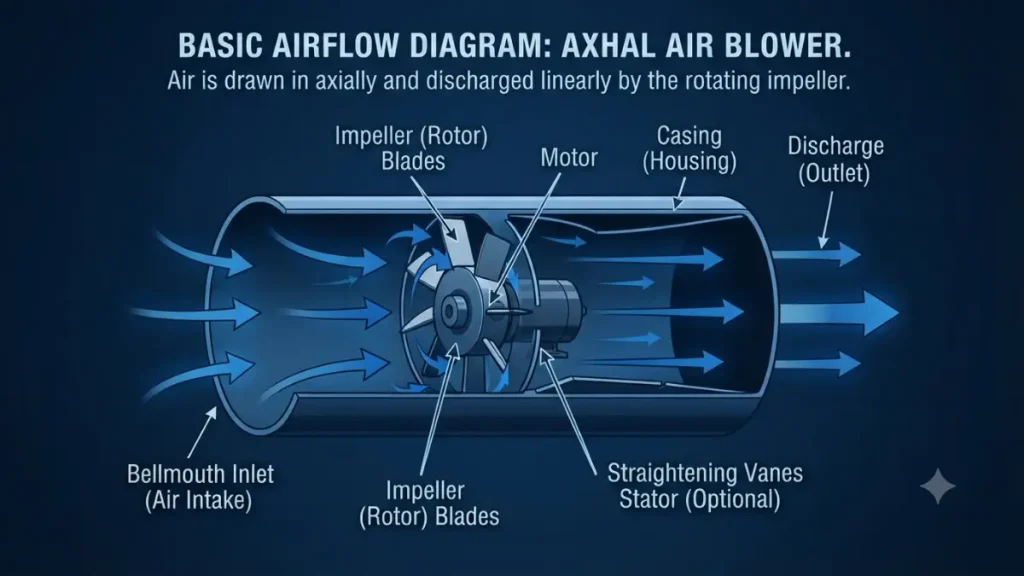
The blower uses an impeller containing multiple blades attached to a central hub. An electric motor rotates the impeller at a specific speed. When the blades rotate, they create a pressure difference between the inlet and outlet sides. This pressure difference causes air to move continuously through the blower.
Air enters the blower through the inlet opening. The rotating impeller creates a low-pressure region that draws surrounding air into the blower.
The electric motor rotates the fan shaft and impeller. The blades are specially designed with an aerodynamic pitch angle to accelerate air efficiently.
The rotating blades transfer mechanical energy from the motor to the air. This increases the velocity and pressure of the moving air.
The air exits through the outlet in the same direction as the shaft axis. This straight airflow path is the defining characteristic of an axial air blower.
The aerodynamic operation of axial fans is fundamentally different from centrifugal blowers, where air enters axially and exits radially.
An axial blower consists of several mechanical and electrical components. Understanding the major components helps industrial buyers select and maintain the right equipment.
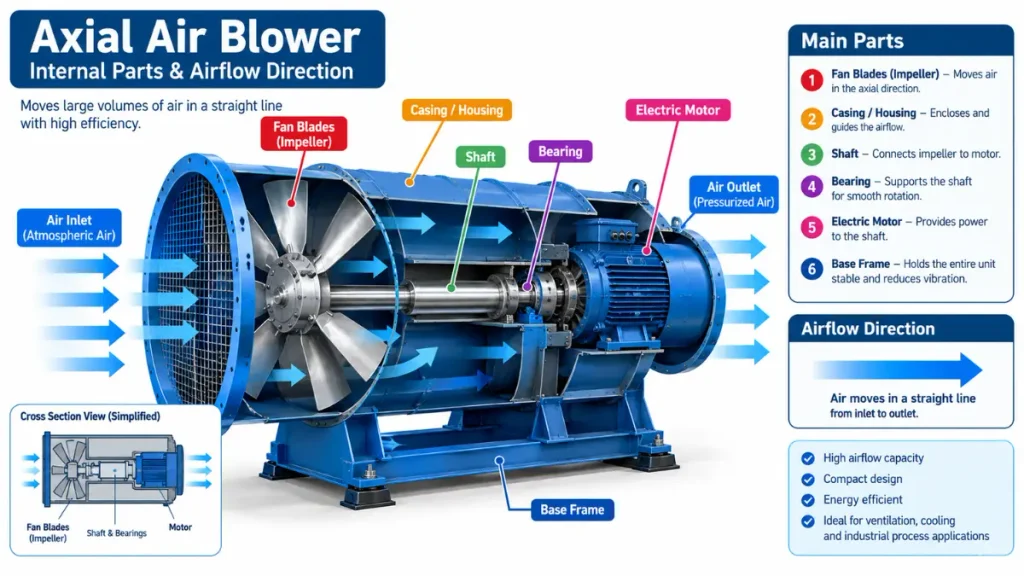
| Part | Function |
|---|---|
| Electric Motor | Provides rotational power |
| Shaft | Transfers motor rotation to the impeller |
| Impeller / Propeller | Moves air through the housing |
| Blades | Generate airflow and pressure |
| Hub | Holds blades together |
| Housing | Directs airflow and protects components |
| Bearings | Support the rotating shaft |
| Motor Mount | Secures motor inside or outside housing |
| Safety Guard | Prevents contact with rotating blades |
| Inlet Cone | Improves airflow entry |
| Outlet Diffuser | Helps reduce turbulence and pressure losses |
The motor provides rotational power to the impeller. Common motor types include:
Industrial axial blowers commonly use three-phase motors for continuous operation.
Common motor configurations in the USA include:
- 120V single-phase
- 208V three-phase
- 230V single-phase or three-phase
- 460V three-phase industrial motors
Motor selection depends on airflow requirements, operating hours, and available electrical supply.
The impeller is the primary rotating component. The impeller is the rotating assembly responsible for moving air. It consists of:
Impeller design significantly affects airflow, efficiency, noise, and power consumption.
Blades are designed using aerodynamic principles. Important blade characteristics include:
Typical materials include aluminum, steel, stainless steel, and reinforced engineering plastics.
The casing protects internal components and directs airflow. Industrial housings are commonly manufactured from:
Tube axial blowers use cylindrical housings for better airflow control.
The shaft connects the motor to the impeller. It transfers rotational energy from the motor to the blades. Proper shaft alignment is essential to reduce vibration and bearing wear.
Bearings reduce friction and support the rotating shaft. Common bearing types include:
Poor bearing lubrication can result in vibration, overheating, and premature failure.
A protective grille or guard prevents accidental contact with rotating blades. Safety guards are especially important in factories, workshops, and commercial installations.
Axial air blowers are available in different designs depending on airflow requirements, static pressure, installation conditions, and industrial applications.
A propeller fan is the simplest type of axial air blower. It consists of a motor and rotating blades without a cylindrical housing. It uses large blades mounted on a central hub.
Propeller fans are generally used where static pressure resistance is low.
A tube axial blower contains an impeller inside a cylindrical casing. The casing improves airflow direction and makes the blower suitable for ducted ventilation systems.
Tube axial fans are widely selected when airflow must pass through ducts with moderate resistance.
Tube axial fans are popular for industrial ventilation applications.
A vane axial blower includes stationary guide vanes positioned before or after the impeller. These vanes help straighten airflow and improve static pressure performance.
Vane axial fans are suitable for applications requiring improved pressure performance compared with standard propeller or tube axial fans.
Variable-pitch axial fans allow blade angles to be adjusted. Changing the blade pitch changes airflow and pressure performance.
These fans are commonly used in large industrial facilities and power generation applications.
Industrial axial flow fans are heavy-duty systems designed for continuous operation in demanding environments. They are available in large diameters and high-capacity airflow configurations.
Portable axial blowers are compact and easy to transport. They are commonly used for temporary ventilation.
Explosion-proof axial blowers are designed for hazardous industrial environments. They may include specially certified motors and electrical components.
Always verify applicable safety certifications and local regulations before selecting equipment for hazardous environments.
High-pressure axial blowers are designed to generate greater static pressure than conventional propeller fans. They are used where airflow must overcome moderate duct resistance.
One of the most common questions in industrial ventilation is whether to choose an axial or centrifugal blower.
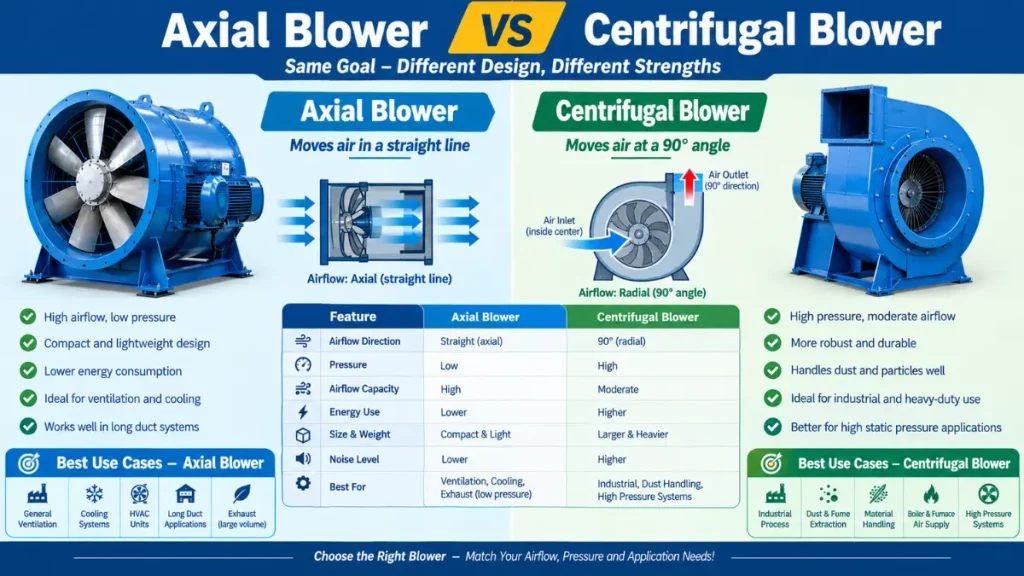
| Feature | Axial Air Blower | Centrifugal Blower |
|---|
| Airflow Direction | Parallel to shaft | Radial / 90-degree turn |
| Airflow Volume | High | Medium to high |
| Static Pressure | Low to moderate | Moderate to high |
| Energy Efficiency | Excellent at low pressure | Better for high resistance |
| Installation | Compact and inline | Requires duct arrangement |
| Best Application | Ventilation and cooling | Process air and high-pressure systems |
| Maintenance | Relatively simple | More complex |
| Space Requirement | Low | Higher |
| Cost | Usually lower | Usually higher |
Choose an axial air blower when:
Choose a centrifugal blower when:
Axial fans are generally designed for high-volume, low-pressure applications, while centrifugal blowers are better suited for systems with higher resistance.
Before buying an axial blower, understanding the technical data is critical.
CFM stands for Cubic Feet per Minute. It measures how much air the blower can move.
| Blower Size | Typical Airflow |
|---|---|
| Small Portable | 500–2,000 CFM |
| Medium Industrial | 2,000–10,000 CFM |
| Large Industrial | 10,000–50,000 CFM |
| Heavy Industrial Systems | 50,000+ CFM |
Actual performance depends on blade diameter, motor power, and operating pressure. Higher CFM means greater air volume, but not necessarily higher pressure.
Static pressure indicates the resistance against airflow. It is commonly measured in:
Axial blowers are generally optimized for lower static pressure compared with centrifugal blowers. Typical axial fan applications generally operate at lower static pressure than centrifugal systems.
| Application | Typical Static Pressure |
|---|---|
| Open warehouse ventilation | 0.05–0.20 in. WG |
| General exhaust | 0.10–0.50 in. WG |
| Industrial ventilation | 0.50–1.50 in. WG |
| Ducted axial systems | 1.00–3.00 in. WG |
| High-pressure axial applications | Above 3 in. WG |
These values are representative selection ranges, not universal ratings.
Motor horsepower determines the energy available to rotate the impeller. Motor power is measured in:
Common axial blower motor sizes:
Motor power should be selected according to airflow and pressure requirements.
Fan diameter directly affects airflow capacity. Common sizes include:
Larger fan diameters generally move greater air volumes at lower rotational speeds.
RPM means Revolutions Per Minute. Typical industrial axial blowers operate between:
Higher speed generally increases airflow and pressure but can also increase noise and power consumption.
Common industrial electrical specifications in the USA include:
Typical frequency:
Always confirm motor voltage compatibility before installation.
Noise is measured in decibels (dB). Industrial axial blowers may produce noise levels between approximately:
Noise depends on:
The following table provides practical model categories for selecting axial air blowers. Actual manufacturer models differ by brand. These are representative engineering specifications for comparison and planning purposes.
| Specification | Typical Value |
|---|---|
| Model Category | Compact Axial Ventilation Fan |
| Diameter | 8–12 inches |
| Airflow | 500–1,500 CFM |
| Static Pressure | 0.1–0.5 in. WG |
| Motor Power | 0.25–0.75 HP |
| RPM | 1,500–3,450 |
| Voltage | 120V / 230V |
| Application | Small workshops and exhaust |
| Specification | Typical Value |
|---|---|
| Model Category | Medium Tube Axial Fan |
| Diameter | 18–24 inches |
| Airflow | 2,000–8,000 CFM |
| Static Pressure | 0.3–1.2 in. WG |
| Motor Power | 1–3 HP |
| RPM | 1,750–3,450 |
| Voltage | 230V / 460V |
| Application | Factory ventilation |
| Specification | Typical Value |
|---|---|
| Model Category | Heavy-Duty Tube Axial Fan |
| Diameter | 30–36 inches |
| Airflow | 8,000–20,000 CFM |
| Static Pressure | 0.5–2.0 in. WG |
| Motor Power | 3–10 HP |
| RPM | 1,200–1,750 |
| Voltage | 460V Three Phase |
| Application | Large factories |
| Specification | Typical Value |
|---|---|
| Model Category | Industrial Variable-Pitch Axial Fan |
| Diameter | 48–72 inches |
| Airflow | 20,000–100,000 CFM |
| Static Pressure | 1–4 in. WG |
| Motor Power | 10–50 HP |
| RPM | 500–1,200 |
| Voltage | 460V / 575V |
| Application | Power plants and tunnels |
Axial air blowers are used across many industries because of their ability to move large volumes of air efficiently.
Factories generate heat, fumes, dust, and airborne contaminants. Axial blowers help remove stale air and introduce fresh air.
Large warehouses often experience poor air circulation. Axial exhaust fans help remove hot air from upper areas and improve airflow throughout the building. Common uses include:
Axial fans are widely used in heating, ventilation, and air-conditioning systems. They help circulate air through:
Large axial fans are commonly used in cooling tower systems. They move air through the tower to remove heat from circulating water. This is particularly important in:
Tunnel ventilation systems require large quantities of air movement. Axial fans are used to:
Tunnel axial fans can operate continuously under demanding conditions.
Mining operations require reliable ventilation systems. Axial blowers help supply fresh air and remove contaminated air from underground environments. Applications include:
Axial fans are extensively used in agricultural buildings. Applications include:
Proper ventilation helps regulate temperature and humidity.
Industrial axial blowers are used for:
Steel plants generate extremely high temperatures. Axial blowers help cool machinery and ventilate production areas. Applications include:
Portable axial blowers are frequently used during construction and maintenance operations. They help ventilate:
Let’s consider a practical industrial example.
Formula:
Room Volume = Length × Width × Height
= 50 × 45 × 30
= 67,500 cubic feet
For general industrial ventilation, air changes per hour (ACH) depend on the application.
Example assumption:
Formula:
Required CFM = Room Volume × ACH ÷ 60
= 67,500 × 10 ÷ 60
= 11,250 CFM
Therefore, the factory requires approximately:
11,250 CFM of ventilation airflow
For general factory ventilation, a suitable selection could be:
| Parameter | Recommended Value |
|---|---|
| Airflow | 11,000–12,000 CFM |
| Motor Power | 3–5 HP (depending on static pressure) |
| Fan Type | Industrial Tube Axial Blower |
| Diameter | Approximately 36–48 inches |
| Voltage | 460V / 3 Phase (USA industrial standard) |
| Frequency | 60 Hz |
| Static Pressure | Low to moderate |
| Application | Factory ventilation |
If the factory involves furnace combustion, high-temperature exhaust, dust collection, or long ductwork, a centrifugal blower may be more appropriate. For furnace combustion air specifically, blower selection must consider:
In such applications, a centrifugal combustion air blower is often preferred because combustion systems require controlled and stable pressure.
| 1. High Airflow Capacity | Axial blowers can move large volumes of air efficiently. They are ideal for ventilation and cooling applications. |
| 2. Compact Design | Their inline construction requires less installation space. |
| 3. Energy Efficient at Low Pressure | Axial blowers perform efficiently when system resistance is low. |
| 4. Easy Maintenance | Simple mechanical construction makes maintenance relatively straightforward. |
| 5. Cost Effective | They are generally less expensive than high-pressure centrifugal blowers for ventilation applications. |
| 6. Flexible Installation | Available in: Wall-mounted designs Ceiling-mounted designs Duct-mounted systems Portable configurations |
| 7. Suitable for Large Spaces | Factories, warehouses, tunnels, and agricultural buildings benefit from high-volume airflow. |
Despite their advantages, axial blowers have certain limitations.
| 1. Limited High-Pressure Performance | They are not ideal for high-resistance systems. |
| 2. Sensitive to Duct Resistance | Long ducts, filters, and multiple bends can significantly reduce airflow. |
| 3. Noise at High Speed | High RPM operation can generate considerable noise. |
| 4. Dust Accumulation | Dust and debris can collect on blades and reduce efficiency. |
| 5. Limited Process Air Applications | For pneumatic conveying and high-pressure combustion applications, centrifugal blowers are often better. |
Selecting the correct axial blower requires more than simply choosing the largest motor. Follow these important selection factors.
1. Calculate Required Airflow
2. Check Static Pressure
3. Select the Correct Fan Type
4. Consider Operating Temperature
5. Check Electrical Requirements
6. Evaluate Noise Requirements
7. Review Manufacturer Fan Curves
Proper maintenance increases blower efficiency and operating life.
Check:
Inspect:
Perform:
Recommended tasks:
| Problem | Possible Cause | Solution |
|---|---|---|
| Low Airflow | Dirty blades | Clean impeller |
| Excessive Noise | Bearing damage | Inspect bearings |
| High Vibration | Shaft misalignment | Realign shaft |
| Motor Overheating | Overload | Check motor load |
| Low Pressure | Wrong fan selection | Review system resistance |
| Frequent Trips | Electrical fault | Inspect wiring and motor |
| Reduced Efficiency | Damaged blades | Replace or repair blades |
Industrial ventilation systems can consume significant electricity. Follow these tips to reduce operating costs.
| 1. Use Variable Frequency Drives (VFD) | A VFD allows speed control based on actual airflow requirements. |
| 2. Clean Blades Regularly | Dust accumulation reduces aerodynamic efficiency. |
| 3. Avoid Oversized Motors | Oversized equipment can increase unnecessary energy consumption. |
| 4. Minimize Duct Restrictions | Use smooth ducts and minimize sharp bends. |
| 5. Maintain Proper Blade Pitch | Incorrect blade angles can increase power consumption. |
| 6. Monitor Operating Performance | Regular airflow and energy monitoring helps identify performance problems early. |
Before purchasing an axial air blower, check the following:
Let’s take an example of a textile manufacturing factory in Texas, USA, where proper ventilation is required to remove heat and maintain fresh air circulation.
| Parameter | Value |
|---|---|
| Factory Type | Textile Manufacturing |
| Length | 100 ft |
| Width | 60 ft |
| Height | 25 ft |
| Required Air Changes | 12 ACH |
| Application | General Ventilation & Heat Removal |
Formula:
Room Volume = Length × Width × Height
Calculation:
100 × 60 × 25 = 150,000 cubic feet
Therefore, the factory contains:
Total Volume = 150,000 ft³
For industrial manufacturing areas, air changes per hour (ACH) may vary depending on heat generation, process conditions, and ventilation standards.
For this example, assume:
Required Air Changes = 12 ACH
Formula:
Substitute the values:
Required Airflow = 30,000 CFM
Instead of purchasing one extremely large blower, using multiple blowers can improve airflow distribution and maintenance flexibility.
Suppose one industrial axial blower provides:
10,000 CFM
Formula:
Recommended Quantity: 3 Axial Air Blowers
For this textile factory, the following specification would be a reasonable starting point for an engineering evaluation:
| Specification | Recommended Value |
|---|---|
| Blower Type | Industrial Tube Axial Blower |
| Quantity | 3 Units |
| Airflow per Blower | 10,000 CFM |
| Total Airflow | 30,000 CFM |
| Motor Power | Approximately 5–10 HP each* |
| Fan Diameter | Approximately 36–48 inches* |
| Voltage | 460V |
| Phase | Three Phase |
| Frequency | 60 Hz |
| Application | Factory Ventilation |
*Motor power and diameter must be confirmed using the manufacturer’s fan performance curve.
Airflow alone is not enough to purchase a blower. You must also consider static pressure. Assume the factory ventilation system has:
| Component | Pressure Loss |
|---|---|
| Intake Louvers | 0.15 in. WC |
| Exhaust Grille | 0.10 in. WC |
| Short Ductwork | 0.20 in. WC |
| Bends and Restrictions | 0.15 in. WC |
| Safety Margin | 0.20 in. WC |
Therefore, the blower should be selected to deliver:
10,000 CFM at 0.80 in. WC Static Pressure
This is extremely important.
A blower advertised as “10,000 CFM” may only achieve that airflow under free-air conditions. Once connected to ducts, filters, and louvers, actual airflow can decrease.
A simplified fan power formula can help estimate motor requirements.
Formula:
Assume:
Calculation:
The theoretical fan power is approximately 1.94 HP.
However, after considering:
A practical motor selection might be approximately: 3 HP to 5 HP per blower
The final motor size must be confirmed by the manufacturer’s engineering data.
One-Line Answer For This Example : A 100 × 60 × 25 ft textile factory has a volume of 150,000 ft³. At 12 air changes per hour, it requires 30,000 CFM airflow, which can be achieved using three 10,000 CFM industrial axial air blowers operating at approximately 0.80 in. WC static pressure.
| Parameter | Requirement |
|---|---|
| Total Required Airflow | 30,000 CFM |
| Number of Blowers | 3 |
| Airflow per Unit | 10,000 CFM |
| Static Pressure | 0.80 in. WC |
| Motor | Approximately 3–5 HP* |
| Voltage | 460V |
| Frequency | 60 Hz |
| Fan Type | Tube Axial |
| Duty | Continuous Operation |
| Installation | Wall/Duct Mounted |
1. Room Volume
2. Required Airflow
3. Number of Blowers
4. Static Pressure
5. Fan Horsepower
Different environments require different construction materials.
| Environment | Recommended Material |
|---|---|
| General Industrial | Carbon Steel |
| Corrosive Chemicals | Stainless Steel |
| Outdoor Applications | Galvanized Steel |
| Lightweight Systems | Aluminum |
| Chemical Exhaust | FRP / Corrosion-resistant materials |
| High-Temperature Applications | Heat-resistant alloys |
Material selection depends on temperature, humidity, chemicals, dust, and operating conditions.
AMCA’s industrial fan guidance emphasizes considering hazardous gases, corrosive materials, dust, maintainability, and environmental conditions when specifying industrial fans.
This calculation is suitable for preliminary blower sizing and purchasing discussions. For an actual factory installation, final selection should be based on:
For furnace combustion, kiln exhaust, high-temperature air, or heavy dust applications, an axial blower may not be the correct choice. A centrifugal blower may be required because of higher static pressure demands.
Proper installation is essential for efficient performance.
Important Guidelines
Incorrect installation can reduce airflow and increase energy consumption.
Use the following checklist before purchasing an axial air blower.
| Specification | Required Information |
|---|---|
| Airflow | CFM |
| Static Pressure | in. WG / Pa |
| Motor Power | HP / kW |
| Voltage | 120V / 230V / 460V |
| Frequency | 50 Hz / 60 Hz |
| RPM | Operating speed |
| Fan Diameter | Inches |
| Blade Type | Fixed / Adjustable / Variable Pitch |
| Housing Material | Steel / Aluminum / Stainless Steel |
| Noise Level | dB |
| Efficiency | Fan and motor efficiency |
| Mounting | Wall / Duct / Floor / Ceiling |
| Warranty | Manufacturer coverage |
When purchasing industrial ventilation equipment in the United States, buyers commonly evaluate manufacturers based on engineering quality, performance curves, warranty, and service support.
Well-known manufacturers in the industrial fan and air movement sector include:
| Factor | Importance |
|---|---|
| Airflow Performance | Very High |
| Static Pressure Capability | Very High |
| Motor Efficiency | High |
| Warranty | High |
| Replacement Parts | High |
| Noise Level | Medium to High |
| Energy Consumption | Very High |
| Certification | High |
Do not select a blower based only on brand popularity or maximum CFM.
An axial air blower is an efficient and cost-effective solution for moving large volumes of air in industrial, commercial, and ventilation applications. Its straight-through airflow design makes it ideal for factories, warehouses, cooling towers, HVAC systems, tunnels, agricultural buildings, and equipment cooling.
The biggest advantage of axial blowers is their ability to deliver high airflow at relatively low pressure while maintaining a compact and simple design.
However, selecting the correct blower requires careful consideration of CFM, static pressure, motor power, fan diameter, operating temperature, and system resistance.
For general factory ventilation and cooling, axial blowers are often the preferred choice. For high-pressure applications such as furnace combustion, dust collection, and pneumatic conveying, centrifugal blowers may provide better performance.
Choosing the right industrial air blower can improve ventilation efficiency, reduce energy costs, protect machinery, and create a safer working environment.
An axial air blower is a fan-type machine that moves air parallel to its rotating shaft. It is commonly used for high-volume, low-pressure ventilation, cooling, and exhaust applications.
An axial blower uses rotating blades to create a pressure difference that pulls air into the fan and pushes it out in a straight direction parallel to the shaft.
An axial blower moves air parallel to the shaft, while a centrifugal blower changes airflow direction by approximately 90 degrees. Axial blowers are best for high airflow and low pressure, whereas centrifugal blowers are suitable for higher-pressure applications.
CFM stands for Cubic Feet per Minute. It measures the volume of air an axial blower can move.
Yes. Axial blowers are widely used for factories, warehouses, workshops, cooling towers, tunnels, and agricultural ventilation.
The best axial blower depends on required airflow, static pressure, room size, temperature, and installation conditions. Tube axial or vane axial blowers are common choices for industrial ventilation.
Axial blowers may be suitable for low-pressure air circulation, but furnace combustion systems often require controlled static pressure. Centrifugal combustion blowers are frequently preferred for this application.
A tube axial blower is an axial fan installed inside a cylindrical housing. It is commonly used in ducted ventilation and industrial exhaust systems.
A vane axial blower includes guide vanes that improve airflow direction and pressure performance.
A good CFM depends on the room size and application. Small industrial systems may require 2,000–5,000 CFM, while large factories may require 10,000 CFM or more.
10,000 CFM means the blower can theoretically move 10,000 cubic feet of air per minute under specified operating conditions.
Axial blowers are generally better suited for clean-air applications. Dust-heavy environments may require specially designed industrial fans or centrifugal blowers.
Noise depends on motor speed, blade design, airflow, and installation. Industrial axial fans can produce moderate to high noise levels at high speeds.
Standard axial fans are best for low to moderate pressure. High-pressure axial or vane axial designs can handle greater resistance.
Common industrial voltages include 230V and 460V three-phase, depending on facility electrical infrastructure.
Multiply warehouse volume by the desired air changes per hour and divide by 60.
Not necessarily. The correct fan must match airflow, static pressure, motor power, and installation requirements.

Welcome! I am a dedicated entrepreneur running an industrial affiliate product website, helping businesses and professionals find the best tools, equipment, and resources for their needs. With a passion for industrial products and a keen eye for quality, I curate and recommend top-performing items that enhance efficiency and reliability.
Through my platform, I aim to simplify the buying process by providing valuable insights, expert reviews, and trusted affiliate links to high-quality industrial products. Whether you’re looking for the latest machinery, tools, or safety gear, I strive to connect you with the best solutions available.
Thank you for visiting, and I look forward to helping you make informed purchasing decisions!
