Our Location
Killa-Pardi, Dist. Valsad, 396125

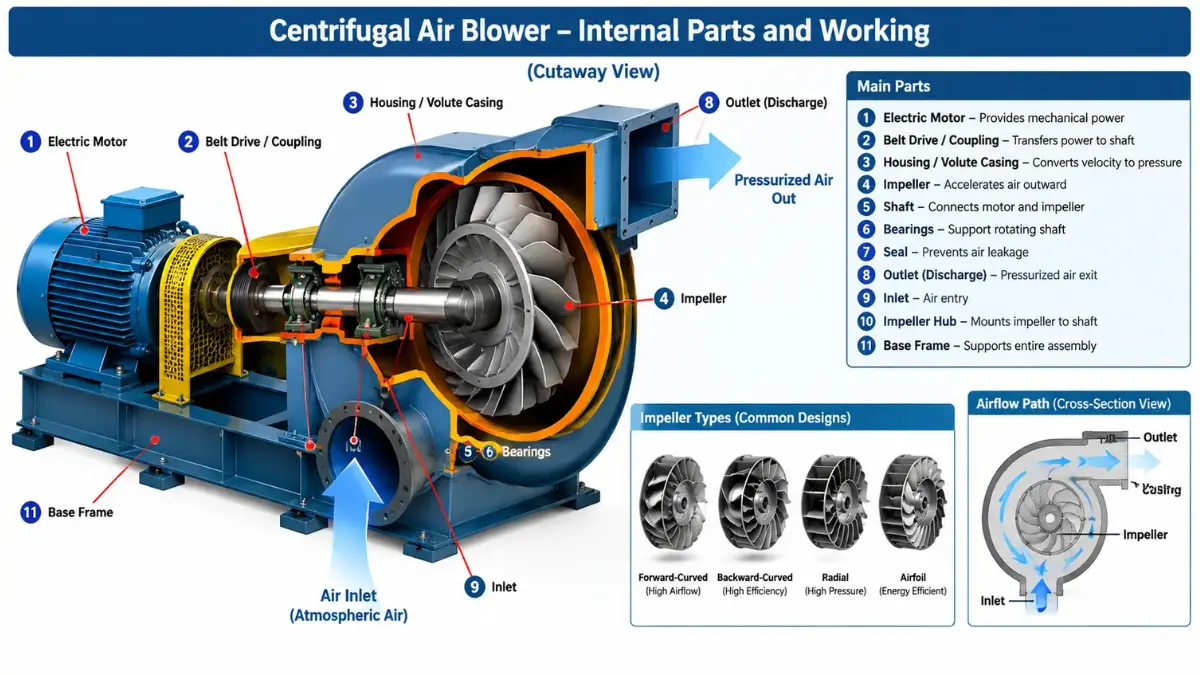
A centrifugal air blower is an essential industrial machine used to move air and gases at controlled airflow rates and pressures. Unlike ordinary fans, centrifugal blowers are designed to overcome duct resistance, filters, heat exchangers, and industrial equipment pressure losses.
From factory ventilation to dust collection, HVAC systems, combustion air supply, pneumatic conveying, and cooling applications, centrifugal blowers are widely used across the USA and global industries.
This comprehensive guide explains what a centrifugal air blower is, how it works, its technical specifications, model-wise performance examples, practical applications, maintenance requirements, and important buying considerations.
A centrifugal air blower is a mechanical device that uses a rotating impeller to increase air velocity and pressure. The air enters through the center of the impeller and moves radially outward because of centrifugal force.
The high-speed rotating impeller transfers mechanical energy from the motor to the air. Inside the housing, called a volute or scroll casing, the velocity energy is converted into useful static pressure.
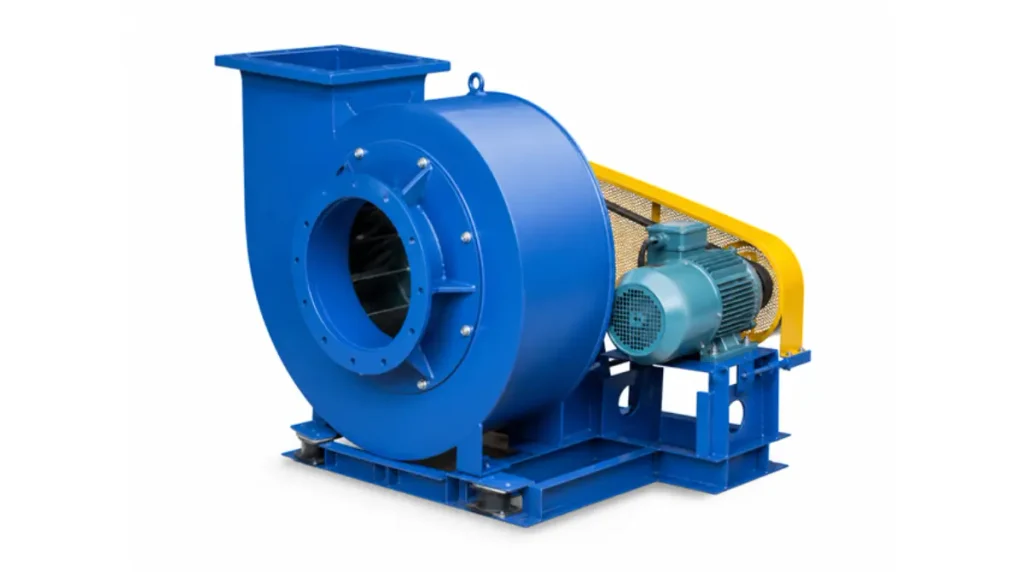
A industrial centrifugal air blower is a machine that draws air through the center of a rotating impeller and discharges it at a higher pressure through a side outlet.
Centrifugal blowers are commonly called:
The terms fan and blower are sometimes used interchangeably, although blowers generally operate at higher pressure levels than conventional fans.
The working principle of a centrifugal blower is based on centrifugal force and energy conversion.
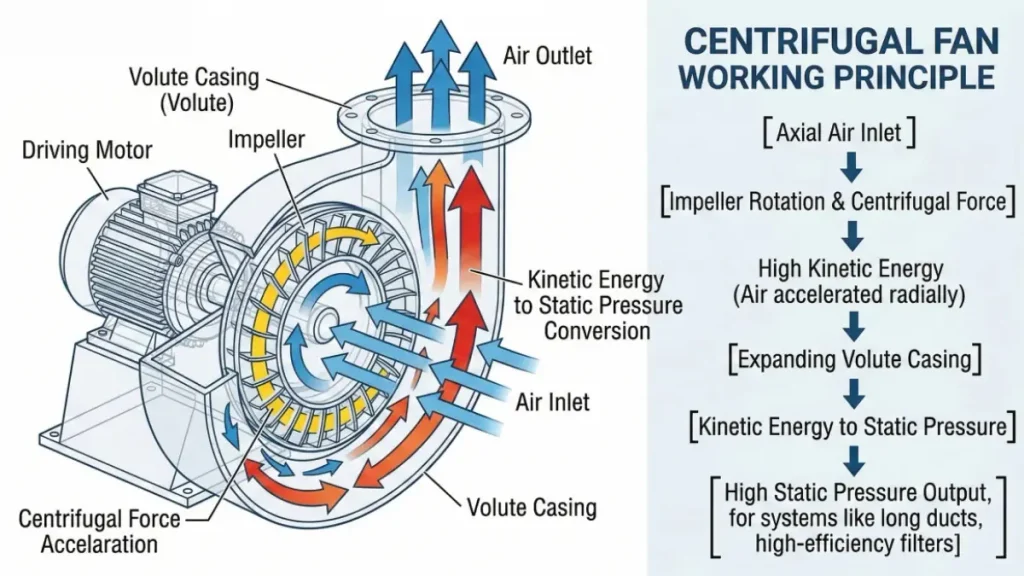
1. Air enters the inlet: Atmospheric air or process air enters through the central inlet of the blower.
2. Impeller rotates: An electric motor rotates the impeller at high speed. Depending on the design, the impeller may contain forward-curved, backward-curved, or radial blades.
3. Air gains velocity: As the impeller rotates, air is accelerated outward from the center toward the outer diameter.
4. Pressure increases: The rotating blades transfer kinetic energy to the air, increasing its velocity and pressure.
5. Volute converts velocity into pressure: The air enters the scroll-shaped casing. The gradually increasing cross-sectional area reduces air velocity and converts velocity pressure into static pressure.
6. Air exits through the discharge outlet: The pressurized air leaves through the blower outlet and enters ducts, machinery, filters, or industrial processes.
The basic relationship between airflow and velocity is:
Where:
For industrial systems, blower performance depends on the interaction between airflow, static pressure, system resistance, and motor power. AMCA technical publications define airflow, static pressure, and velocity pressure as important parameters for evaluating fan and blower performance.
Air enters axially through the center and exits radially through the side outlet.
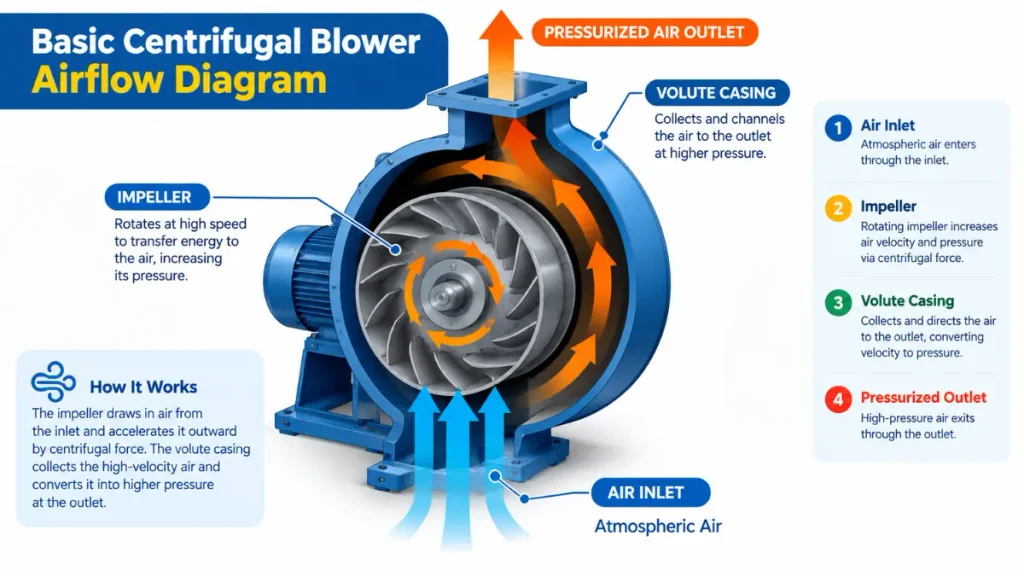
A centrifugal blower contains several important mechanical and electrical components.
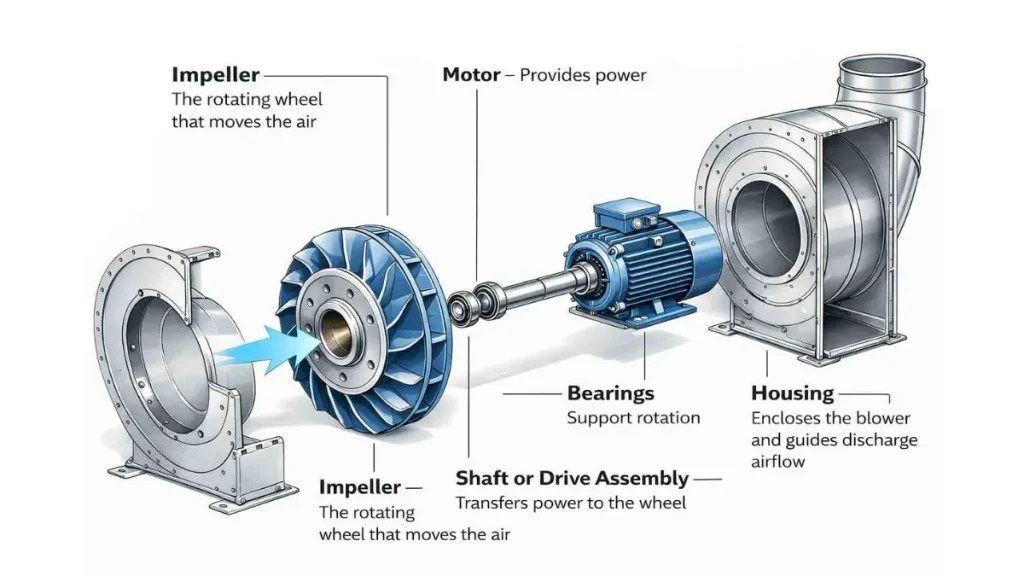
| Component | Function |
|---|---|
| Impeller | Rotates and transfers energy to air |
| Motor | Provides mechanical power |
| Housing / Volute | Converts velocity into pressure |
| Shaft | Connects motor to impeller |
| Bearings | Support rotating shaft |
| Inlet | Allows air entry |
| Outlet | Discharges pressurized air |
| Belt Drive | Transfers power in belt-driven models |
| Coupling | Connects motor and blower shaft |
| Base Frame | Supports blower assembly |
| VFD | Controls motor speed in variable-speed systems |
The impeller is the heart of the centrifugal air blower. Its diameter, blade shape, number of blades, and rotational speed determine airflow and pressure performance. Common impeller blade designs include:
Most industrial centrifugal blowers use electric motors. Common motor types:
The volute casing surrounds the impeller and collects discharged air. Its increasing cross-sectional area helps convert kinetic energy into static pressure.
Bearings support the shaft and reduce friction during rotation. Poor bearing lubrication can cause overheating, vibration, and premature failure.
Centrifugal blowers can be classified according to blade design, pressure capacity, drive arrangement, and application.
Forward-curved blowers use blades curved in the direction of rotation.
Forward-curved fans are generally suitable for applications requiring high airflow at moderate pressure.
Backward-curved centrifugal blowers have blades angled opposite to the direction of rotation.
Backward-curved blowers are widely preferred in commercial and industrial ventilation because they can achieve high efficiency over a broad operating range.
Radial blowers use straight blades extending outward from the impeller.
High-pressure blowers are designed to deliver significant static pressure.
Typical applications include:
These blowers are selected based on pressure requirements rather than airflow alone.
A double-inlet blower draws air from both sides of the impeller.
Double-width double-inlet centrifugal fans are common in large industrial air-handling systems.
Understanding the difference between centrifugal and axial airflow equipment is important when selecting an industrial blower.
| Feature | Centrifugal Air Blower | Axial Fan |
|---|---|---|
| Air Direction | Changes direction by approximately 90° | Moves parallel to shaft |
| Pressure | High to medium | Low to medium |
| Airflow | Medium to high | Very high airflow possible |
| Duct Resistance | Handles resistance well | Less suitable for high resistance |
| Applications | HVAC, dust collection, industrial systems | Cooling, ventilation, exhaust |
| Design | Impeller + volute casing | Propeller blades |
| Energy Efficiency | High in suitable operating range | High in low-pressure applications |
Choose a centrifugal blower when the system has:
Choose an axial fan when the requirement is mainly high-volume air movement with relatively low pressure resistance.
Before purchasing a centrifugal blower, understanding technical specifications is essential.
CFM means Cubic Feet per Minute. It indicates the volume of air the blower can move.
Example:
Higher CFM does not always mean better performance. The blower must deliver the required airflow at the required static pressure.
Static pressure is the resistance the High pressure centrifugal blower must overcome. It is commonly measured in:
Typical applications:
| Application | Approximate Pressure Range |
|---|---|
| General ventilation | 0.2–1 in. WG |
| HVAC duct systems | 1–3 in. WG |
| Dust collection | 3–10 in. WG |
| Pneumatic conveying | 5–20+ in. WG |
| High-pressure industrial process | Above 20 in. WG |
Actual requirements depend on system design.
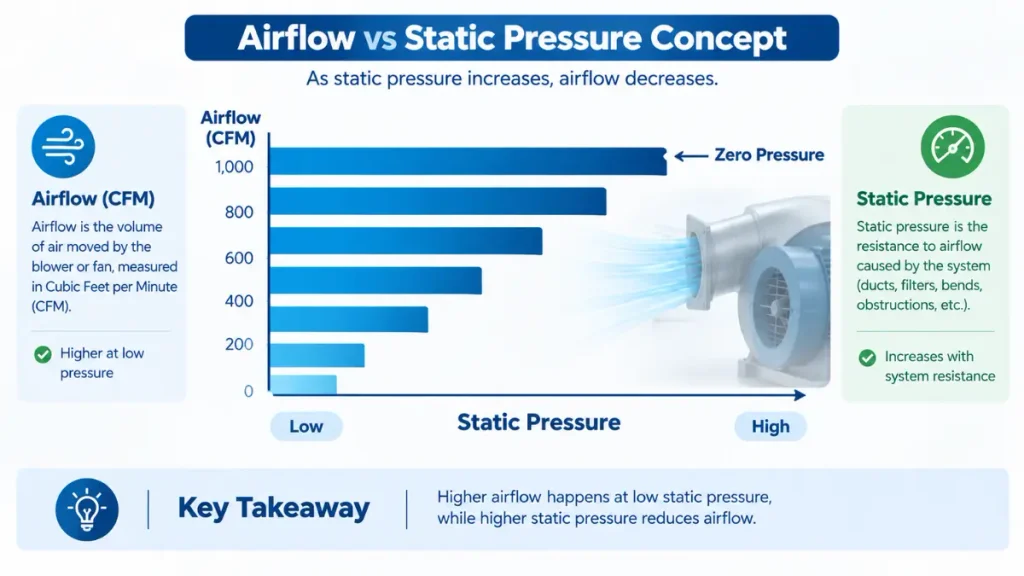
Motor power determines how much mechanical energy is available to move air. Common industrial blower motor sizes:
Motor selection should never be based on horsepower alone. The required power depends on airflow, pressure, efficiency, and air density.
Where:
For practical engineering calculations, units must be converted correctly.
RPM indicates how fast the impeller rotates. Common centrifugal Air blower speeds:
Higher RPM generally increases airflow and pressure but may also increase noise, vibration, and power consumption.
Efficiency indicates how effectively the Centrifugal Air Blower converts electrical energy into useful airflow and pressure. A high-efficiency blower can significantly reduce long-term operating costs. Important efficiency parameters include:
The following examples represent common centrifugal blower performance categories available in industrial markets. Actual manufacturer performance varies by impeller size, motor, speed, and operating conditions. Always verify final selection using the manufacturer’s certified performance curve.
| Specification | Typical Value |
|---|---|
| Model Category | Small Inline Centrifugal Air Blower |
| Airflow | 150–600 CFM |
| Static Pressure | 0.2–1.5 in. WG |
| Motor Power | 0.1–0.5 HP |
| RPM | 2,000–3,000 RPM |
| Voltage | 120V / 240V |
| Application | HVAC and ventilation |
| Specification | Typical Value |
|---|---|
| Model Category | Medium Industrial Centrifugal Blower |
| Airflow | 1,000–5,000 CFM |
| Static Pressure | 2–8 in. WG |
| Motor Power | 1–5 HP |
| RPM | 1,450–2,900 RPM |
| Voltage | 230V / 460V Three Phase |
| Application | Industrial ventilation |
| Specification | Typical Value |
|---|---|
| Model Category | Heavy Industrial Blower |
| Airflow | 5,000–20,000 CFM |
| Static Pressure | 5–15 in. WG |
| Motor Power | 5–20 HP |
| RPM | 900–1,750 RPM |
| Voltage | 460V Three Phase |
| Application | Factories and process industries |
| Specification | Typical Value |
|---|---|
| Model Category | High Pressure Centrifugal Blower |
| Airflow | 500–10,000 CFM |
| Static Pressure | 10–30+ in. WG |
| Motor Power | 3–50 HP |
| RPM | 1,750–3,500 RPM |
| Application | Pneumatic conveying and combustion |
Commercial centrifugal fan catalogs demonstrate that performance varies significantly with static pressure.
For example, an AMCA-certified inline centrifugal fan catalog shows airflow values changing from approximately 161 CFM at zero static pressure to approximately 66 CFM at 1.005 inches of water gauge for one small model. A larger model in the same catalog delivers approximately 555 CFM at zero pressure and approximately 352 CFM at 1.005 inches WG.
This demonstrates an important engineering principle:
As system resistance increases, actual airflow generally decreases.
Therefore, never select a blower only by its maximum CFM rating.
Suppose a manufacturing workshop in the USA requires an industrial exhaust system.
The system requires:
A suitable blower should provide:
A blower rated at 10,000 CFM at zero pressure may deliver significantly less airflow when connected to ductwork and filters.
The correct selection must be based on the blower performance curve.
Let’s assume:
Using approximate air power calculations, the required motor power may fall in the range of several horsepower depending on actual operating conditions.
If two blowers deliver the same airflow and pressure:
| Blower | Efficiency | Energy Consumption |
|---|---|---|
| Blower A | 55% | Higher |
| Blower B | 75% | Lower |
Over thousands of operating hours annually, a more efficient blower can provide significant electricity savings.
This is especially important for US manufacturing facilities where industrial electricity costs contribute substantially to operating expenses.
Fan laws are useful for understanding how changes in speed affect blower performance.
Airflow is proportional to rotational speed.
If speed increases by 10%, airflow approximately increases by 10%.
Pressure increases approximately with the square of speed.
A 10% speed increase can produce approximately 21% more pressure.
Power consumption increases approximately with the cube of speed. This is why uncontrolled speed increases can dramatically raise electricity consumption.
If a blower operates at 1,000 RPM and consumes 5 HP:
Increasing speed to 1,100 RPM may result in approximately:
These are theoretical relationships and actual results depend on system conditions.
High pressure centrifugal blower are widely used across American industries.
Commercial buildings, warehouses, hospitals, schools, and office complexes use centrifugal blowers for air circulation and ventilation.
Manufacturing plants use centrifugal blowers to remove hot air, fumes, smoke, and contaminated air.
Factories use industrial blowers to transport dust particles into filtration equipment. Common industries:
High-pressure centrifugal exhaust blowers remove welding fumes from work areas.
Centrifugal exhaust blowers transport lightweight materials through pipelines. Applications include:
Industrial furnaces require controlled air supply for combustion efficiency.
Blowers are used in:
Choosing the correct centrifugal blower requires more than comparing horsepower.
Calculate the airflow needed for your application. For ventilation, consider:
Include all system resistance:
Incorrect static pressure calculations can result in poor blower performance.
Avoid oversizing the motor unnecessarily. An oversized motor may increase:
| Blade Type | Best Application |
|---|---|
| Forward Curved | HVAC and moderate pressure |
| Backward Curved | High efficiency and industrial ventilation |
| Radial | Dust and particulate handling |
| Airfoil | Energy-efficient high-performance systems |
Noise can be an important issue in commercial and residential environments. Look for:
For USA industrial installations, common voltage options include:
Always verify motor nameplate requirements.
Regular maintenance increases blower reliability and service life.
| Maintenance | Check |
| Daily Maintenance | Unusual noise Excessive vibration Airflow reduction Motor temperature Visible damage |
| Weekly Maintenance | Belt tension Shaft alignment Air inlet obstruction Dust accumulation |
| Monthly Maintenance | Bearing inspection Electrical connection tightening Impeller cleaning Filter inspection Motor ventilation cleaning |
| Annual Maintenance | Complete mechanical inspection Bearing replacement if required Impeller balancing Motor insulation testing Duct system inspection Performance testing |
| Problem | Possible Causes | Solution |
| 1: Low Airflow | Dirty filter Blocked duct Incorrect rotation direction Damaged impeller Insufficient motor speed | Inspect the complete air path and verify operating RPM |
| 2: Excessive Vibration | Unbalanced impeller Worn bearings Loose foundation bolts Shaft misalignment | Stop the High pressure centrifugal blower and inspect rotating components. |
| 3: Motor Overheating | Overloading Incorrect voltage Blocked cooling vents Excessive static pressure | Check motor current, airflow, and system resistance. |
| 4: Excessive Noise | Damaged bearings Loose components Incorrect installation Turbulent airflow Impeller imbalance | Inspect mechanical components and duct transitions. |
Proper installation is essential for achieving rated performance.
Poor installation can reduce airflow and increase energy consumption.
These machines are often confused.
| Feature | Centrifugal Air Blower | Air Compressor |
|---|---|---|
| Main Function | Moves air | Compresses air |
| Pressure | Low to high depending on design | Very high |
| Airflow | Continuous | Often compressed and stored |
| Energy Use | Lower for ventilation | Higher for compression |
| Applications | Ventilation, exhaust, cooling | Pneumatic tools, air storage |
A blower is generally used for moving large volumes of air at moderate pressure, while a compressor produces compressed air at significantly higher pressure.
Energy efficiency is becoming increasingly important for US industries. The largest operating cost of an industrial Centrifugal exhaust blower is often electricity consumption.
A variable frequency drive controls motor speed according to demand. For systems with changing airflow requirements, VFD operation can significantly reduce energy consumption.
Because power approximately follows the cube of speed, even moderate speed reductions can create substantial savings.
When purchasing industrial equipment in the United States, buyers commonly evaluate established manufacturers based on performance data, certifications, warranty, and service availability. Important brands and manufacturers in the industrial fan and blower industry include:
AMCA certification and published performance curves provide useful confidence when comparing industrial fans and blowers.
Before finalizing a purchase, compare the following specifications.
| Specification | Why It Matters |
|---|---|
| CFM | Determines airflow capacity |
| Static Pressure | Determines resistance capability |
| Motor HP/kW | Determines power requirement |
| RPM | Determines performance and energy |
| Voltage | Electrical compatibility |
| Frequency | 50 Hz or 60 Hz compatibility |
| Efficiency | Operating cost |
| Noise Level | Workplace comfort |
| Impeller Type | Application suitability |
| Material | Durability and corrosion resistance |
| Mounting | Installation requirements |
| Warranty | Long-term reliability |
To purchase the correct centrifugal blower, do not select it only by HP. First calculate the required Airflow (CFM) and Static Pressure (inWG or mmWG).
For factory ventilation:
Formula:
CFM = Room Volume × Air Changes per Hour ÷ 60
Room Size:
Volume = 20 × 15 × 12 = 3,600 cubic feet
For 10 air changes per hour:
CFM = 3,600 × 10 ÷ 60 = 600 CFM
Required airflow: 600 CFM
Add the pressure losses from ducts, elbows, filters, and equipment.
| Component | Pressure Loss |
|---|---|
| Ductwork | 1.5 inWG |
| Elbows | 1.0 inWG |
| Filter | 1.0 inWG |
| Dust Collector | 3.0 inWG |
| Safety Margin | 1.0 inWG |
| Total Required Pressure | 7.5 inWG |
Therefore, the blower requirement is: 600 CFM @ 7.5 inWG Static Pressure
Formula:
HP = (CFM × Static Pressure) ÷ (6356 × Efficiency)
Example:
Required motor power ≈ 1.1 HP.
For continuous factory operation, a 1.5 HP motor would be a practical choice, subject to the manufacturer’s performance curve.
Ask the supplier for:
Centrifugal Blower:
Important Rule
- Always buy a blower based on “CFM at Required Static Pressure,” not just motor HP. This ensures the blower will deliver the required airflow under actual factory operating conditions.
A centrifugal air blower is one of the most important air movement machines used in industrial, commercial, and HVAC applications. Its ability to deliver controlled airflow at higher static pressure makes it suitable for demanding systems such as dust collection, industrial ventilation, combustion air supply, cooling, and pneumatic conveying.
When selecting a centrifugal blower, always consider airflow (CFM), static pressure, motor power, RPM, efficiency, blade design, and installation requirements. A Centrifugal exhaust blower that provides excellent performance at zero pressure may not deliver the same airflow when connected to a real industrial duct system.
For USA buyers, selecting a reliable manufacturer with certified performance data, proper warranty support, and replacement parts availability is equally important.
The best centrifugal air blower is not necessarily the largest or most powerful model. It is the blower that delivers the required airflow and pressure efficiently, reliably, and economically for your specific application.
A centrifugal air blower is used for industrial ventilation, HVAC systems, dust collection, exhaust, cooling, drying, combustion air supply, and pneumatic conveying.
A centrifugal blower generally operates at higher pressure and is designed to overcome greater system resistance than a conventional ventilation fan.
Required CFM depends on room volume, ventilation rate, equipment requirements, and process conditions. For industrial applications, airflow calculations should consider system design and pressure losses.
Static pressure is the resistance the blower must overcome to move air through ducts, filters, equipment, and other components.
Backward-curved and airfoil centrifugal impellers are generally recognized for high efficiency in suitable operating conditions.
Yes. Radial-blade centrifugal blowers are commonly used for dusty and particulate-laden air applications. However, proper material selection and maintenance are essential.
A centrifugal blower is generally better for high-pressure applications and duct systems with resistance. An axial fan is better for high-volume, low-pressure air movement.
Common US industrial voltages include 230V and 460V three-phase systems, although 120V and 208V configurations are also available.
Higher RPM can increase airflow and pressure, but it also increases power consumption, noise, and mechanical stress. Performance must be evaluated based on the complete system.
Basic inspections should be performed regularly, while detailed mechanical and electrical maintenance is typically scheduled monthly, quarterly, or annually depending on operating conditions.
The most important specifications are required CFM and static pressure. Motor horsepower should be selected after these two requirements are established.
The ECHO PB-9010H is the strongest commercial gas backpack blower, delivering an industry-leading 48 Newtons of blowing force and 1,110 CFM
The cost of a centrifugal blower machine ranges from $15 to over $10,000, depending entirely on its size, power (horsepower/CFM), and intended application.
The best air blower brand depends on your specific tasks, with EGO Power+ leading for high-power cordless performance, Milwaukee for professional build quality, and Ryobi for everyday homeowner value.
Centrifugal fans are better when you need to push air through high resistance, tight spaces, or long ducts.

Welcome! I am a dedicated entrepreneur running an industrial affiliate product website, helping businesses and professionals find the best tools, equipment, and resources for their needs. With a passion for industrial products and a keen eye for quality, I curate and recommend top-performing items that enhance efficiency and reliability.
Through my platform, I aim to simplify the buying process by providing valuable insights, expert reviews, and trusted affiliate links to high-quality industrial products. Whether you’re looking for the latest machinery, tools, or safety gear, I strive to connect you with the best solutions available.
Thank you for visiting, and I look forward to helping you make informed purchasing decisions!
